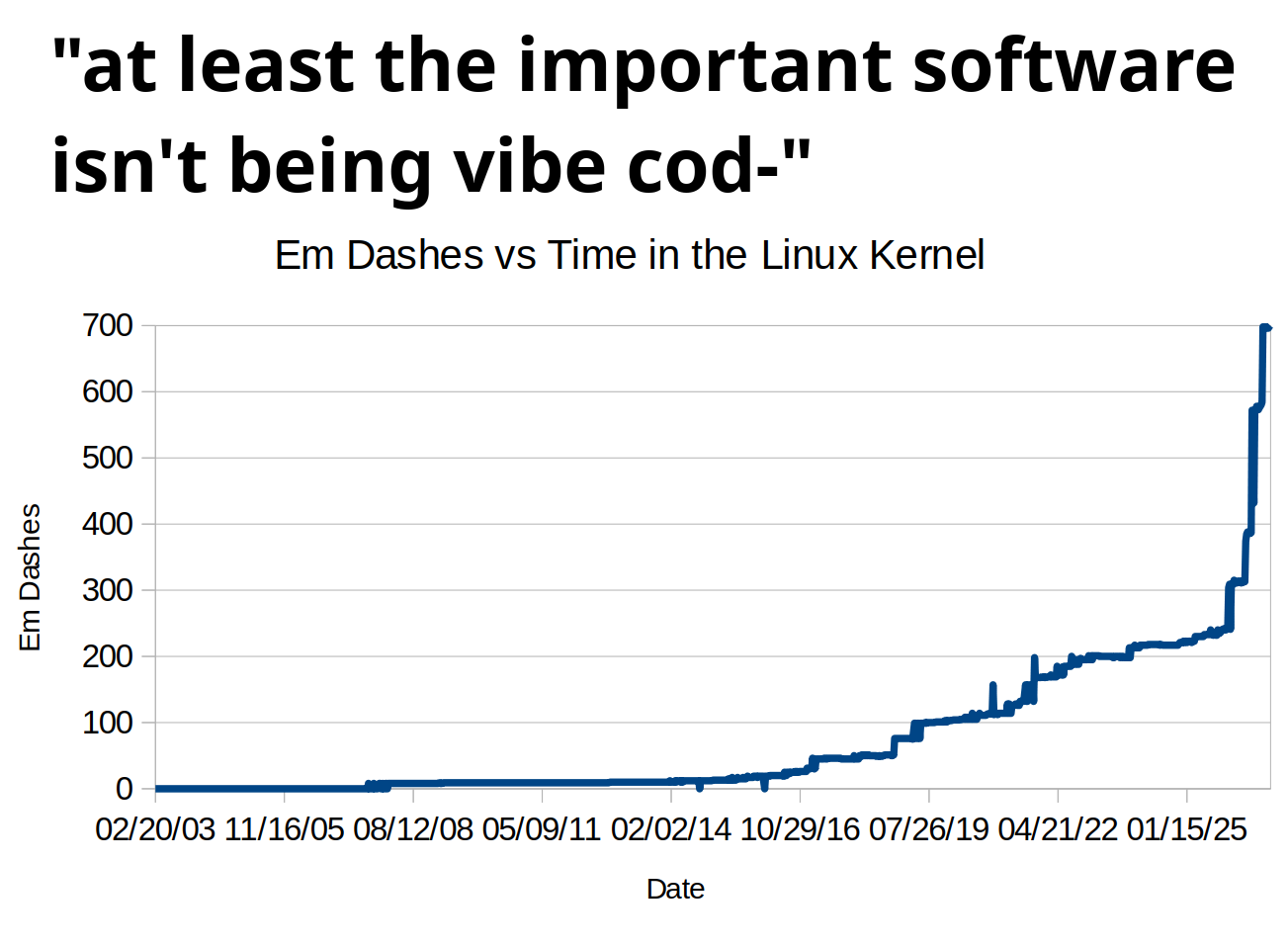
I’ve been using linux for 18 years, but since reviewing the Open Slopware list I’ve been making a lot of changes.
FreeBSD ticks almost every box I need it to. It runs Plasma, it runs Steam/Proton (through a thin compatibility layer that enables a lot of other linux software), it can be set up immutably and has superior containerization natively via jails. It even supports XDG compliance.
But there is no support for changing voltage or clock rate on any amd gpu (maybe any gpu at all) and no driver support for my newer amd gpu at all.
It honestly feels like how linux used to feel back in the day 😅
I don’t think I’m gonna jump ship just yet. The recent ai code fiasco that happened in the linux kernel (race condition, regression, vacation) was averted by the team of talented human developers who reviewed Linus’ code. I am choosing to have faith that it will be ok for a while… given there are few alternatives.
That being said, I think I might finally be ready to hop on the fuck-sysyemd train. I was able to look past the megalomaniacal tendencies of the dev because the tools were so convenient, but the AI PRs and code review pushes me over the edge. I am gonna configure a daily driver in Artix soon.
Edit: I should note, FreeBSD also has some AI code issues. But the linux-libre kernel might not. Something like Hyperbola (GNU/Linux-libre) might be more appropriate for someone who is trying to avoid ai code strictly.
I use Gentoo with OpenRC btw.
can you elaborate on the recent fiasco you mentioned? I totally missed the news on that
Linus introduced a race condition and a regression with a AI generated code, then handed off fixing the problem to someone else because he was going on vacation.
Fiasco might have been an exaggeration, but it’s still pretty lame.
This was caught during review, so nothing was “introduced” quite yet. And there’s no indication that Linus wouldn’t have produced a race condition (a notoriously more easy to miss kind of bug) without the use of AI tools.
It’s only being exaggerated so much because he used AI.
I could attribute the race condition just as much to their use of the C language as to AI.
Race conditions I’m pretty sure aren’t language specific. Rust can have them too.
Yes, but the tools provided by Rust:
- Prevent most common ones via aliasing^mutability, Send and Sync marker traits, etc.
- Require explicitly marking the cases not handled by this, e.g. unsafe features require an
unsafe {}block to be used.
Yea he basically said “This seems to work but is slop, lead Dev, make it real.”
That is something I am surprisingly okay with. Quickly figuring out if something is feasible is good, and doing it in a back of the napkin style is the norm, even without LLMs. Of course then you need to do it properly, without falling into the trap of reimplementing the slop.
Not what happened. I’m not digging it up but this story has been debunked repeatedly
(you’re welcome to just point folks to a debunking)
People are welcome to stop spreading the falsehoods. In every thread where this is said (including this one), the truth is pointed out but those spreading it couldn’t care less. Just scroll. Others are pointing out the details here just like every other place.
Great
This doesn’t make me nervous at all…
nothing to be nervous about, its literally software engineering and project management 101, programmer writes code reviewer catches bugs, nothing goes to production. this happens all the time, has happened in the linux kernel way before LLMs were a thing
pretty lame
lame /lām/
adjective
Disabled so that movement, especially walking, is difficult or impossible.
:/
This is why dictionaries list more than 1 definition and you shouldn’t stop at the first one:
- weak; inadequate; unsatisfactory; clumsy.
a lame excuse.
- Slang: Sometimes Disparaging and Offensive. awkward, dull, stupid, or uninteresting.
- Slang: Sometimes Disparaging and Offensive. out of touch with modern fads or trends; unsophisticated.
Linus admitted he uses LLMs sometimes, so now the most trustworthy developer in the history of computers is now being shat on and raged about by people who probably couldn’t write a hello world app in any programming language. They’re just parroting the idea that Linux is vibecoded now, but it isn’t, and if anything they should be heartened by the recent decision to raise the bar for kernel contributors. Instead, they’re pretending Linus and other contributors aren’t trustworthy at all, based solely on a desire to feel outrage. When people correct them on these lies they’re spreading, no one ever admits they are wrong and stops spreading it, they just don’t respond to comments like that and continue writing them elsewhere.
Tldr; people are stupid.
You didn’t answer the question at all.
I take it you’re another outrage junkie who cannot help but tell everyone the kernel is vibecoded. Your feedback is only valuable in that it communicated that
Completely incorrect.
What is the accelerating rise of m-dashes from approximately 2014-2019 about? That trend apparently continued until very recently, even slowed down a bit, before exploding at some point in 2025 or 2026 for obvious reasons.
Does anyone have a theory?
People slowly learned to use their keyboards for proper typography?
That was a good one.
I wonder how many em dashes are real vs interpreted.
I love an em-dash, but I have never typed one on purpose; they are all just two minus in a row and I use them wrong – with a space around (*inspect source to see that lemmy translates for me). I abuse them like I abuse semicolons. They are a typographical tick that indicates a pause or pivot when I translate my thoughts to text.
I can imagine a human manuscript editor turning punctuation like a comma into an em-dash when it makes sense, but I can’t imagine a developer ever specifically typing out one – with the need to either know or look up the unicode for it. The only relevant place would be a comment, but even then IDE’s are not generally known for their tendency to replace typed characters with something else.
Maybe some tool in the pretty-print/code-formatter ecosystem added that as a feature? But
var--is so common that I can’t imagine that’d be a good idea, even in a comment.They probably write code in Microsoft Word
Absolutely insane ide choice. Wonder if visual studio tries to add those too.
I used to write websites in Notepad. It was kind of like digital Amishness.
For pedantry’s sake:
Two dashes –
--– in Markdown is usually rendered as an en-dash – more common in British-adjacent styles and usually surrounded by spaces.Three dashes—
—in Markdown is rendered as an em-dash—more commonly associated with American styles and usually (though not always) without spaces.Hah. Neat!
For pedantry…
My understanding was that en-dash was a range, and em-dash was a change in topic or a parenthetical, so I’ve been using the wrong one but for the right reason. This may be an American style distinction, though. Time to jump into a new rabbit hole.
I’ve always just used a hyphen for ranges, without having any idea whether that makes me a philistine. A quick search says that, like most of this, it varies depending on who you ask.
Good luck in your rabbit hole!
The OP graph is just absolute count on the y axis, so I also assumed it was basically measuring LoC, but looking at this chart, the em-dashes do appear to be definitely more of a modern phenomenon compared to raw LoC:

Maybe some policy/tooling change around 2014? A guess is perhaps something to do with allowing UTF-8 in source files, but that’s a pretty long shot.
Foooork
Can we have this divided by the total number of commits?
Total number of commits has climbed too though
I really love the emdash. I’m very—very—upset ai ruined it for me—cunts.
Turns out AI learned from humans, who learn from the writings they’re exposed to
It’s an endless cycle, and we’re only in the first revolution
Rebel. Start using triple em dashes⸻see?
Fu———ck yeah.
(╯°□°)╯︵┻⸻━⸻┻
You can get a lot done when you’ve got 29 months in a year
?
The weird US American Date scheme is not used in most of the world.
I wish. Am European. I know one person that voluntarily uses their date and time formats. For reasons I will never comprehend.
He or she must enjoy the endless confusion and friction in the interaction with others. That said, some idiotic IT systems use the US format to. Causes a lot of problems.
I’m in the US and have had problems with C-level douches misreading dd-mm-yyyy dates in some system we had that logged in that format and freaking out (and also missing that the log time stamps were in UTC-0, causing further confusion/freakout)
Anyway, this is part of why I always use yyyy-mm-dd, because nobody will confuse that date string for any other date, and everyone who can understand dates at all will be able to read it.
D/M/Y > M/D/Y
There is only YYYYMMDD
sadly for everyone that’s factually incorrect, but the phrase DD/MM/YYYY > MM/DD/YYYY does not preclude YYYYMMDD > DD/MM/YYYY > MM/DD/YYYY
your pedantery is apreciated.
Because one lives the other should not long live Y-M-D
ISO 8601 is the only correct way.
It’s close, sure, but actually no. That standard currently requires the letter T (and no white-space) between date and time when both are present, and, frankly, that’s ugly and a space should be allowed.
An old version of the standard allowed the space, and GNU’s coreutils seem to have carried on the tradition, so I’m not alone in thinking this.
NO. You need a character per digit and you always want the leading 0 shown.
YYYY-MM-DD
At least it makes my folders really easy to sort through…
Only if you leave the leading zeros!
…or your file manager is smart enough to do numeric sorting
OP’s graph uses slashes.
Dashes would remove all the confusion.
No because it’s the global format that typically uses periods.
D.M.Y (normal)
Y-M-D (superior)
M/D/Y (mental illness)Mixing up the formats and denominators makes this mess even worse.
you should also always specify YYYY-MM-DD because often M and D ignores leading zeros, YY means the 2 digit suffix, and Y… well, i don’t even know what that is but i’m sure it’s something less specific than YYYY
if we’re going to be picky about being clear about things, let’s be truly clear about things
YYYYY would be something like “The Year of Our Lord, Two-Thousand and Twenty-Six” (or probably just “Twenty Twenty-Six”, but the other is more ridiculous so I’ll go with that)
Y would just be “6” but I can’t think of any context where that would ever be used
Is that graph actually real/based on data?
Yep, I cloned the git repo and wrote a script to step through commits a week at a time and count the total em dashes in the repo at each point in time
Could you divide this by the total number of lines. That would help tell the rate of change better.
git grep -I '—' master | wc -ljust did a quick check, my graph looks similar.
How does it look for double hyphens? I would expect those to be more common in code comments (before the LLMageddon at least) as an em dash just looks like a hyphen in the typically displayed monospace type.
As an actual human who uses em dashes — or usually, two or three hyphens that turn into an em dash in Markdown — I feel personally attacked.
aren’t those regular dashes? em dashes seem just a bit longer
N dashes. They are as wide as an n. M dashes are as wide as an m.
But what is em?
I will usually just use one (1) hyphen for that purpose - in the much same way that I will use "…" instead of “…” - because I like to upset typography nerds.
Have you tried using the dedicated triple dot character (…) instead of three separate dots (…)? It’s a life changer
They said they do it to ‘upset typography nerds’ — likely they tried…
I’m upset now
Personally the only part I have seen is documentation is now vibe coded, where in the past, it was autism coded.
As long as it’s short, sweet and to the point and not prose.
“This function doesn’t return an
int*, it returns achar *.”
Man, I miss when Linux felt like a refuge. It’s always been flawed of course but now it feels like everyone in positions of influence are embracing the awful
It’s getting harder to justify the inconvenience of going off the beaten path if that path is turning into the same slop as the commercial ones.
I imagine there’s been quite an effort by commercial interests to influence the direction of this path
The Linux Foundation has unfortunately become a commercial shithole, run by a clusterfuck of Silicon Valley VCs. When I see the kinds of garbage AI projects that are being shoveled into it every day, I lose more and more respect for it.
Look for yourselves: https://www.linuxfoundation.org/projects
And it’s sad to see Linus falling into their lock and step. I respect him for a lot of things, but when it comes to AI, he’s sadly just wrong.
Holy fuck, that is a lot of AI hype projects.
It’s probably about to drop off. Opus 5.5 isn’t outputting em dashes in work produced anymore
It’s been replaced by the overuse of confusing
foo's own [implied noun]phrases.
em dashes are not ai exclusive! humans have used them for ages before ai! stop calling all em dashes ai!!
maybe people have now see the em dash in use enough that they’re observing it’s greatness in real usage!!!
/s
-f pour one out for the em-dash, it’s reputation has been tarnished
I wondered the same, really.
I used to underuse it, but now, using it anywhere is enough to draw ire, so I’ve essentially gone to zero. :)
As someone that uses AI at work because 1. this is a run-out-the-clock situation, and 2. I don’t give a fuck and would like to be at my desk as little as possible, it feels weird and hypocritical to expect no AI in all of the software around me as well.
With that said, if I still had any semblance of passion for writing code, which I do not, anything I worked on for the OSS community would be fully devoid of AI usage. But I’m mentally at a point where I’d rather move to a cabin and use computers less and less with each passing day.
There’s also a huge difference between someone like Linus Torvalds, who understands code better than most people on earth, using AI supervised to increase productivity, and Timmy off the street having chatGPT build something he has no clue how it works or what code even does.
Vibe coding isn’t just using AI. It’s using AI to do things you don’t understand in the first place.
There’s also a huge difference between someone like Linus Torvalds, who understands code better than most people on earth, using AI supervised to increase productivity, and Timmy off the street having chatGPT build something he has no clue how it works or what code even does.
disagree. there’s no difference between the car mechanic or the politician pouring oil into the river. They’re both horrendous. sure, one of them might have a reason for doing so, but that reason isn’t a good reason.
Both things are going on at the same time, as Torvalds and Timmy are both paying Sam Altman to pour oil into the river as a byproduct of the service he’s providing. For something as important as the Linux kernel, it wasting fewer CPU cycles as a result of LLM-aided optimisation work might even be net beneficial for the environment once you take into account that it’ll affect billions of computers for years to come. If the end product is shitty, though, there’s no question that it wasn’t worth the environmental damage.
It would have to use trillions of fewer cpu cycles to do that. Currently scientists estimate it at 8 cups of water consumed for every 100 word prompt. What developer do you know that consumes 8 cups of water a day much less every thirty seconds. A developer can sit there and think with their own mind, computer doing nothing, while an LLM consumes thousands of gallons of water and kilowatts of electricity to do the same thing.
It only needs to save a few hundreds of seconds on one computer, or one second on a few hundreds of computers, or a tiny fraction of a second on the number of computers that actually run Linux to save trillions of cycles. A trillion cycles isn’t very many at all. A hundred-word prompt on a frontier model running on GPUs in a datacentre burns much more power than a trillion cycles on a CPU, so for a large Linux kernel patch, trillions is the wrong number by many orders of magnitude. There are also a lot of computers spending a lot of time running Linux, so it kind of balances out. There’s only one Linus Torvalds, and he’s very busy, so it’s likely that if he’d not used an LLM to get this work done, it simply wouldn’t have happened, even if someone had been willing to fund a different human to do it.
Either way, the original point of the post was that LLM-generated code is always shitty (even when it’s not immediately obvious to whoever’s responsible for it that it’s shitty) and so having any amount of it already makes things worse, even ignoring the huge environmental cost. With that context, it is the case that there’s a huge difference between Timmy and Torvalds as Torvalds is famous for having very high standards, so if he’s using it, he might be able to make something that isn’t shitty.
I didn’t realize you were talking about performance in the kernel, which I think will be incredibly hard to measure. That that’s usually the main focus of enterprise investment into Linux, so I very much doubt that an LLM is coming in and making improvements there, but maybe it’s happening. As far as I can tell all the latest things are security scans, which usually will result in worse performance since the goal isn’t speed but safety.
This comment chain is specifically referencing a single LLM-assisted patch that Linus Torvalds posted to the mailing list for review a few days ago that solves a longstanding performance problem that interacts with enough things parts of the kernel that there are only a handful of people in the world qualified to deal with it, and that none of them have had the time to investigate and fix properly until just now. https://www.tomshardware.com/software/linux/linus-torvalds-posts-his-first-llm-assisted-patch-to-the-linux-kernel-after-issuing-clear-pro-ai-directives-the-bossman-makes-use-of-ai-tooling-himself
there’s a lot of wilful ignorance around that last point
It’s valid to feel that way working in software, but try to hold space also for the fact that computing is ‘the means of production’ in the information age, and how it is made and who controls it is inherently political.
I felt a lot like that too. I still do, but this helped me a lot:
Thank you for linking that talk. I wasn’t expecting something that deep and also funny. I concur with your recommendation wholeheartedly.
No, coding should be done to garner clout, so eventually when I start my shitcoin, I can rugpull more people! /j
I don’t give a fuck and would like to be at my desk as little as possible
I always had this stance and found it weird when people resisted. Your boss’s boss’s boss’s boss is telling you to work half as much? Whether you think that the output is half as good quality or not why the fuck aren’t you JUMPING at the chance to do that.
Whether you think that the output is half as good quality or not why the fuck aren’t you JUMPING at the chance to do that.
Two reasons actually.
-
Most people want to be productive in some way. Even if you don’t like your job very much, its a much bigger mental burden to sit around and do nothing than it is to actually work.
-
You employer isn’t going to pay you the same rate for half as much work done. It is that way now cause they have no idea what the actual productivity will end up being, but once the numbers are stable they will save as much money as possible. You will either be lucky and will work just as much as before with more but worse output, or you will be fired.
-
It’s coming after your job. Why would I want to feed my output into the machine breathing down the back of all our necks? I like what I do. A carpenter isn’t going to be happy working in a factory where chairs are made by robot arms. I’m not gonna be happy working in a slop factory
Standing in the Mississippi won’t dam it
Your comment was that people should be jumping at the opportunity to use it. I’m telling you why people aren’t. Efficicecy is a different thing. Maybe it might be ore apparent to you if you were to say the same thing about outsourcing to oversees rather than outsourcing to AI.
If enough people do it will.
Every person on earth could jump in the mississippi and it would flow anyways.
it most definitely would not. you ever switched the direction of a lazy river? doesn’t take that many people. Your ignorance is showing.
You comparing the mississippi to a lazy river is showing your ignorance lmao
I can’t use AI in my job, because I manufacture.
But the HR lady can use it to make policies that are fucking stupid and my direct boss can use it to create an app to more effectively micromanage us without having to actually do the micromanaging himself so he has free time to blow his boss and cook breakfast for 30min on the clock every day.
So yeah I’m not a fan.
when using a monotype font, shouldnt n and m dashes look the same even?
grep doesn’t care about font.s
They do, but I still use the correct dash in code comments. It’s easy to type with a compose key. I don’t know; I’ve just always done it. I think maybe because English is not my first language so I spent a while learning all the grammatical rules; it feels wrong to deliberately break them to indicate an informal tone, the way a lot of people do online.
The graphical representation does not matter, they are still different character
Let’s test. In order of hyphen, en, and em dashes:
-----
–––––
—————
Same overall width of character, but the whitespace between characters is different