


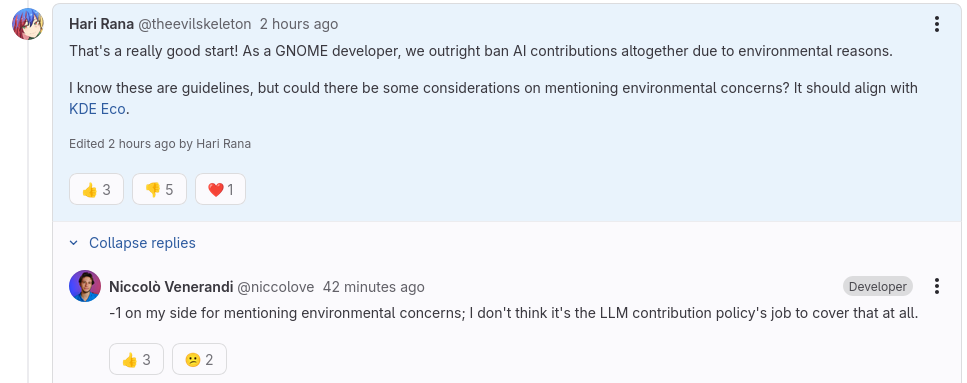
Example of a KDE dev not wanting environmental concerns to play any role, despite KDE having an environmental project:
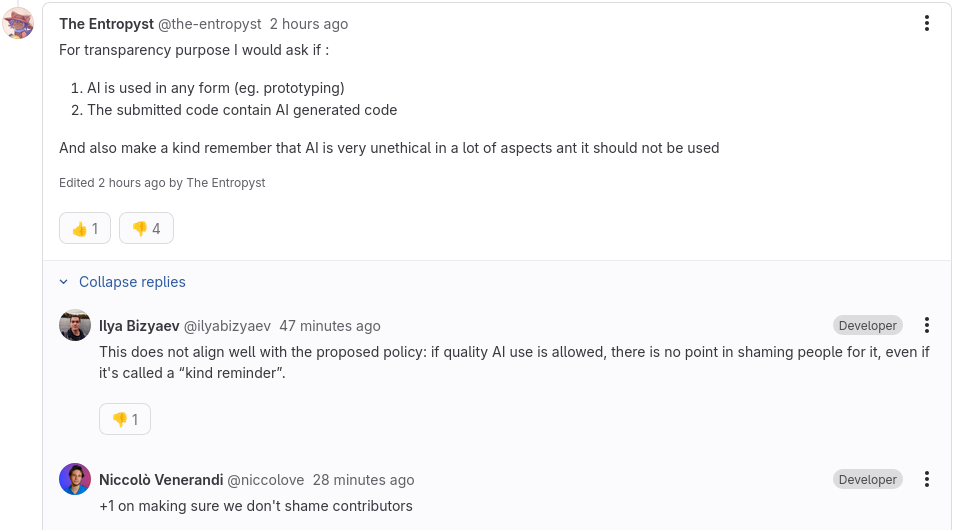
Devs rejecting any notion of transparency by disclosing AI usage in code submissions (in direct opposition to advice from the FSFE):
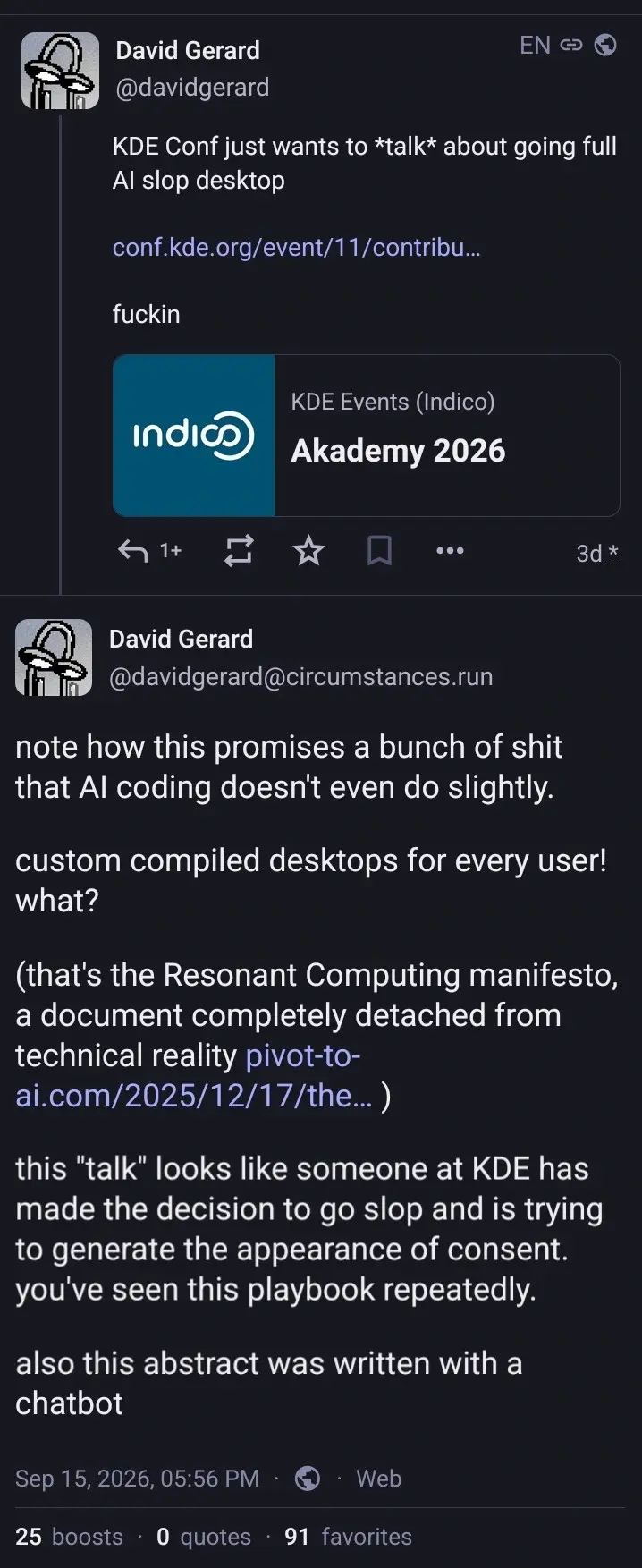
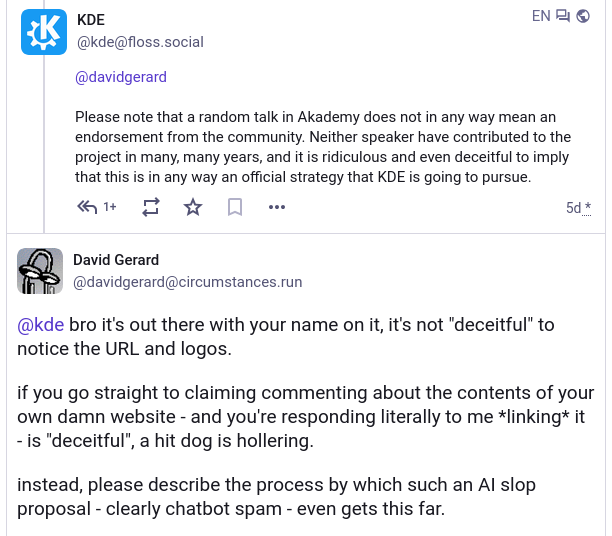
And all of this is coming right after the debacle with an AI slop project being allowed to give a presentation at Akademy, and the person asking how this was allowed being blocked by KDE:
https://lemmy.nz/post/42029517

as well as the discussion thread bringing up legitimate concerns about AI usage being closed:
https://discuss.kde.org/t/sorry-to-bring-up-a-contentious-topic-kde-ai-llm-policy/46333/164
As someone who genuinely loves KDE, and has even donated to the project multiple times, I sadly have to accept that the majority of KDE have hopped onto the Pro-AI train, and they will not be dissuaded otherwise.
In my view having a healthy discussion about this is a good thing. People will always have different views in many things, and it is natural that a common ground is achieved by having a honest debate about a given subject.
With the above in mind, hardline 100% pro or 100% con points of view are usually wrong and counterproductive, and even framing the discussion that way is harmful. I hope the discussion leads to a good and reasonable outcome.
I view AI as a pure evil platform that is terrible for the environment and trained on stolen data. IMO there is no discussion to be had, it should be banned period.
To me, it’s like discussing how much domestic abuse is allowed in a relationship. I say zero tolerance where someone else could say they think it should be fully allowed, and then a middle person thinks that we should be trying to find a common ground.
I find the proposed policy very nuanced and generally useful. It’s not banning LLM usage but still prohibiting mindless vibe-coded contributions. I don’t see an issue and your post seems to be blowing this out of proportion.
Nuance? We don’t know what that is. Ban everything we don’t agree with! *grabs pitchfork*
It makes no distinction between self-hosted LLMs or Corportate LLMs, and disregards the dangers of using LLM code in FLOSS projects due to copyright concerns and the environmental and social damage corporate AI causes. For more details:
-
Simply using an AI that’s run on a corporate data centers encourages the construction of yet more data centers, with all of the environmental/climate negatives they bring, as well as local harms they induce on the people living near them, such as increased electricity rates.
-
Using corporate AI directly helps the financial situations of those giant corporations (by boosting usage/user numbers, they are able to attract more investment capital), most of which are ran by right-wing CEOs who are more than willing to collaborate with and fund fascist governments to ensure that they are not regulated in search of both maximum profits. Some of these companies, such as Nvidia, Palantir and Oracle, genuinely appear to be seeking to use these tools for what would previously be considered crackpot conspiracy theory levels of public control and surveillance.
-
I’m wary of the potential effects of AI usage resulting in declining or stagnating critical thinking based on some preliminary studies (example 1, example 2).
-
I do not think LLMs can be “just a tool” as many claim.
-
99% of LLMs (the ones virtually everyone use) are trained on copyrighted code that is incompatible with GPL licensed projects. LLMs have a 3 to 10% chance to unknowingly reproduce the copyrighted code perfectly, introducing legal plagiarism into an open-source project, which could easily open up the developers to being sued in the future if companies scanned open source repos for copyright violations.
-
Many courts are ruling that LLM generated code cannot be copyrighted at all, meaning that it also cannot be legally made GPL, losing the protections from corporate exploration the GPL normally grants. https://fsfe.org/news/2026/news-20260825-01.html
-
Do we have a list of desktops that ban AI?
This list contains the only known DE’s that openly reject AI. Basically just a couple window managers.
Pretty much every major full blown DE accepts or uses AI. Gnome and Cinnamon have no official stances
https://codeberg.org/ethical-foss/open-slopware#desktop-environments
https://codeberg.org/ethical-foss/open-slopware#window-managers
tl;dr: Lumina, Lumina NG, and GNOME (not mentioned) are good choices of DE; bspwm, River, Sway, and Openbox are good choices of WM. The two options in bold have anti-AI policies, while the rest are simply untainted. Openbox is safer than the rest, as it has been feature-complete since 2010, and therefore only gets occasional patches.
Niri should join that list since this recent commit: https://github.com/niri-wm/niri/commit/7256ccf6274a1f953c6987ade34ea1c0e4944c27
I do kinda get Niccolo’s point that a contribution policy is not the place to decide environmental concerns even though it feels contradictory at first glance. He’s generally very critical and nuanced when it comes to LLMs so I wouldn’t call him “pro-AI”. Just watch his YouTube content.
The contribution policy is the only place where anything meaningful can be done, as that is ultimately what will influence developers trying to contribute. Putting environmental concerns anywhere else is, IMHO, just virtue signalling.
I personally consider advocating for non-disclosure of AI use to be Pro-AI. Advocating for disclosure but still allowing it would be neutral.
Be quiet, we’re trying to be mad about AI.
Damn. I was thinking of switching to one of the KDE distros. That’s out the window now.
this is quite… disappointing, and I say that as someone who uses primarily GNOME :(
I’ll likely be switching my gaming PC to Gnome due to all this :\
(on a side note, the Gnome dev in that thread mentions that Gnome bans AI usage, but I haven’t been able to find anything that confirms that, and AFAICT Gnome doesn’t have an official AI usage policy, only Gnome Circle does for 3rd party Gnome Extensions).
are you switchong off linix since the li ix kernel allows ai
As it is impossible to completely avoid AI use with Linux, I must content myself with only minimization instead of complete elimination, as I won’t let the pursuit of perfection mean I just give up entirely, as any reduction is still meaningfull, just as it’s still worthwhile to minimize fossil fuel usage and meat consumption as much as is reasonably possible.
you realize ai is just the tool and isnt a data center. data centers exist with out ai and ai exists with out data centers
I do not think LLMs can be “just a tool”.
Most LLM use is with corporate AI, and this KDE policy explicitly allows corporate AI usage. If they had restricted it to only open-source local models, I wouldn’t have nearly as many environmental concerns (though that would not solve the plagiarism issue).
For a more complete look at all of the downsides of AI usage, I’d encourage you to take a look at this comment.
“If they had restricted it to only open-source local models”
Is this even remotely enforceable? Stylometry can pretty effectively determine between AI and human written text ( not sure about code specifically since those are much stricter languages), but can it tell the difference between models or even if the LLM was run locally? (almost certainly not in the latter case).
Most contributors generally respect the rules of a project, and there are other rules put in place that are also not technically enforceable, such as asking a contributor to not submit copyrighted code (this would be virtually impossible for a reviewer to distinguish if it came from a closed source project), which also gives the project a stronger defense if brought to court, as they can then at least point to the rules and show where a contributor willfully broke them. In comparison, I suspect a court would not look kindly on a policy that says “Don’t disclose that you used a tool that has a 3 to 10% chance of introducing plagiarized copyrighted code with every prompt to avoid being shamed.”
As an example, the WINE project has a rule to not allow anyone who has even seen Windows source code from contributing to the project. This is to avoid the chances of someone subconsciously or consciously submitting a reproduction of what they saw in the Windows source code, and thus hopefully prevent the project being sued into oblivion from Microsoft (who would likely love to see that happen).
Adding a stipulation in the guidelines that contributors can only use more-ethical LLMs likely wouldn’t entirely prevent someone breaking that rule, but by in large, it is likely that most would adhere to it, making it an effective rule despite being difficult to enforce.
the Gnome dev in that thread mentions that Gnome bans AI usage, but I haven’t been able to find anything that confirms that
You can bet your behind that the developers employed by IBM Red Hat are 100% using LLMs to code. Chances are they are even mandated by corporate higher-ups to do so.