- cross-posted to:
- collapse@sopuli.xyz
- cross-posted to:
- collapse@sopuli.xyz
cross-posted from: https://feddit.org/post/1097575
You must log in or # to comment.
To the people who are saying “Yeah but you’re the one who buys the oil!!!” Please stop. Please think about any of the context surrounding those supposedly individualist decisions. Please think about what the most practical solutions are for fixing the problem. You can do that and be helpful or you can be smug and look down on others.
Sure, you buy and drive the car, but you didn’t:
- Design towns and cities that can only be easily traversed by car.
- Decide where jobs and housing were located.
- Spend millions of dollars to lobby against public transit.
- Spend millions of dollars to lobby against regulations.
- Spend millions of dollars to lobby against green energy investments.
- Spend millions of dollars to lobby for imperialist wars to access oil.
- Spend millions of dollars to spread misinformation about climate change.
- Decide what cars were available to buy and at what price. (Demand driving supply only makes sense if consumers have a way to signal that they want something that isn’t being offered. The main market way of doing that would be to not buy anything until the right good is offered… but as stated above, people can’t just opt out of needing a car if the places where they can live and work are built around cars.)
- Decide to be too poor to buy luxury goods masquerading as green alternatives.
Framing the issue in terms of individual decisions lets the people who have most actively stood in the way of progress off the hook and ironically shirks any real responsibility to fix the issue. You think by saying that it’s us doing it that you take responsibility for your actions and therefore because YOU got a hybrid car or some shit, you did your part and everyone else needs to do the same and it’s not your responsibility anymore. Needing to put in the political struggle to take on the corporate interests destroying the planet takes effort that deviates from your normal life. You have to actually talk to people, work with them, and take part in collective action. And your responsibility isn’t over until the problem is solved.
Also, sort of related: I always take issue with how dealing with issues like climate change is framed in terms of making sacrifices. Like sure, are we going to be able to do as much excessive consumption as we do now? No. But there are so many climate policies that would also just make life better for people in the short/medium term. We would be happier, healthier, and safer in a world where we got rid of our dependence on cars and replaced it with walkable cities and good mass transit. But instead of talking about how good it could be, instead the message ends up being “You’re a bad person for diving a car. You need to give up using your car and go either walk to your job which is too far away and across a bunch of busy streets or cram yourself onto the underfunded public transportation that is crowded, slow, unreliable, and falling apart.” No wonder people get so defensive. We don’t want them to have to use the bad infrastructure. We want it to be so good that it’s the best option by far. Pitch that future instead of lecturing people.
TL;DR: I WANT TRAINS! GIVE TRAINS!
At some point, you realize that ordinary people are not responsible for any of these big “problems” (some doesn’t even exist).
Corporations and governments are responsible for all problems we have. They create them with their laws and their greed for power.
But they love telling people to donate money to the problems they cause, or to make us feel guilty for things we have nothing to do with. We should always be in a state of fear and guilt, because that makes us easy to control.
Ah yes companies that famously refine oil only to pour it into a hole and light it on fire for their own amusement, one else uses it at all.
If it’s just these companies that would be affected let’s just close them down. I’m sure it would make no difference whatsoever.
Shell is an evil demon corporation.
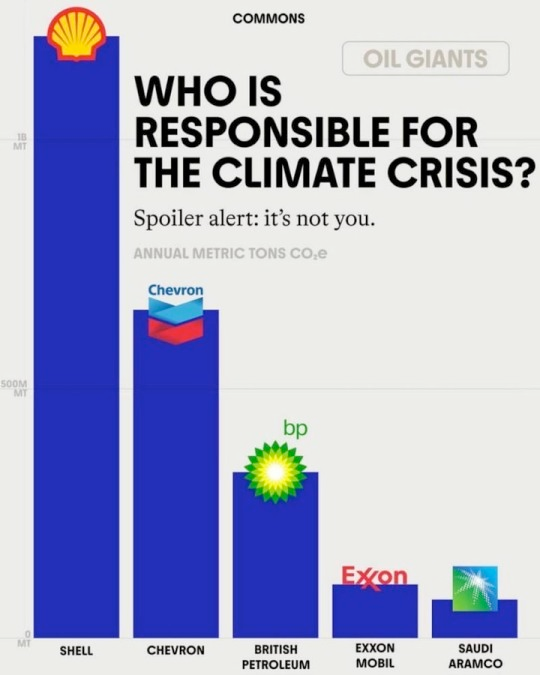
>>“Spoiler alert: it’s not you”
>>proceeds to display a chart of companies who sell a fuel we all use
Well i don’t create the system. Given the chance i would rather not be a part of it.
I hope big oil is paying you well for propagating their “personal carbon-footprint”-narrative.
What do do you say? They don’t even pay you? … Then why are you doing it?
Because I don’t trust anybody who tells me things I wanna hear like “you bear no responsibility; it’s somebody else’s fault”.
Oil companies couldn’t sell if nobody was buying. The idea that the world can be fixed and I won’t need to sacrifice a thing is a little too good to be true. Sure, maybe others will need to make more changes than me, and I’m certainly not gonna let them off the hook, but I’m not gonna let myself off the hook either, and anyone who tells me I can is selling me something.
If you can spot me $30,000 I’ll get an electric car today
30,000? A domestically manufacturered, highway-capable EV is 10,000 USD here in vn and even cheaper over in China.
Who do you think is responsible for your inability to buy reasonably priced evs?
Just do what you can, when you can. It’s all any of us can do.
Whatcha gonna drive it on? The streets and roads are a major source of CO2 by themselves.
I’d argue not having to burn your fuel is already a great improvement
If someone can spot me $300 million, I’ll get functional public transit going in my city instead.
In the meantime, my options are drive a car, or be unemployed.
You’d also have to deal with all of the residents who pitch a screaming fit any time anybody suggests maybe possibly removing a parking space. Unfortunately, it’s a whole, self-reinforcing system, not just the fault of a few corporations.
First, I have to get a new range hood, repair my foundation drain, regrade my yard, and earn a spare 30k after that.
I think I’d get close to $5 if I traded in my current car, if that helps
I’ll give you $3.50
“we all use”
Speak for yourself. I refuse to pay them a cent, and have taken every step I can to distance myself from them.
Most of the factories that manufacture the stuff you use are driven by fossil fuels. The food you eat is most likely grown using fertilizer that was made using natural gas. Unless you live in the forest and eat nuts and berries, you use fossil fuels.
You realize that fossil fuels or natural gas are not evil by themselves, right?
What causes climate change is burning them and releasing CO2 in the atmosphere.
If you use it to create fertilizer, or plastic, or whachamacallit, it doesn’t create greenhouse effects.
That’s even more of a reason to focus on buyers rather than sellers.
The factories may use fossil fuels, but I do not.
The fossil fuel companies are responsible for their own actions, as are the companies and people who still choose to use fossil fuels.
The people who have made an active choice to avoid fossil fuels (or the people without a choice) are not at fault. Blaming them instead of the people who can make a difference helps no-one.
It’s trump diddling kids, not me!
- this guy, eating a trump steak on trump airlines.
Whoever said “instead”?
This is a false choice between huge lifestyle changes for everyday people and regulating the polluters. Regulating the polluters is going to cause huge lifestyle changes for everyday people.
The idea that any of us get to go on as usual is the main roadblock to meaningful climate action.
K that’s fine
Well can’t we just ban Shell from selling oil, and then get in our F150s to drive to the airport?
I’m cool with that. I also don’t think it would necessarily be huge in terms of inconvenience for the average person because alternatives would pop up before long. For example, if air travel became prohibitively expensive we might actually see an expanse of passenger rail for domestic travel. It’s ridiculous that it’s still cheaper/more convenient to take a 45 min flight (plus the time the whole airport experience takes) vs a couple hours (or less with high speed rail) train ride. Certain plastics might also become too expensive so we might see the return to more sustainable packaging. A lot of the oil and byproduct consumption from the average person comes down to lack of choice ratger than people choosing products made from oil ober alternatives.
No, we are past that point. A gradual reduction in CO2 levels is not enough any more. If you want to save billions of lives we need to cut CO2 production hard and right now. Since that is never going to happen you happy go lucky scenario becomes impossible. In any realistic climate scenario humanity is already fucked, it’s only matter of how much exactly.
Nothing changes until the price of an electric car is less than the cost of a gas one when it comes to the vehicle cost.
A Hyundai Sonata is 35k CAD
A Hyundai IONIQ 6 is 55k CAD
Miss me with that bullshit.
Hyundai Sonata is a budget sedan. Ioniq is their top of the line electric. Perhaps look at Hyundai Inster or Hyundai Kona or something.
This is why buying new cars is dumb,
A used Hyundai sonata 2024 is ~20k USD
A used Hyundai ioniq 6 2024 is ~24k USD
Yeah it may be more upfront, but most people finance any way and your monthly payment will be offset buy your fuel savings.
There’s enough of a stock of used EVs, quite often with low mileage, at this point that cost is becoming less of an issue for people then the perceived lack of convenience. That and dealerships/manufacturers not promoting them because they get less maintenance fees and they’re lower margin then a giant SUV or pickup.
Yeah. If you’re paying for the car outright, your free cash every month will be higher, which can go back into savings. If you’re financing the car, your monthly expenses will quite possibly be the same or lower, because you pay for gas every month, too.
I just looked in Canada
2024 sonata. 28k
2024 IONIQ 6. 39k
I’m sorry I’m not paying over 10k more for an electric car that’s absolutely insane.
Not equivalent, the IONIQ is luxury
Slate is 25k
Yes, but regulating pollutors requires a populace that won’t accept anything less. Instead people are placated by paper straws.
Godammit. I’ve boycotted Exxon and BP, for their negligence that led to spills, for a long time. I knew shell probably wasn’t much better but I’ve preferred them anyhow. Turns out I was helping the worst offender. Awesome.
And you base that on… a shitpost on lemmy without a source or even a damn label? It’s literally bunch of rectangles.
It in fact doesn’t matter much which one you buy from, they all sell the same product and the product they sell is the problem.
Yes, it’s impossible to effect change as a single person so government action is needed… But the necessary consequence of that is that we also stop consuming as much fuel.
if it’s impossible to affect change as a single person, then why do anything at all? Why bother to vote? I hear this logic all the time and it doesn’t make sense to me.
- “Don’t bother making personal changes, voting will save us!”
- people vote for Trump
- “Wait not like that”
That’s not to say that public policy is pointless. “Tragedy of the commons” tells us that regulation is necessary. But I think the framing is wrong. The culprit here is not oil companies. It’s oil. If you tell people “oil companies are evil”, and tax the oil companies more, these people are just going to get mad when the taxes trickle down to them in the form of higher gas prices.
The correct framing is “Oil and gas cost more to us, than the cost of simply digging it out of the ground. The added taxes are to reflect the true cost”. Then people will understand why gas prices need to go up.
Then add on some Infographics and memes that show how much more efficient public transit is. How solar panels pay off over the long term. Etc. Because personal responsibility does in fact make a difference.
Just a friendly heads up, it’s affect, not effect.The way I remember it is affect is an action, and effect is the result of an action. English is dumb.I was confidently incorrect. See below.
No, they used effect in its verb form correctly.
effect
effected; effecting; effects
1: to succeed in doing or achieving (something) : to cause or bring about (something) : accomplish
effect a transformation in company culture
effected a settlement of the dispute
… a powerful reminder of the potential of technology to effect change.—Chris Gallagher
2: to put into operation
the duty of the legislature to effect the will of the citizens
… an executive grant of clemency … to effect the prisoner swap.—Eric Tucker et al.<
English! 😆
Your point should be that usually “affect” is the verb and “effect” is the noun. I’m having trouble coming up with a mnemonic device, but at least these can be pronounced slightly differently.
Thank you for the correction!
Who buys and burns most of the fuel they create and why?
“there is no ethical consumption under capitalism” has to me always been a clear call to reduce your consumption within a capitalist system. yes, it is these shit heads who shackle us. but when we reduce our dependence on them we begin the breaking of our bonds to a system that kills thousands every year
No ethical consumption under capitalism, I scream, at my local farmers market. (Made up quote btw).
But yeah, fuck oil companies, they are real fuckers.
Farmer’s markets, co-ops, and mutual aid all exist as forms of resistance to capitalism purely by making sure your dollars go to people within your community rather than get captured by the modern company store through Wal-Mart or Target. At the same time though, they are also not everything. It’s a whole thing. Nothing anywhere is or can be perfect. The best we can do is the best we can do. I know that sounds like a thought terminating cliche but sometimes it’s important to set aside the things you can’t control and to focus on the things you can and have faith that the more people that do that the easier it will become to resist the horrors that surround us all
How is a farmers market a resistance to capitalism? It’s in the very sprit of capitalism to increase efficiency and remove the middle man
Increasing efficiency isn’t capitalism; letting those with capital decide is capitalism. If you exclude capital and just do the thing directly, you’re resisting capitalism.
most farmer’s markets where i am have a heavy emphasis on community building and resiliency as well as income stabilization for vulnerable people with the bank’s sword of Domacles hanging over them. of the three i mentioned, they are the weakest form of resistance but they still have a role to play, which is why Granges put so much work into making sure they are available to non members of the grange
I always hate that most people are happy to blame corporations, forgetting we are consuming that’s why corporations are creating.
yeah, it is like blaming china for a pollution, when that pollution is externality of cheap shit we buy from them. it is our pollution in the end.
that isn’t an argument for blaming the end consumer, because that problem is not going to be solved from the bottom, but it is also childish to pretend like we, the consumers, are not complicit.
You should read Terry Pratchett’s Boots Theory. Many people don’t have the option to pay more up front to consume less, if there is even an option to buy a more expensive but longer-lasting item in a given market any more.
Many people don’t have the option
well many do and they will buy cheap shit anyway. and i am not talking about boots, i am talking about people who have a dog, which is clearly non-essential expense, and they buy him shitty toy from temu. is that rubber toxic? who knows, who cares, look how cheap it is!
Well said
I agree. It’s obvious to me that it will never be a tidy “it’s just them to blame” scenario but people really want it to be, regardless. I suspect the downvote crew will show up soon…
The corporations blame the consumer, the consumer blames the corporations and everyone gets to consume and profit blamelessly.
Yeah, that’s a nice fairy tales to keep burning the planet.
In reality the main consumers are a handful of rich people including those owning the corporations and paying off politicians and media while 95% of the people would not consume anything if not forced to do it and are also contributing only a miniscule amount to the total consumption.
The top 10% of people create something like 50% of the carbon footprint which means 90% of people create the rest of it.
No one’s blameless.
But that also means that if the top 10% cut their consumption by half, we would have blown past the required targets to not have global warming pass 1.5° C, even if the other 90% didn’t change a thing. And they would have still been engaging in massive consumption by anyone else’s standards.
I also they’ve that a large amount of the bottom 90% are paying the top 10% to do it.
Also the difference between create and consume is important. even if shell only had 1 employee and 1 shareholder, that person would have many customers paying. you can measure both of course.
Wouldn’t be us if they hadn’t lobbied for decades against renewables
It’s always easiest to blame someone else.
How am I wrong?
Yeah, we already knew how how propagandists operate. No need to spell it out what your are doing here.
What am I doing here besides pointing out that people buy things that corporations create and no one is blameless here?
You say this like buying only from sustainable companies is something everyone can just decide to do, and there haven’t been decades of lobbying and propaganda against policy that would make it possible at a collective level.
That’s true, if you’re in a wheelchair then I can see an argument for the necessity of cars. But if you have working legs, you don’t really need a car.
I’m not gonna ride 50km round trip daily to work on my labour job. I mean i technically can and did with my ebike, but as someone with the lack of time, the time loss is really significant.
The thing about your opinion is, you’re assuming everyone work 5km away from home, or can reach it just crossing the street, but the reality of what we’re in now, is people often live far from their job because the rent is (significantly) cheaper, room is bigger, and they already have a car, and have near zero public transit availability. There’s many lazy people who wouldn’t walk 500m, but there’s even more people who aren’t given a chance to pick their mode of transport.
because not purchasing anything that is produced or transported with energy from fossil fuels means fucking off into the woods to starve to death naked in a hut made of mud and twigs
As if there is nothing in between “don’t do anything” and “go live in the woods”
Exactly. Cutting out all net resource consumption is really difficult, but almost all of the difficulty tends to come in the second half. The first half is worth doing.
Somewhat counterintuitively, switching from a 15 mpg vehicle to a 20 mpg vehicle (and driving the same number of miles) represents a greater reduction in fuel consumption compared to switching from 20 mpg to 30 mpg. Side note, this is also why we probably should’ve always been talking about fuel consumption per unit distance rather than distance per unit fuel, but it’s hard to change the conventions around this.
So there are a ton of examples of products that use far more or less energy than alternatives, or simple changes in time of day that can make a huge difference in fossil fuel demand.
if there’s a minimum amount of consuming fossil fuels that’s required to continue to live in society, and the goal is to eliminate that, then we need change on a societal level. individuals alone cannot solve the problem, and therefore cannot be blamed for the problem existing
Sure there probably is a minimum somewhere, but most people are far above that minimum.
I’m vegan and carfree. I’m probably closer to that minimum than most people in this thread. I looked up the stats once and saw that the average American produces ten times as much CO2 as the average Congenese person. Imagine that, ten times. If you’re an average American, you can reduce way more of your emissions than that average Congenese person can! If you eat meat and drive a car, you’ve got so much opportunity for growth!
Are you an AI? It sounds live you live in a binary world.
It’s actually the capitalist system as a whole. The large fossil fuel companies of course push for extraction and maximizing their customer base, but it is the entire underlying economic system that ensues it is wasteful and that alternatives for energy production are avoided or limited.
Let’s go through some examples.
Just think about all the jobs on the planet. How many of them are actually necessary and doing work that prioritizes sustainability or limits environmental impact? How much is producing pointless goods or forcing them to be grown in wasteful ways in order to maximize profit? Is the fruit in your fruit cup grown in Latin America, packaged in Thailand, and sold in Germany? Is your job in or related to finance, real estate, or insurance (all useless or leech industries)? Are there 30 people doing a job when only 3 are needed because 5 companies are doing redundant hiring between each other?
Look at one of the largest single-entity consumer of fossil fuels on the planet: the US military. More than the vast majority of countries. Now you might say, “hey wasn’t this about the economic system?”, and yes it is. The purpose of the US military is not “defense” of the United States itself, its lands. The purpose of the US military is to enforce its unipolar status as the primary seat of global capital. Bases all around the world, surrounding shipping lanes and energy. Their most conspicuous targets revolving around either energy (Venezuela, Iraq, Iran) or opponents of the capitalist system or peripheral countries trying to assert a slightly higher level of economic autonomy.
The reason for this is that the economic system is driven entirely by profit-seeking, namely accumulating more and more capital via injecting capital into activities. Productive, redundant, destructive, capital doesn’t care so long as more comes back through the activity. Environmental sustainability is not something capital considers except as a new way to market selling more products and therefore increasing itself. Capital industrialized entire nations while dooming generations to lung problems from soot and famine conditions and dust bowls from over extraction and the elimination of the commons. It simply does not care, at all, and it is in control of nearly every human on the planet, including those who own businesses, pressing them into the capital-increasing social activities it spurns.
You could end every energy monopoly tomorrow, even nationalize them, and the vast majority of emissions would still remain, as the actual primary engine would be left intact.
The only way to secure an environmental future is to overthrow capitalism and put people, not capital, in charge.
US and Europe carbon emissions have gone down in the past 20 years, while China’s has grown rapidly. China accounts for %35 of the world’s emissions. Of course lots of manufacturing for goods happens in China, but this just tells me that capitalism is not to blame here, China is. China needs to raise their carbon taxes. Or maybe manufacturing needs to come back to the US and Europe, where it can be properly regulated.
Capitalism moves manufacturing to a location with less regulation or the overhead from regulation, resulting in more profits for the capitalists. This is clearly not because of capitalism.
Spoiler
/s for those who need it.
This is not a result of capitalism. It’s simply the result of competition. Now if you want to erase country borders, that’s a different discussion. But as long as one country doesn’t regulate fossil fuel emissions, it doesn’t matter what economic system they use, capitalism, communism, or whatever, they’re going to be able to produce goods for cheaper. Because they’re ignoring the real costs.
Most greenhouse gas emissions occurred when colonizer Western countries were industrialized. They were not “properly regulated”, instead they were offshored in order to discipline labor and extract even greater profits. The offshoring was not exclusive to China, GHGs accordingly increased everywhere that further industrialized as a result of this. This effect is about as capitalist as it gets, trying to maximize profits via labor discipline and opening new fronts for increased exploitation (more profit per worker).
China’s approach to this shift was to realize it was an opportunity to build their own productive forces, that capitalists would give up productive centers and move them to other countries, and those countries should be able to domestically gain and upper hand so long as they ensured that production could broadly increased with every investment. For example, China requires technology transfer as part of direct foreign investment. China was correct in this and it is why it is an exception to the rule for national development as a former peripheral country. Compare ita development to India, which did not require such transfers or focus on building production.
Now, again, this means that industrial production moved outside the imperial core and into other countries, including but not limited to China. That industry did not suddenly become green nor did it become immune to the global economic system. It meant being wed to it. As we all know China’s strategy is one of interdependency with global capitalism even as they try to steer an otherwise anarchic process in a coherent direction via the commanding heights of the economy.
And yet we can see the difference those commanding heights make even on this specific issue. China is the global exporter and consumer of green energy, leading the charge on solar panels that countries like the US sanction and tariff, instead promoting fossil fuels. China is taking the actual steps you’d imagine Western nations doing (even though they never have), like setting public targets and meeting or exceeding them, and sticking to their obligations.
Imagine what could be done if every country could work in concert for those developments. Specifically, against the anarchic tendencies of the market and capitalist profit seeking.
Why are you acting like China is a poor helpless victim to capitalism here. China chose to shift to capitalism at the end of the 1900s. And they can choose to impose stricter regulation on fossil fuel emissions. They choose not to because it hurts their bottom line. Simple as that.
The US and EU have controlled their emissions, while China’s continues to grow. China has the highest GDP in the world, and 7th highest GDP per capita, it has no excuse anymore.
Why are you acting like China is a poor helpless victim to capitalism here.
I didn’t. I gave a pretty dry analysis. Maybe ask yourself why that feels overly sympathetic to you.
China chose to shift to capitalism at the end of the 1900s.
That’s not a particularly accurate or useful description of China’s gambit to allow (mostly foreign) capital to exploit its people to build productive forces while maintaining overall control over sweeping aspects of their economy. If China simply switched to capitalism one then has to explain why it is so different from every other capitalist country. China’s trajectory is responsible for the vast majority of global poverty index improvements and this runs in dramatic contrast to the rest of the periphery that was already fully capitalist and continues to be. The redirection of funds and productive capacity to infrastructure, education, housing, direct poverty alleviation. The limits/outright bans on the financialization and speculation that characterize imperial core economies. The policy of embedding the party in large firms and turning developed industries into state-meditated co-ops. The lack of imperialist expansion required by monopolized, financialized capital. But I digress.
And they can choose to impose stricter regulation on fossil fuel emissions.
Sure. They could set them to any arbitrary level. What is the correct rate for it to be sustained? Remember, they’re almost alone in meeting targets among countries as advanced as they are. What level of production flight should they unilaterally sacrifice, if any, and who picks up the slack? At which limits do they begin sacrificing that production? Are their regulations too loose or strict for the optimal trajectory? Why are we focusing on one of the only countries meeting their targets and making progress on renewables?
They choose not to because it hurts their bottom line. Simple as that.
It is, in fact, not as simple as that and this ignores the active work and debate within China that produces the results we are discussing. They aren’t making their targets because that’s just what capitalism does. It’s deliberate, literally a result of deliberation, research, modeling, and pulling levers at the commanding heights.
The US and EU have controlled their emissions
lmfao you can’t be serious they can’t even meet their own targets. France is the only one that ever does and it’s because they became a primary source of nuclear weapons materials (producing low emission energy as a nice side effect).
while China’s continues to gro
Everyone’s continue to grow. The targets are set, at the moment, for when they will hit peak and then begin dropping. China’s peak target is set to 2030 and they are slated to beat that.
China has the highest GDP in the world, and 7th highest GDP per capita, it has no excuse anymore.
Which part of “the only ones taking this seriously” is not registering?
Let’s bring back this old trope:
GEKOLONISEERD
It’s worth stating that this is showing just the private company contributions (private as in not owned by national governments). State-owned oil companies of various nations contribute massively as well, so beyond the
bribeslobbying problem there’s a direct conflict of interest for many nations that get a substantial amount of revenue from those state-owned oil companies.Striving to maximize profit is what companies do. Blaming them is not useful. Instead, advocate for and promote government policies that would disincentivize fossil fuel use, like carbon taxes.
When you’re traveling through the desolation that is Midwest US, you’ll notice there’s a lot of shell stations. They’re kind of like “Casey’s” (except you hear about “Casey’s” more because of the pizza) located in many small towns that have only a dollar store with a refrigerated section as the only source of groceries. Food deserts full of 200 pound children riding electric scooters while staring at their phone. It’s terrible.
…I digress
A fun fact… in the Midwest US; the reason so many small towns are 14 miles apart is that’s how far a horse could carry a full wagon in a single day. So they built train stops every 14 miles. And somehow, 125+ years later, those lil towns still exist. They grow the corn that becomes syrup in candy and soda & whatnot. Also those towns all have a “Shell” station because of some backroom handshake deals done a long time ago.
Actually, it might’ve been 7 miles. Either way, 7 or 14… it’s true. Look it up :)
Fucking adopt renewables already and reserve the criminal calling for the people actively sabotaging the change.
Yeah, many of those people work for some of those companies, but their work is not producing barrels of oil.
As if oil companies aren’t the tip of the spear of anti-renewable propaganda and climate change denial.
Why are we blaming these companies when there’s a much bigger contributor

Why blame China? They do this so you guys can have crappy stuff that won’t last because your country makes you too poor to buy local 😉
I’m sure you’re joking but I do recommend reading Tragedy of the Commons, it’s just a few pages long. Amongst other things, it talks about how regulations need to be applied everywhere for them to be effective.
So the US, with 1/5 the population of China, produces almost half the CO2 emissions that China does? How much is that per person? I wish they could get that Chinese level efficiency, maybe they need more solar panels.
If you want to measure efficiency, population is not the way to do it, economic output is. After all, a person laying in bed does not contribute much to emissions, but also not much output.
The US has 3/4 the GDP of China with less than half the emissions. The EU also has 3/4 the GDP of China, but less than 1/4 the emissions. Both are far more efficient
China builds physical objects for the world. The US sells intellectual property, financial services, with far less manufacturing.
So no, CO2 per GDP is not a useful measure.
When your hospital or HMO decides to jack up the price of a medication, that’s measured as an increase in GDP. When your car insurance goes up, that’s GDP going up.
Information has tons of value. I’m not a fan of copyright but I also don’t agree that physical products are inherently more valuable.
Also regarding insurance raises and other price raises. Prices usually rise when demand rises. So it’s a measure of what people want. Much better than just measuring pure survival. Now if all prices rose, that would be inflation, and GDP accounts for that. But if the price of one product rises while the prices of others fall, that’s just shifting consumer demand. Of course GDP isn’t perfect since there can be monopolies, oligopolies, and state-controlled companies, but imo it’s better than using population as a measure.
This is a bad faith argument. You are arguing the efficiency of a country based upon its CO2 per GDP. That’s kind of a shit argument because GDP is a human construct. Global warming doesn’t give a shit about GDP.
How much “value” a country produces based upon…what, exactly? How much it extracts from the ground? How much value other humans assign to those goods?
Capitalism got us into this fucking mess and you’re still using it as the goddamn ruler.
If you want to compare states, fine, I guess that works as a proxy for cultural differences, but if you are going to compare the efficiency of the people within the state, you measure per capita.
Using GDP is just a shit excuse to be able to defend capitalism while simultaneously dismissing the fact that China supports more people with fewer per-capita emissions.
Energy is money, and US will use more of it per capita because we have more money per capita. That’s going to be true until there’s a massive economic recession or a technology that greatly increases efficiency.
Or you reduce consumption, but the line going down is not part of the plan for China or the US.
Fossil fuel emissions are also a human construct. We did fine before fossil fuels, and even coal. Population is a horrible measure because all it captures is if you are keeping people alive. Even North Korea can keep people alive. But people want more than just survival.
But fine, you want to talk about population? You’re ignoring the second example I brought up. The EU has 1/3 the population of China and 1/4 the emissions. In other words, China is still the problem.
Edit: I just did the calculation, and North Korea is 4x more “efficient” than China if we are using carbon emissions per capita. I don’t think population is a great measure, to say the least
Fossil fuel emissions are also a human construct.
Huh what?
It’s a human activity, not a human construct.
What it essentially is, is sequestered carbon from millions of years ago, now being burned off and released into the atmosphere. Lion King’s Circle of Life is essentially the Carbon Cycle, and lots of blades of grass don’t get eaten. Carbon that returned to the earth in large quantities and under the right conditions became oil/coal, and now we are digging that back up and burning it for funsies.
But that’s besides the point. The point is that each individual emits an amount of carbon per year, much of which was formerly sequestered. Some countries, each individual is using less than others.
The problem is that you won’t be able to pull out a number that makes America/the west/Capitalism look good, because such a thing doesn’t exist…so instead you just try to brush it off as “oh well our country is better because of this number”.
It’s xenophobia and nationalism. Not science. Not even statistics.
The problem is that you won’t be able to pull out a number that makes America/the west/Capitalism look good, because such a thing doesn’t exist…so instead you just try to brush it off as “oh well our country is better because of this number”.
You’re contradicting yourself here. You’re saying I can’t pull out a number so I…pull out a number?
I’m not even clear what you’re arguing here. My point is that the US and EU emissions have been declining for the past 20 years while China’s continues to climb.

Is that scientific enough for you?