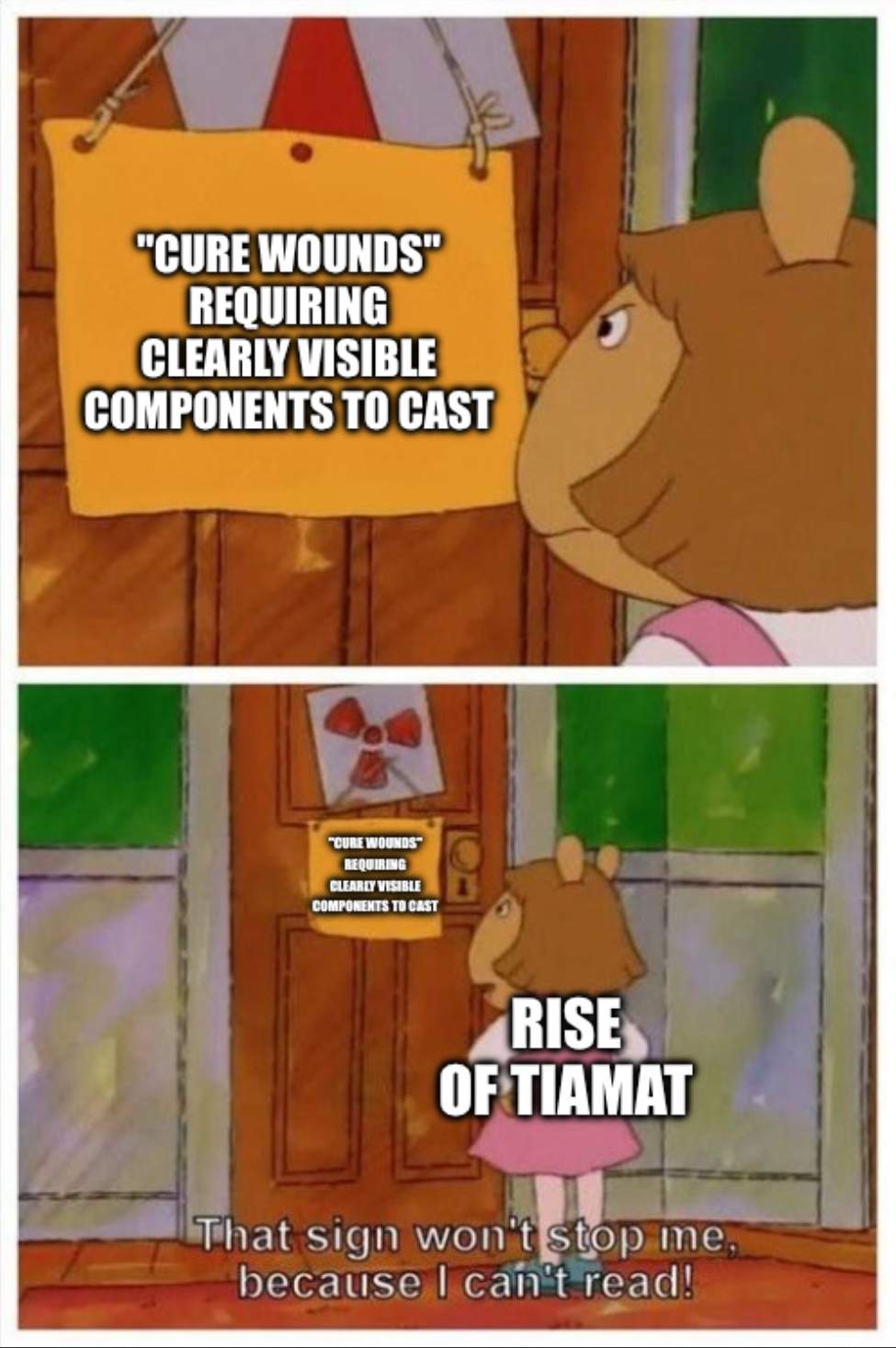
For reference: There is a duell in the module where a shaman tries to secretly help one NPC by continously casting Cure Wounds on him while supposedly only helping him “stand up” after he intentionally let‘s himself fall prone. To spot this, a PC has to specifically declare checking for interventions a then suceed a DC 15 perception-check despite being within earshot…
People actually pay attention to spell components? I’ve been playing D&D for 20 years and literally every campaign I’ve ever played in just ignored them.
I tend to rule that any components are “assumed to be in the materials pouch”, unless there is a significant (relative to party wealth) gold price attached, in which case they need to be bought. In practice I found that only really seems to apply to resurrection spells.
From there, the only thing that matters to me is can you reasonably perform or (roll to hide to perform) the semantic and vocal components, as well as get out the materials of your materials pouch in your current state.
In practice this means I can ignore components 85% of the time, but can still temporarily de-power my players if needed for some reason.
They’re talking about verbal and somatic components. That spell doesn’t have material components.
Glad someone else knows it. As a player who frequently had to transcribe spells into roll20, I always just assume other people know the components certain spells take to cast and then end up confused if they don’t.
RAW verbal and somatic components give you away similar to making an attack. That’s why Subtle Spell and similar exist. There’s no “roll to cast secretly” mechanic on purpose, the benefit of being hidden is that you get advantage on your first attack
deleted by creator
Yes, flavoring your spellcasting while it’s mechanically just “I have a component pouch that carries everything I need” is part of the fun for many…
Some do. I know I do. It limits what casters can do at least a little.
its also the lowest rated official module, after its prequel hoard of the dragon queen
I did run it and it was a fun game all the same, but i made soooo many changes. if i could go back in time I’d teach myself how to make dragon encounters richer
I feel you. I’m currently planning to run it someday and there are just so many things I’ll definetly change.
It is the first long module I’ve run. Still going after 3 years (we’re slow). My players say they’re enjoying it but I’ve spent so long trying to fix things I might as well be home brewing.
I think anyone that wants to use a module to simplify GMing (like me) should choose anything else. Anyone that’s ok with home brewing doesn’t need the module. Maybe read the plot overview at the beginning and fill in the blanks.
I like using modules so that I have a general basis to start with. It keeps me focused on the things relevant to the campaign.
I love this gem. The only thing they got a but wrong is that Bardic inspiration could actually be whispered, since it only requires the target to be able to hear you.
I mean, I don’t see an issue with hiding the casting of a spell from people. I do think it should probably be the other way around for players (do a slight of hand to hide the semantic/material components, and beat passive perception), but in principle I don’t see why you shouldn’t be able to hide those?
msbbritain@lemmy.world The issue us that it breaks with the established systems of “reality” without explanation or cause. It’s an arbitrary deviation from the established and shared understanding of how things work, with the only available explanatiin being “because I said so, so shut up and don’t question me”.
It’s one thing if there’s the equivalent of the Conceal Spell feat and actiin from Pathfinder being leveraged here,but tbat comes with both a build tax and an action tax. If there’s no price being paid, it’s a little bit of a “fuck you” to the players.
Thanks for pointing this out, that’s better than what I could’ve said to explain it. The DM can always make changes without adhering to any limitations, but if they are a good DM, they’ll at least try to be consistent. And that’s the least I expect from professional writers. (And I similarly expect them to wait for the actual rules of the system to be published before writing an adventure.)
Because it would make subtle-spell kind of redundant and why even use components in the first place if they cannot be used to tell you are casting something?