- cross-posted to:
- science_memes@mander.xyz
- cross-posted to:
- science_memes@mander.xyz
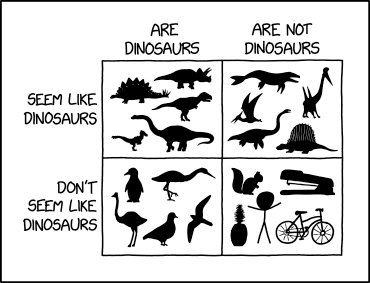
xkcd #3204: Dinosaurs And Non-Dinosaurs
Title text:
Staplers are actually in Pseudosuchia, making them more closely related to crocodiles than to dinosaurs.
Transcript:
Transcript will show once it’s been added to explainxkcd.com
Source: https://xkcd.com/3204/
You must log in or # to comment.
Fuck that, I’ve been in close proximity to ostriches and emus and they one hundred percent seem like dinosaurs.


Cassowaries are even worse.
Now I see why Australia fought and lost a war against them.
TIL dimetrodon is not a dinosaur, based on a silhouette in a cartoon.
I haven’t really thought about dimetrodons since I was a kid.
The name (di metro don ≈ two teeth sizes) is a clue, as teeth specialization is very much a synapsid (i.e., mammal and proto-mammal) thing.
How about snakes?
True, (some) snakes have also evolved specialized fangs.
Several times independently with significantly different designs, it seems.
I’m a little disappointed, I was hoping for some very specific explanation why it’s technically different :-) It’s cool that they are independent, thanks!
Well, reptiles seem to have split pretty early on between the ancestors of lizards and snakes (and the lonely tuatara), and the ancestors of turtles, crocodiles, and dinosaurs, the main differences seemingly being in the bones of the skull, and specifically for the group with the snakes and lizards in, the ability to self-amputate the tail (though that’s lost in many of their descendants), and the keratinized scales; you won’t see a turtle, crocodile, or dinosaur molting its whole skin in one go like lizards and snakes do, they’ll molt their scales (or feathers, or scutes) one at a time.
And almost all of these are fishes.
Who else is in the lower right corner? 🙋♂️