

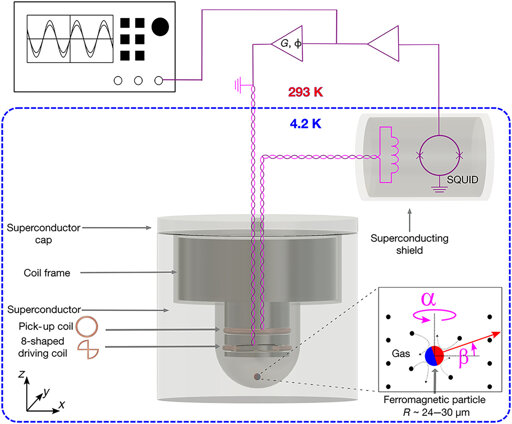
The team involved in the new study levitated magnetic spheres with a radius of approximately 30 micrometers inside a superconducting lead trap cooled with liquid helium. The superconductor trap expels magnetic fields through the Meissner effect, allowing a tiny magnet to float without active position control.
Magnetic coils were then used to accelerate the spheres up to 2.3 million revolutions per second, or 138 million revolutions per minute, while an ultrasensitive superconducting detector tracked their rotation and slowdown. For context, the previous record for levitated magnets was the half-millimeter-diameter magnet at 38 million revolutions per minute.
The researchers conducted the experiments at a temperature of around 4.2 Kelvin (roughly −269°C). The measured slowdown of the magnet implied a characteristic speed-decay time of about 24 days, which is the lowest damping rate ever measured in a levitated micro- or nanosized object. In a separate, slower-running experiment, the rotor’s magnetic-field sensitivity matched the best previously demonstrated with a nonspinning levitated magnet of similar size, allowing it to make impressively sensitive measurements.

Interesting choice of picture… Gordon, we cannot predict how long the system can operate at this level!
I just hope wherever this goes I get to adopt a many-eyed screech dogggo