

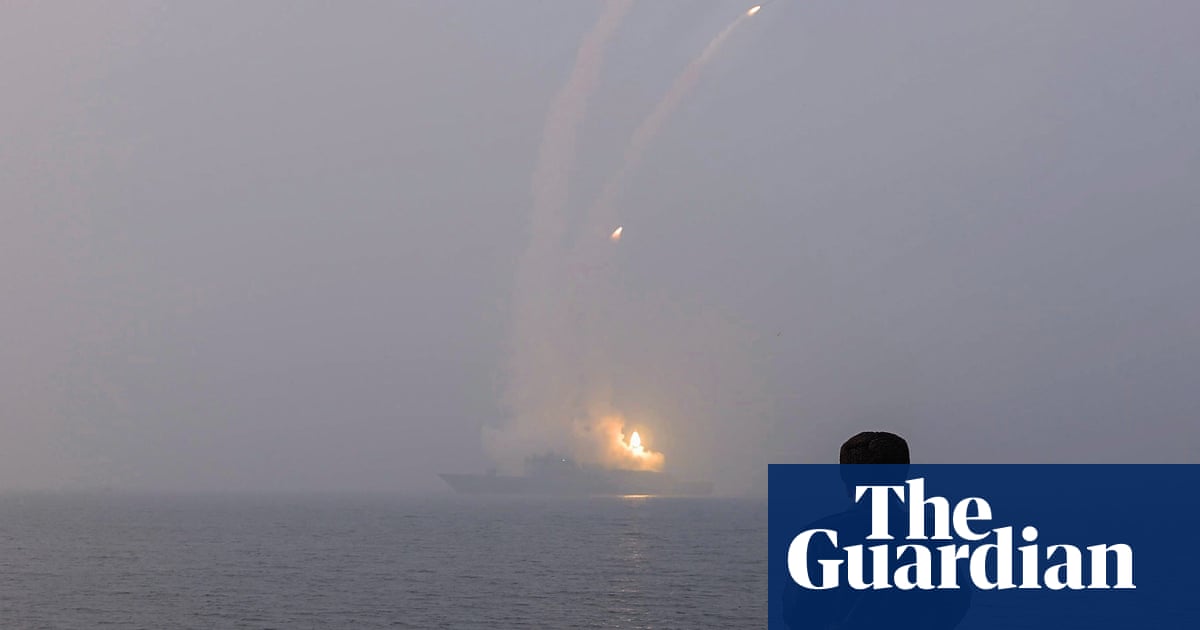
As speculation mounts that Kim Jong-un and Trump could meet this month, analysts say Pyongyang will continue to see nuclear weapons as a matter of survival
North Korea’s launch last week of a missile from a naval destroyer elicited an uncharacteristically prosaic analysis from the country’s leader, Kim Jong-un. The launch was proof, he said, that arming ships with nuclear weapons was “making satisfactory progress”.
But the test, and Kim’s mildly upbeat appraisal, were designed to reverberate well beyond the deck of the 5,000-tonne destroyer-class vessel the Choe Hyon – the biggest warship in the North Korean fleet.
His pointed reference to nuclear weapons was made as the US and Israel continued their air bombardment of Iran – a regime Donald Trump had warned, without offering evidence, was only weeks away from having a nuclear weapon.
Realism = looking at your neighboring countries and wondering if it’s worth turning them into a toxic wasteland because you felt a little scared. The repercussions of nuclear armament in these psychotic times will be all consuming.
It’s just a really funny thing to see casually thrown around with the context of the last hundred years. I can’t imagine any of you guys have looked into the Cold War nuclear policies.
Realism in this case is one approach to examining international relations, which models states as self-interested actors in an anarchic global system. It assumes that there are no other rules than reasonable self-interest constraining decisions. In essence, it takes a “worst case” approach to human decency, but also a “best case” approach to rational government.
It’s not a “perfect” model, because no model is, but it can offer explanations and predictions for some decisions, which makes it a useful tool in talking about national security.
Not quite.
The objective of a defender is self-preservation. The way they achieve that is typically to make attacking them unattractive by raising the cost of the attack and eroding the will of the attacker. If they can no longer afford to keep pushing, or if their own people are rebelling against the austerity of wartime measures, they will eventually either have to negotiate or collapse.
The sooner the enemy comes to the conclusion that they won’t get a favourable result, the sooner they’ll want to cut their losses. Ideally, they will come to that conclusion even before attacking at all. That is where nuclear deterrence comes into play: Not to be used (lightly), but to communicate “A war with me may become so horribly expensive that the risk isn’t worth whatever you stand to gain.”
You don’t nuke your neighbour because you feel a little scared. You build nukes because you’re no longer sure that conventional weaponry is enough to deter a potential attacker. Your rival isn’t sure whether you’ll use them offensively, accordingly unsettled by the possibility of getting nuked and starts building their own.
And then we arrive at the principle of MAD and the cold war: if either attacks the other, they risk getting destroyed as well, but if either disarms, they risk losing that deterrence that keeps the other from attacking first.
To make all of this worse, I’ll return to my introductory note: This line of reasoning is built on the premise that all involved parties are rational. We can safely say that this doesn’t hold up to reality.
On one hand, a state is larger than its leader, and a lunatic in charge can’t launch the first strike without the cooperation of his people. If they act rationally and refuse to carry out the order, that might prevent the irrationality of individuals from fucking up everyone.
On the other, deception or error may lead to the launch of a “second” strike where no first one has taken place, fucking up everyone.
The Cuba crisis stands as an example for both of those “deviations” from the rational premise of Realism. Fortunately, one ended up compensating for the other, but the idea that it took two “wrongs” at once to make a right is scary.
There is also another premise that doesn’t entirely hold, one that can break the dilemma and led to the disarmament: having faith that the other will take the same risk to break out of the stalemate isn’t strictly self-interested, but humans aren’t all evil and paranoid. Human decency can help us build a better world.
We “just” need to get the pricks out of the way…
There’s also that pesky calculation of how many nukes can I deliver effectively. I believe you pointed out that Russia wants to protect its main cities. The scale of your arsenal would have to be able to overwhelm counter missiles for a small nation to get to MAD scale would cost a fortune.
You can look at it from an IR perspective. You can look at it by game theory we can look at the historical context. It’s all quite frightening to me.
I personally believe we should be disarming the things. I liked growing up in that period of history where there wasn’t a constant threat of nuclear extinction. Hate to see us go back in that direction.