

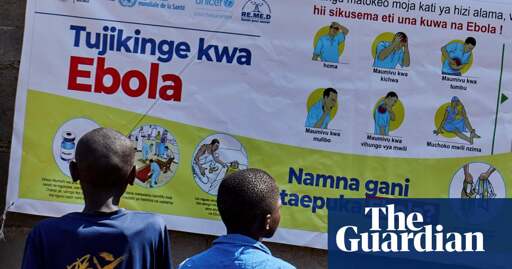
There is no cure and no vaccine for the rare Bundibugyo variant of Ebola, which has caused two outbreaks in recent decades. Health leaders and scientists are now racing to understand where the virus is spreading and attempting to stop it – but the US is notably absent in these efforts.
In the past year, the US Agency for International Development (USAID) has been dismantled, thousands of staff at US health agencies were laid off, communications stalled and key scientific research canceled.
There are 482 suspected cases and about 116 deaths reported since April in the Democratic Republic of the Congo (DRC), with two cases and one death in Uganda and potential spread to neighboring South Sudan. The outbreak “might have been going on for a few months”, said Kristian Andersen, a professor of immunology and microbiology at Scripps Research.
If the world ends it will be with a bang, but the bang will certainly only be the final confirmation of something that had started without anyone seeming to notice.
It’s not. However, by having lots of money (apparently) and therefore attracting many of the world’s best, it is the US’s responsibility to assist the world just as every other country does. Not only for protecting their own nation against the spread of worldwide dangers, but minimising the impact before it starts global strain.
But honestly, like everything, the US is no big loss. It’s always the other nations that solve these things anyway and all the best doctors are leaving to other nations—those shutdown in the programs obviously would’ve earlier. If things stay business as usual, the recipe will get published, and the US pharmaceuticals industry will pump out the final products for everyone because that’s the part of the process where the money is.