- cross-posted to:
- hackernews@lemmy.bestiver.se
- cross-posted to:
- hackernews@lemmy.bestiver.se
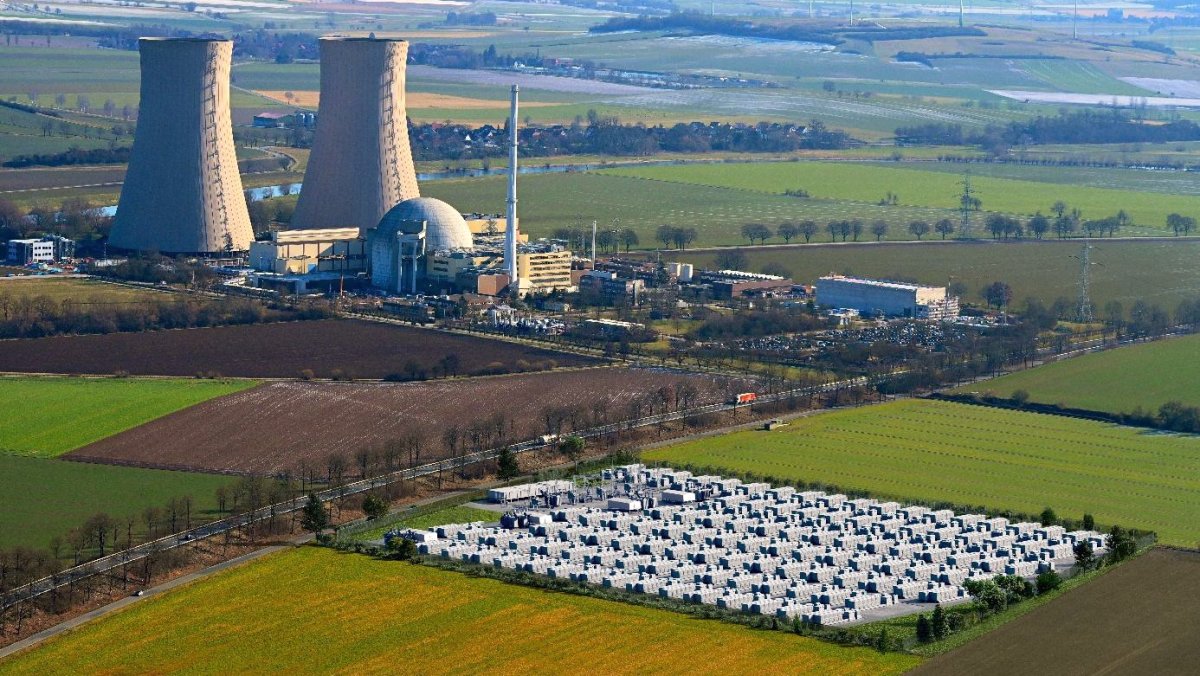
In 2021, the Grohnde nuclear power plant in Lower Saxony on the Weser River was shut down. Now, immediately next to it, the Emmerthal energy cluster is growing with three very large battery storage systems, ground-mounted photovoltaic systems, and a new substation for several 380-kilovolt high-voltage lines.
You must log in or # to comment.
This is good. Europe is becoming more independent from Russian uranium.
What is also important is decentralization. Russia has massively attacked infrastructure like power plants in Ukraine. For this reason, it is far better to have decentral storage, too.
Most European uranium comes from Canada and Kazakhstan. Russia is still third on the list though, with Australia shooting up for obvious reasons. That was 2024, I hope in 2025 they swapped places.
What would also be great: Solar power produces a surplus of energy on summer days, and summers are becoming hotter. One can use seasonal heat storage and bidirectinal heat pumps to cool buildings and store that heat, and use it to heat homes in the winter. Seasonal storage turned out to work well.
How would you store the heat/convert to electricity?
Just a large water tank with a thick layer of insulation. Could also be sand or even the ground which is used for some heat pumps.
Interesting, thank you for sharing
Hot sand stores a huge amount of heat, and the bigger the storage, the less heat it loses. With modern insulation, even the cheap options, it lasts months. Circulate water or some other fluid through pipes embedded in the sand, and you can introduce or extract the heat.
Personally, for long term storage, I’m more a fan of simple solutions because they scale better, such as using the excess electricity to pump water up a hill, then using generators in the winter to convert it back to electricity (pumped storage).
Unfortunately, the potential for pumped hydro storage is very small in Germany :/
Not sure if that’s a problem though, the German power grid is connected to many European countries including France, Switzerland and Austria.
I think the pumped storage is more used when there is an excess of electricty, for example when wind power plants produces large amount of electricity and the prices goes toward zero, or sometime negative.
Heat storage is much simpler and cheaper than electricity storage.
Both are needed, but storing electricity when all you need is heat is overkill, and unnecessary expensive.
Molten salt can also be used for heat storage. I’m not sure what the advantages are of molten salt vs water vs sand and what is most realistic.
I don’t think any of those alternatives are used in large scale.
As a side note, some ski resorts are saving snow during the summer to be able to open earlier in the season.
Grond! Grond! Grond!
Markt regelt! The market regulates itself. Please touch more of that you oh so mighty invisible Hand of the market!
You wish… I recently heard in Germany there was more than a full day worth of electricity usage applied for in battery storage but doesn’t get permitted. All the while the federal government pushes subsidised gas plants.
Regulation is killing the country. Not so much the regulation itself (as there’s a lot of good and necessary regulation), but the aquiration and approval processes can take forever - slowing down projects to a crawl.
Its a toxic mix of complexity and slowness, which costs a lot of money and repels investment.
Can the reuse the nuclear cooling towers to optimise those batteries?
No those are dismantled first because they are the most visible iconic thing that also outputs scary big white smoke! /s Nice idea but i really think those are gone first because they are the biggest virtue signal. Humans are weird.
Yeah people always seem to get hung up on pictures of coal fired plants with no smoke coming out of the stacks but heaps of steam coming out of the cooling towers. Not that coal generation should be defended in any way.
For these they totally wouldnt be wasting a huge amount of energy knocking down and hauling away two massive concrete towers. I wonder if anyone did the math on how long the batteries would need to be in operation to offset the carbon from that demolition.
That said, I have no idea if there’s even any way to utilise them, it’s a nice thought though.
They can quickly and easily be torn down by explosives (video). In fact, they are huge but not that massive.
And concrete can be re-used which saves carbon. With new technology (combination with
electric blast furnacessteel recycling), the cement can even be recycled, saving even more carbon. Which is huge, since it is a very important but extremely carbon-intensive material.The debris still needs to be hauled, crushed etc, you could push use renewable electricity to do most of it. Reuse insitu would be significantly less energy intensive than recycle, it’s higher up the hierarchy for a reason.
All the infrastructure is in place, it’s a great site.
It would also be a great site for some kind of power generation system, using a tiny amount of material to generate an enormous amount of power. Too bad such systems have recently become very unpopular in Germany.
Smugposting aside, nuclear is a heinously expensive thing to build, and from my understanding not a particularly cheap source of energy.
Its not super cheap to build, but it’s very cheap to run, and a lot more environmentally friendly than the several browncoal plants that Germany chose not to close when it shut down its nuclear plants.
You are wrong - nuclear is not cheap to run. It only used to be because the state limited the possible liability the companies faced in case of a malfunction and due to the fact that the nuclear waste costs were not part of the equation.
For Germany the price per kwh for a newly constructed nuclear plant would be around 45-63 ct/kwh - according to the power companies themselves. They aren’t interested in running these any more for a reason.
You are wrong - nuclear is not cheap to run. It only used to be because the state limited the possible liability the companies faced in case of a malfunction and due to the fact that the nuclear waste costs were not part of the equation.
So, exactly like the brown coal mines Germany keeps operating? Those don’t deal with the waste at all, simply pumping the CO2 into the air. They also don’t pay for the massive destruction caused by browncoal rooftop mining, or the immense opportunity costs of just having an immense hole in the ground.
But those still run, ruining the planet for everyone, while the nuclear plant “isn’t profitable”, because they actually do account for all the waste, and under incredibly strict requirements.
I’m not suggesting nuclear instead of solar/wind/battery, I’m suggesting nuclear instead of the second worst form of energy right after literally burning down rainforests for power.
So how do you explain France having such cheap electricity, mostly through nuclear power plants? https://www.sfeninenglish.org/nuclear-electricity-price-gap-france-germany-2026/ The issue is not the technology, it’s the implementation. Just like in the US, Germany overegulated the industry, causing prices to increase. France can do it safely and cheaply. What’s the excuse? I don’t get it.
Too bad such systems have recently become very unpopular in Germany.
They did become unpopular since such a system contaminated most of Europe in April 1986.
In that case this sadly applies:
with enormous amounts of power comes an enormous amount of waste…
…which sadly needs to be kept safe for several hundreds of thousands of years.
But hey, that is a problem of future generations, am I right?It’s not. The amount of waste is extremely small. The amount of power your household uses in 100 years results in roughly a 1 inch cube of spent fuel. Including heating, cooking and an electric car. There’s a frankly absurd amount of energy in uranium.
Yes, it will stay radioactive for a long time, but you know what’s the also radioactive? The uranium we dug up to make reactor fuel. We could literally grind up the spent fuel and mix with the mining debris and toss it back into the hole to end up with a less radioactive area now, except that flies in the face of every method of dealing with hazardous materials.
The idea that nuclear power leaves “super dangerous waste forever” is basically just fossil fuel propaganda. We know perfectly well how to deal with it…
Source: I do hazardous materials handling regulations for a living, am also PhD chemist. Ama, i guess.
The amount of highly dangerous waste (e.g. fuel rods) may be small, but, well, it’s highly dangerous and not only because of the immediate danger from radiation, but because it can be weaponized.
I agree and understand that converting mass to energy makes absurd amounts of energy available.
Aren’t especially the fuel rods more dangerous than the uranium, that has been dug from the earth, because it’s a mix of radionuclides with in parts complex decay chains?
Doesn’t almost all uranium that has been dug up (according to wikipedia 99.3%) have a half-life of 4.463×10⁹ years (before being used as fuel rod)?
Which made the level of radiation smaller than for radionuclides with shorter half-life that are in the used fuel rods, right?The propaganda from fossil against the dangers of radiation doesn’t work well as long as especially coal plants emit vast amounts of dangerous radionuclides through their chimneys.
To be fair I could stomach continuing to use nuclear plants for some more time until the transformation to way more renawables and storage for electric energy has come a longer way.
After all it’s no big difference, if you add some more nuclear waste to the already quite big pile.
I’d be adamant if we were talking about starting the first nuclear reactor ever, though.
Building new nuclear reactors now seems like the wrong way given how dirt-cheap solar has become.This is exactly my point.
If you line up all the fossil fuel powerplants, then nuclear should be the very last one to be closed in favour of renewables, and lignite is in the top 3.
Germany did the reverse, and even built more gas plants when the first phaseout of nuclear happened.
Apparently lobbying is running deep in Germany…
We’ll get to a cleaner world - hopefully, eventually.
I get what you are saying, but there are some subtleties that make it seem a bit out or context.
-
Battery storage plants and power plants do not serve the same purpose. One is to generate electricity, the other is used to buffer and stabilize the net. They have to be used together.
-
Solar and wind are cheaper to build/run and also way more decentralized than a nuclear plant. Plus a nuclear power plant takes 1-2 decades to complete and should therefore be seen as a long term benefit, it’s not a solution for the short term electricity problems Europe is facing.
-
Nuclear hasn’t recently become unpopular in Germany. It was unpopular in the '80s and '90s, particularity after the Chernobyl accident. The decision to phase out nuclear was taken around the turn of the century. That’s 25 years ago. Nowadays people have a more positive outlook on nuclear but it still has to make sense from an economic point of view before companies want to invest.
Battery storage plants and power plants do not serve the same purpose. One is to generate electricity, the other is used to buffer and stabilize the net. They have to be used together.
And yet, they closed one down.
Solar and wind are cheaper to build/run and also way more decentralized than a nuclear plant.
As long as you don’t mind occasionally not having power during winter nights. You need an insane overcapacity in both prodiction and storage if you want to get rid of all baseload generation. It’ll take decades to build, we don’t have that yet. Shutting down plants now is very premature.
Plus a nuclear power plant takes 1-2 decades to complete and should therefore be seen as a long term benefit, it’s not a solution for the short term electricity problems Europe is facing.
This plant was literally already there. Not shutting it down took zero construction years.
I’m also not saying “don’t build solar”, I’m saying "shut down browncoal rooftop mining, keep nuclear open.
-