
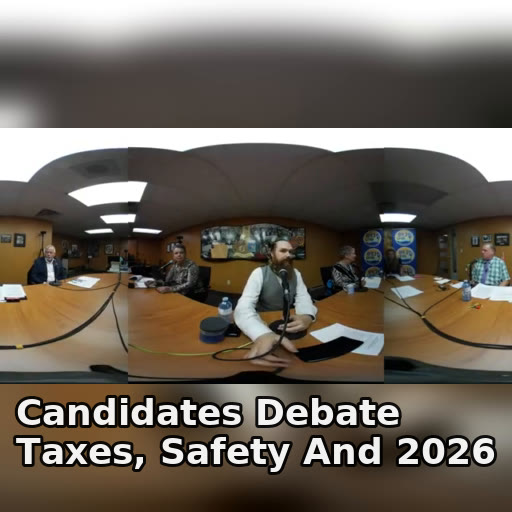
Livestream recap for Candidates Debate Homelessness Safety Taxes And Growth In 2026 Mayoral Race - Council - October 13, 2026 on October 13, 2026.
Watch the 360° event footage used for this transcript.
One-Sentence Summary
Whole Stream Summary
Five mayoral candidates presented distinct motivations ranging from addressing the drug pandemic to restoring civic pride and leveraging decades of experience. Regarding fiscal strategy and growth, proposals included lowering taxes via cost reductions and tourism revenue, regionalizing services to combat bloat, though one candidate insisted that resolving crime and homelessness must precede any expansion plans. Disagreements also emerged on maintaining municipal services without tax hikes, where candidates debated between exponential growth through zoning amendments, targeted development charges, preventative infrastructure maintenance, and a fundamental review of necessary service levels versus cuts.
Most Newsworthy Items
Recurring solutions below are counted by distinct verified questions; repeated follow-ups within one question count once.
- Ray Botten: Lobby for Ontario government subsidy on water bills (2 distinct questions); Opt out of Grey County to retain property taxes (2 distinct questions).
- Jodi King: Affordable housing incentives and tax breaks (4 distinct questions); Intergovernmental grants for infrastructure and businesses (2 distinct questions).
- Carol Merton: Affordable housing first policy (3 distinct questions); Regionalizing services to save money (2 distinct questions).
- Richard Thomas: Targeted development charge incentives (4 distinct questions); Transforming tourism into an economic business (2 distinct questions).
- Andrii Zvorygin: Vacant home tax (4 distinct questions); Lowering property taxes through better government (3 distinct questions).
Candidate Response Comparison
The following tables summarize each candidate’s verified response to each question. Repeated follow-ups within one question are combined in that candidate’s cell.
1. Why are you running for mayor
| Candidate | Response summary |
|---|---|
| Ray Botten | Ray Botten states his mission is to address the drug pandemic in Owen Sound and save lives, emphasizing a supportive role for empowering youth to meet personal goals. |
| Jodi King | Jodi King explains she is running because she has seen Owen Sound decline and fears among residents, aiming to unite the community and address homelessness first. |
| Carol Merton | Carol Merton runs to restore civic pride and create a safe, affordable, and welcoming city where seniors and families feel secure, leveraging her experience as a counselor. |
| Richard Thomas | Richard Thomas challenges the notion that nothing happens in Owen Sound, citing his history there and his desire to leave the city better than he found it as his reason for running. |
| Andrii Zvorygin | Andrii Zvorygin runs to provide safer streets, affordable homes, and a real voice for families, outlining plans for budget reduction, vacant home taxes, and community safety improvements. |
2. Relevant experience for the mayoral role
| Candidate | Response summary |
|---|---|
| Ray Botten | Ray Botten shares his background as a certified Red Seal chef who served Ronald Reagan, his missionary work in Nigeria, and his commitment to serving the Owen Sound community rather than telling people what to do. |
| Jodi King | Jodi King draws on her 12 years as a retired security guard dealing with difficult situations and her work in various industries to argue she can help unite the community and address issues like those in Old Town. |
| Carol Merton | Carol Merton highlights her senior leadership roles in public and private sectors, experience with multi-million dollar budgets, union negotiations, and service on various task forces to show she can bring a business mind and network to the mayoral role. |
| Richard Thomas | Richard Thomas cites his 40 years in Owen Sound, including covering city council as a reporter, serving on the library board for 24 years, and holding roles as a city councillor and committee chair to demonstrate his municipal leadership experience. |
| Andrii Zvorygin | Andrii Zvorygin outlines three areas of experience—public work, business ownership, and financial management—as a foundation for connecting costs, responsibility, and results in city hall decisions. |
3. Homelessness Support and Downtown Safety
| Candidate | Response summary |
|---|---|
| Ray Botten | He emphasizes listening to grieving individuals on the street, supporting leadership, and fighting for compassion over rules as he runs for mayor to address those dying or struggling daily. In his follow-up, he argues that forced rules cannot change hearts and that street-level compassion is essential to addressing the human element of homelessness. |
| Jodi King | Drawing on her personal experience of homelessness, she advocates for affordable housing incentives, tax breaks for landlords, and rezoning to reduce rental costs below the high rates families previously paid. |
| Carol Merton | She frames homelessness as a crisis requiring immediate action like public washroom access, syringe drop-off boxes, sanitation improvements, and affordable housing first rather than waiting for future enforcement protocols. She expands her stance to a whole-city approach, noting encampments exist everywhere and that addicted individuals live in homes as well as without roofs, requiring comprehensive strategies. |
| Richard Thomas | He outlines a ten-point plan including a River District action team, rapid cleanup standards, and extending the neighbourhood response team to balance business security with compassion for vulnerable people. |
| Andrii Zvorygin | He proposes mobile meals on city outskirts, shared equipment for cleaning common spaces, civilian dispatch pilots to route lower-risk calls, and neighbourhood watches to support residents and reduce police involvement. |
4. Current Tax Rate View
| Candidate | Response summary |
|---|---|
| Ray Botten | The candidate notes that while everything is higher, taxes are in step with the overall budget because the city cannot sustain itself without the money. He expresses specific anger about water bills being paid by residents rather than the Ontario government and calls for lobbying to subsidize these costs. The candidate announces a plan to give back $1,200 a year to property owners and mentions discussing opting out of Grey County as part of his strategy. |
| Jodi King | The candidate calls for more transparency regarding where tax money is going and agrees that many people are struggling. She proposes offering a tax break to residents so they can afford groceries and fuel. |
| Carol Merton | The candidate argues that residential taxes are far too high and causing residents to leave the city. She proposes determining core essential services versus nice-to-have items, adding revenue through tourism and institutional links, and regionalizing services with other municipalities to save money. The candidate expresses concern that the new budget committee will have no public membership and states she voted against this structure. She pledges to bring public representation back to the table if elected mayor. |
| Richard Thomas | The candidate acknowledges that taxes are high but advocates for growth rather than service cuts. He cites his past introduction of a development charge holiday and the municipal accommodation tax as creative approaches to encourage growth and bring revenue into the city. The candidate agrees with Carol Merton on the need for public representation in budget discussions. He promises to transform the mayor’s budget process back into a public-facing model where the public and council thoroughly vet the budget before adoption. |
| Andrii Zvorygin | The candidate states that Owen Sound’s tax burden is too high relative to local incomes and proposes lowering taxes through better government, simpler software, and clearer workflows. He outlines a plan to publish financial records, review costs with residents, and create a savings ledger to ensure taxes match the clear value of services. In a follow-up, the candidate reiterates that he is the only one with a fully costed plan to lower taxes and improve services, pointing residents to his website for details. |
5. Plan to Achieve Population Growth
| Candidate | Response summary |
|---|---|
| Ray Botten | Botten highlights the upcoming nine-billion-dollar water storage facility in Meaford as a catalyst for growth and regional leadership. He advocates for Owen Sound to opt out of Grey County to retain property taxes, aiming to merge with Meaford to become a unified city. In a follow-up, Botten emphasizes that building is necessary to attract people and invests in the community rather than relying on developers who pass costs to taxpayers. He argues that without significant growth, the city will not progress. |
| Jodi King | King states that the city cannot grow unless it first addresses homelessness and crime in Owen Sound. She proposes offering incentives like lower rates or grants for new builds to attract professionals like doctors and improve housing affordability. |
| Carol Merton | Merton acknowledges confusing data on growth but argues for aggressively targeting economic opportunities like tourism and clean energy. She proposes linking with Georgian College for skills training and building deeply affordable housing to attract essential workers. Merton mentions additional municipal tools not yet addressed, specifically citing the recent use of building permit fee forgiveness to help nonprofit housing projects reach completion. She also suggests exploring community bonds and land trusts for local housing. |
| Richard Thomas | Thomas urges stopping the wait for growth and actively pursuing it through targeted development charge incentives and restoring a dedicated economic development function. He proposes transforming the tourism department into an economic business to capitalize on regional possibilities. |
| Andrii Zvorygin | Zvorygin outlines a plan starting with economic growth to improve quality of life and local jobs. He proposes working with regional partners on services and tourism, clarifying permit costs for staff, and publishing recurring purchases to support local suppliers. Zvorygin notes that development charge forgiveness has not been effective and cites the high cost of Harbor West homes as unaffordable for most residents. He reiterates the need to pursue economic growth while caring for actual local residents. |
6. Maintain services without tax increases
| Candidate | Response summary |
|---|---|
| Ray Botten | Advocates amending zoning bylaws to support housing supply and argues that exponential growth is necessary to fund infrastructure without raising taxes, warning that incremental changes are insufficient for future generations. |
| Jodi King | Agrees with Richard Thomas on the need for growth and cleaning up downtown, shares a personal anecdote about losing snow removal contracts due to poor conditions, and calls for intergovernmental grants to attract new infrastructure and businesses. Proposes maintaining existing assets through preventative maintenance and clear priorities, citing an asset management plan showing needs exceed current funding, and suggests tools like sewer separation and public reporting to manage costs and extend infrastructure life. |
| Carol Merton | Challenges the premise of ‘maintaining’ services in a housing and affordability crisis, proposing a review of essential services, economies of scale, regional opportunities for waste management and road resurfacing, and sharing resources to improve operational efficiency. |
| Richard Thomas | States that growth via targeted development charges and incentives is the only solution, emphasizing the need to clean up the downtown river district to improve curbside appeal and attract new businesses and industries. |
| Andrii Zvorygin | Andrii Zvorygin proposes maintaining reliable services by prioritizing repairs based on resident input, implementing preventative measures like early wastewater screening, and matching road surfaces to traffic needs while publishing asset data to ensure transparency. He argues that these strategies will extend infrastructure life and manage costs without requiring tax increases. |
7. Revisiting OPP Costing Process
| Candidate | Response summary |
|---|---|
| Ray Botten | Ray Botten advocates for revisiting the issue due to officer burnout and staffing shortages, praising Carol Merton’s board service, and later clarifying a point about recruiting one new officer after an interruption. |
| Jodi King | Jodi King supports revisiting the process, arguing that an OPP switch could save millions for community use while providing unbiased officers to address specific issues like drug trafficking, despite her praise for current police performance. |
| Carol Merton | Carol Merton advises caution before seeking OPP costing, emphasizing the need to fully understand the current budgeting process and revenue-generating activities unique to municipal police that are not offered by the OPP. |
| Richard Thomas | Richard Thomas opposes revisiting the OPP costing process, citing that previous figures underestimated costs which would exceed current city police expenses, and highlighting the high financial burden of closing the municipal headquarters and building a new OPP station. |
| Andrii Zvorygin | Andrii Zvorygin is open to reviewing the OPP option to address resident concerns about crime and response times, proposing a civilian pilot programme for lower-risk calls and committing to an official costing if needed to ensure factual decision-making. |
8. Municipal Actions for Housing Supply
| Candidate | Response summary |
|---|---|
| Ray Botten | Emphasizes the need for growth and economic stimulus projects to create jobs and entrepreneurial advances as a solution to housing supply challenges. Shares personal experience managing a homeless shelter with faith groups without government funding as an example of community-driven solutions. |
| Jodi King | Enforces legally binding affordable housing commitments on developers to prevent them from backing out after receiving incentives like zoning variances and tax breaks. |
| Carol Merton | Links housing to economic development, advocates for an ‘affordable housing first’ policy prioritizing deeply affordable units in new builds, and suggests using municipal surplus lands with nonprofit partners. Advocates for defining and setting specific targets for deeply affordable housing based on median income to guide development efforts. |
| Richard Thomas | Suggests replicating Saugeen Shores’ partnership model with local developers and nonprofits, donating municipal land, and using development charge incentives to reward affordable unit inclusion. |
| Andrii Zvorygin | Proposes a vacant home tax, building fee deferrals tied to affordable unit delivery, repurposing surplus sites for housing, and a ‘home with land’ pathway to increase supply. Follows up by detailing a specific affordable home design costing between eighty and ninety thousand dollars with a monthly mortgage around four hundred dollars that meets building code. |
9. Gaps in Municipal Service Provision
| Candidate | Response summary |
|---|---|
| Ray Botten | Sharing his personal experience as an amputee and wheelchair user facing transportation barriers despite legal protections, he highlights the issue of being considered a liability by taxi services and pledges to change this situation regardless of whether he is elected mayor. In a follow-up, he expresses gratitude for the existing mobility service but warns that without changes to taxi policies regarding liability and AODA compliance, he will be forced to take an ambulance or face legal action against the city. |
| Jodi King | She agrees that transit is the primary gap affecting people with mobility issues and requests that the city accommodate at least one wheelchair-accessible bus and extend operating hours to better serve workers and visitors. Jodi King addresses gaps in municipal service provision by proposing specific measures to improve infrastructure and resource allocation while acknowledging the need for community input on implementation strategies. She discusses rideshare standardization at the provincial level and the need for accessibility inclusion, then transitions to announcing a break and providing details about the upcoming radio broadcast. |
| Carol Merton | Identifying transit as the significant gap due to city growth and high renter populations, she calls for expanded affordability passes, synchronized traffic lights, a working group of residents to solve issues, and reviewing contracts before signing to ensure service adequacy. |
| Richard Thomas | He notes that while car owners worry less about transit, those without cars face significant issues with the current inefficient service. He suggests combining city transit with subsidized rideshare options to provide door-to-door service during off-hours. |
| Andrii Zvorygin | The candidate proposes keeping at-large elections while allowing each councillor to serve a ward they choose, arguing that local representatives connected to specific neighborhoods can better organise community tasks and help residents connect with city services. He directs listeners to a fully costed four-year transit plan on his website that includes evening and Sunday service, as well as mobility transit and rideshare options. |
10. Addressing Cost of Living Concerns
| Candidate | Response summary |
|---|---|
| Ray Botten | Ray Botten argues the municipality lacks a mandate for cost of living help but suggests capitalizing on water storage facilities, restructuring zoning to attract residents and jobs, and maintaining recreation services like Harrison Park campground. |
| Jodi King | Jodi King identifies the cost of living question as an extra item to be answered at the end of the round and confirms she will address it. Jodi King focuses on affordable housing, suggesting incentives and grants for development below Harborfront unit costs, tax breaks for landlords offering below-average rental units, and rezoning to accommodate suitable builds. |
| Carol Merton | Carol Merton proposes reconsidering bag tag costs, implementing family transit rates with free fares for young children, linking worker rates to local institutions, stabilizing water rates, expanding community improvement plans, supporting nonprofits, and seeking increased social assistance rates. |
| Richard Thomas | Richard Thomas agrees that growth is the key to solving cost of living issues, notes that eliminating bag tags would require finding other budget funds or raising taxes, and proposes restoring an economic development function and transforming tourism into a business to bring in investment and jobs. |
| Andrii Zvorygin | Andrii Zvorygin addresses taxes, housing, and daily services. He proposes reviewing software for lower costs, a vacant home tax to increase supply, affordable rural communities with resident-owned homes, and a pilot programme for free meal delivery to struggling seniors. |
11. Number One Issue Facing Owen Sound
| Candidate | Response summary |
|---|---|
| Ray Botten | Identifies the drug pandemic as the primary issue, attributing it to Chinese triad gangs and emphasizing that God’s love is the solution needed to support broken individuals. |
| Jodi King | Agrees with the focus on downtown safety, citing specific violent crimes against women in the core, and proposes increased police presence and additional cameras to deter drug trafficking. |
| Carol Merton | Identifies homelessness, addictions, mental illness, cleanliness, and safety as issues causing a loss of civic pride; calls for bridging the gap between City Hall and social services, providing more funding, and outlines a fully costed downtown plan with civilian outreach and patrols. |
| Richard Thomas | States that problems in the downtown river district are the number one issue, arguing that solving them is a prerequisite for economic development and safety, citing residents’ fear and his proposed ten-point plan. |
| Andrii Zvorygin | Acknowledges downtown issues but argues affordability is the top issue connecting taxes, housing, and downtown life; proposes lowering property taxes and supporting affordable construction to help seniors and businesses. |
12. Effective Decision Maker for Owen Sound
| Candidate | Response summary |
|---|---|
| Ray Botten | Ray Botten attributes his decision-making ability to following his heart before God, sharing stories of building bridges in war-torn areas and corruption-ridden places, and concludes with a scripture about hope and a future. |
| Jodi King | Jodi King emphasizes her lifelong connection to Owen Sound and her background in working-class jobs. She highlights her compassion for all citizens, including the homeless, her approachability, and her ability to listen and bring good ideas together for solid solutions. |
| Carol Merton | Carol Merton describes herself as goal-driven with a track record of quick resolution and strong networks, advocating for high-performance teams and value for money to make decisions quickly. |
| Richard Thomas | Richard Thomas states his fifty-year career has been focused on leadership and listening to residents. He notes that while the mayor is a figurehead with limited voting power, their true influence comes through leadership, which he claims to excel at. |
| Andrii Zvorygin | Andrii Zvorygin outlines a decision-making process based on three questions: effectiveness, evidence, and resident perception. He details his experience in council and business to connect concerns with costs, proposing open forums and public ledgers to ensure transparency and accountability. |
Chapters
- 00:00 Owen Sound Mayoral Candidate Discussion
- 00:00:48 Why are you running for mayor
- 00:07:38 Relevant experience for the mayoral role
- 00:15:51 Homelessness Support and Downtown Safety
- 00:28:44 Current Tax Rate in Owen Sound
- 00:38:06 Population Growth Plans
- 00:47:23 Maintaining Services Without Tax Increases
- 00:58:12 Revisiting OPP Costing Process
- 01:16:10 Municipal service gaps and neighbourhood concerns
- 01:29:10 Cost of Living Solutions
- 01:36:38 Number one issue facing Owen Sound
- 01:44:55 Effective decision maker for Owen Sound
Transcript: Read the full transcript
Official livestream: https://www.youtube.com/watch?v=Dw-2NvWmDQ