In a nutshell, you can’t directly replace gas power with electric power. Gotta have some sort of conversion. Gas is very portable and offers big bang. Solar generally needs to be generated on demand or stored. Then it needs to be transported. We can’t transport the solar power from Texas to Michigan the same way we can truck gas across state lines. The longer an electric line, the more power is lost.
Another issue with this graphic is that it implies that solar panels are a one-time expense. This isn’t true. They generally last about 20 years.
I’m a champion of green energy, but a stickler for details.
Solar panels are easily recyclable as are a lot of batteries once infrastructure catches up. You burn that gas and its gone.
Millions of acres are used for corn to produce ethanol mixes for gas. All of this land is under direct sun. Also wind. This again is because of corn subsidies in the US.
The amount of money tied up in oil companies is second only to the military industrial complex. If we took that money to put toward renewable, we would solve a shit ton of issues.
Yes voltage drop exists. However , you know we have electrical lines to basically every structure in the US right? Even Joe blow in the absolute middle of nowhere has power lines. The grid is already here. We need to invest in it and improve it (also destroy data centers but thats a different discussion)
Also, panels dont just abruptly die after 20 years. They slowly start losing efficiency. You could be using a 30 year old panel, and it could be at 70% efficiency depending on degradation (*I can’t say if 70% is accurate , I’d have to research it). Again, gas is burned up and used instantly, one time. Panel gets old, recycle it.
But we don’t do things because they’re good. We do them because they’re profitable. Capitalism breeds innovation right?
What’s the source on this? To my knowledge they’re like most e-waste: technically recyclable but separating the component elements is functionally impossible
separating the component elements is functionally impossible
No, it’s actually easy to pull apart the different components of a panel and can be done by hand. The main expense is the labour.
The labor cost is the problem - it costs $10 to $20 (AU) to recycle a panel, but the value of the parts vary based on the cost of copper, silver and aluminium and so capitalism struggles to make a consistent profit on it. Hopefully as the oil crisis worsens, transport costs will probably go up and the profitablity of recycling should increase.
Also this is goofy. Panels aren’t centralized. You could have tons of panels and wind in Michigan. You wouldn’t transmit Texas power that far unless you really had to, and there’s still ways to do it if you needed
It wouldn’t be done because the energy density of a battery is atrocious compared to oil, something like 100x worse. Half of the input spent in burning oil comes for free in the air around us, so batteries will never likely beat it.
Why be just as bad as the old system? And while I’m not sure, I would expect it would be hugely more inefficient in terms of energy produced compared to energy delivered to the end user.
Michigan is cloudy or overcast most of the winter. It’s a lake-effect thing, it starts once you get over the border from Indiana. Why use panels 4 or 5 months out of the year?
I had Google help me out with this one. For illustrative purposes, let’s take the Tesla Semi (an electric commercial truck) battery. You could transport about 4 MWh worth of electricity. That’s about 4 months worth of electricity for an average American household. Here’s the details:
A single Tesla Semi utilizes an estimated 850 kWh to 1,000 kWh battery pack, which weighs approximately 10,000 to 12,000 lbs. If a trailer were filled strictly with these large, fully integrated packs rather than smaller, individual battery cells, only about 4 to 6 of these high-capacity, 1-megawatt-hour systems could physically fit within the weight limits of a standard trailer.
Battery Capacity & Weight: The Semi uses roughly 1 MWh, which consists of four, high-capacity, smaller packs.
Total Weight: A full 1 MWh pack weighs between 10,000 lbs (4,570 kg) and 12,000 lbs.
Capacity Limit: Due to weight restrictions of 80,000 lbs for a loaded semi (with a 2,000 lb increase for EVs), you cannot simply load 80,000 lbs of batteries into a trailer.
Physical Space: While the trailer has massive volume, the 10,000+ lb per pack weight means the trailer would reach its weight limit long before it is full of, say, Model S packs (if that was the method).
Then use the next $100M for developing energy storage infrastructure… Or split the upfront cost evenly between generation/storage. Gotta think longer term than a single years’s balance sheet. Anything you build now saves you money in the future instead of shoveling it into a literal incinerator.
Thank you for the sanity. Transmission and distribution loss is a problem, as well as sending power doesn’t even work like that. You can’t tell power where to go in a grid, you just put power in to the system. Trying to shuffle power from the Texas grid across a couple subregions to MI would be bonkers. It would be easier to operate 200 SMRs in MI.
If you’re interested, modern HVDC transmission is really efficient on long distances. “HVDC transmission losses are quoted at 3.5% per 1,000 km (620 mi)” (Wikipedia)
The basic statement is that $100m is spent once and is gone or it is spent on a recurring resource. Seems to clear, all the arguments about the evils of solar panels are ignoring that the bill is$100m or $20,000m over 20 years. For a $20b saving, people should be able to afford a few changes. I have.
One of the more interesting things I’ve learned is that the reason why electricity is so cheap at night is because it’s hard to properly throttle fossil fuel plants.
Wrong details though. You sound like you WANT to be dependent on fossil fuels. And calling yourself a “champion of green energy” reveals quite a lot. 🤷


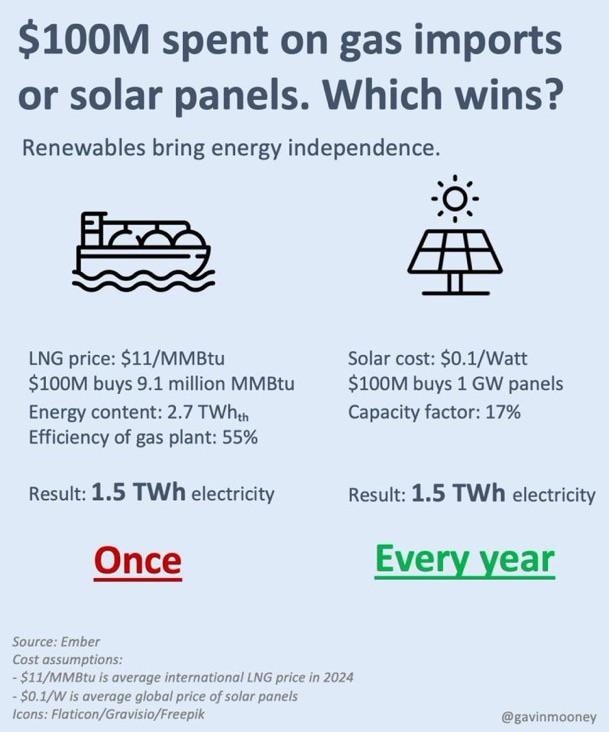
Not a fair comparison.
In a nutshell, you can’t directly replace gas power with electric power. Gotta have some sort of conversion. Gas is very portable and offers big bang. Solar generally needs to be generated on demand or stored. Then it needs to be transported. We can’t transport the solar power from Texas to Michigan the same way we can truck gas across state lines. The longer an electric line, the more power is lost.
Another issue with this graphic is that it implies that solar panels are a one-time expense. This isn’t true. They generally last about 20 years.
I’m a champion of green energy, but a stickler for details.
Then as a stickler you should probably clarify that 20yrs isn’t the lifespan of a panel but the simply the end of most warranty periods.
The panel itself is (typically) fine, just less efficient after so long.
Solar panels are easily recyclable as are a lot of batteries once infrastructure catches up. You burn that gas and its gone.
Millions of acres are used for corn to produce ethanol mixes for gas. All of this land is under direct sun. Also wind. This again is because of corn subsidies in the US.
The amount of money tied up in oil companies is second only to the military industrial complex. If we took that money to put toward renewable, we would solve a shit ton of issues.
Yes voltage drop exists. However , you know we have electrical lines to basically every structure in the US right? Even Joe blow in the absolute middle of nowhere has power lines. The grid is already here. We need to invest in it and improve it (also destroy data centers but thats a different discussion)
Also, panels dont just abruptly die after 20 years. They slowly start losing efficiency. You could be using a 30 year old panel, and it could be at 70% efficiency depending on degradation (*I can’t say if 70% is accurate , I’d have to research it). Again, gas is burned up and used instantly, one time. Panel gets old, recycle it.
But we don’t do things because they’re good. We do them because they’re profitable. Capitalism breeds innovation right?
What’s the source on this? To my knowledge they’re like most e-waste: technically recyclable but separating the component elements is functionally impossible
Most of the mass is aluminum for the frame. Then you have the actual silicon, which are paper thin wafers. And a voltage controller.
Also, its moot anyway, because that gas and oil is burned up the second its used. If we even recycle the frame of the panels only, net win.
No, it’s actually easy to pull apart the different components of a panel and can be done by hand. The main expense is the labour.
The labor cost is the problem - it costs $10 to $20 (AU) to recycle a panel, but the value of the parts vary based on the cost of copper, silver and aluminium and so capitalism struggles to make a consistent profit on it. Hopefully as the oil crisis worsens, transport costs will probably go up and the profitablity of recycling should increase.
PS: The relevant technology connections video
The beauty of solar though is its pretty deployable to where the demand is, especially rooftop solar with residential batteries.
Batteries?
Also this is goofy. Panels aren’t centralized. You could have tons of panels and wind in Michigan. You wouldn’t transmit Texas power that far unless you really had to, and there’s still ways to do it if you needed
deleted by creator
So, driving batteries around the country? Really?
I mean no, because it probably wouldn’t ever need to be done.
But I’m not sure why it would be any worse than trucks full of oil.
It wouldn’t be done because the energy density of a battery is atrocious compared to oil, something like 100x worse. Half of the input spent in burning oil comes for free in the air around us, so batteries will never likely beat it.
As the parent commenter said, the energy itself wouldn’t need to be delivered. You just deliver the panels once.
Why be just as bad as the old system? And while I’m not sure, I would expect it would be hugely more inefficient in terms of energy produced compared to energy delivered to the end user.
Bud, we drive gas around the country. Thats even stupider.
Lot of propaganda from oil companies is working, I see.
Yeah, I know. That’s why driving electrons around the country isn’t any better.
You don’t need to drive electrons around constantly - just drive the panels there once and you have power there for 20 years.
Michigan is cloudy or overcast most of the winter. It’s a lake-effect thing, it starts once you get over the border from Indiana. Why use panels 4 or 5 months out of the year?
I had Google help me out with this one. For illustrative purposes, let’s take the Tesla Semi (an electric commercial truck) battery. You could transport about 4 MWh worth of electricity. That’s about 4 months worth of electricity for an average American household. Here’s the details:
A single Tesla Semi utilizes an estimated 850 kWh to 1,000 kWh battery pack, which weighs approximately 10,000 to 12,000 lbs. If a trailer were filled strictly with these large, fully integrated packs rather than smaller, individual battery cells, only about 4 to 6 of these high-capacity, 1-megawatt-hour systems could physically fit within the weight limits of a standard trailer.
Battery Capacity & Weight: The Semi uses roughly 1 MWh, which consists of four, high-capacity, smaller packs.
Total Weight: A full 1 MWh pack weighs between 10,000 lbs (4,570 kg) and 12,000 lbs.
Capacity Limit: Due to weight restrictions of 80,000 lbs for a loaded semi (with a 2,000 lb increase for EVs), you cannot simply load 80,000 lbs of batteries into a trailer.
Physical Space: While the trailer has massive volume, the 10,000+ lb per pack weight means the trailer would reach its weight limit long before it is full of, say, Model S packs (if that was the method).
Now compare that to high voltage power lines if you’re interested. “HVDC transmission losses are quoted at 3.5% per 1,000 km (620 mi)” (Wikipedia)
Then use the next $100M for developing energy storage infrastructure… Or split the upfront cost evenly between generation/storage. Gotta think longer term than a single years’s balance sheet. Anything you build now saves you money in the future instead of shoveling it into a literal incinerator.
Woah there you socialist, we only care about next quarter profits here !
/s
Thank you for the sanity. Transmission and distribution loss is a problem, as well as sending power doesn’t even work like that. You can’t tell power where to go in a grid, you just put power in to the system. Trying to shuffle power from the Texas grid across a couple subregions to MI would be bonkers. It would be easier to operate 200 SMRs in MI.
If you’re interested, modern HVDC transmission is really efficient on long distances. “HVDC transmission losses are quoted at 3.5% per 1,000 km (620 mi)” (Wikipedia)
The basic statement is that $100m is spent once and is gone or it is spent on a recurring resource. Seems to clear, all the arguments about the evils of solar panels are ignoring that the bill is$100m or $20,000m over 20 years. For a $20b saving, people should be able to afford a few changes. I have.
One of the more interesting things I’ve learned is that the reason why electricity is so cheap at night is because it’s hard to properly throttle fossil fuel plants.
Depends on the type. Coal takes hours to ramp up to temperature but combined-cycle gas turbines ramp up and down in minutes.
Wrong details though. You sound like you WANT to be dependent on fossil fuels. And calling yourself a “champion of green energy” reveals quite a lot. 🤷