slate.com There Is No Male Loneliness Crisis. What’s Actually Happening Is So Much Darker. Nick Keppler 25–32 minutes
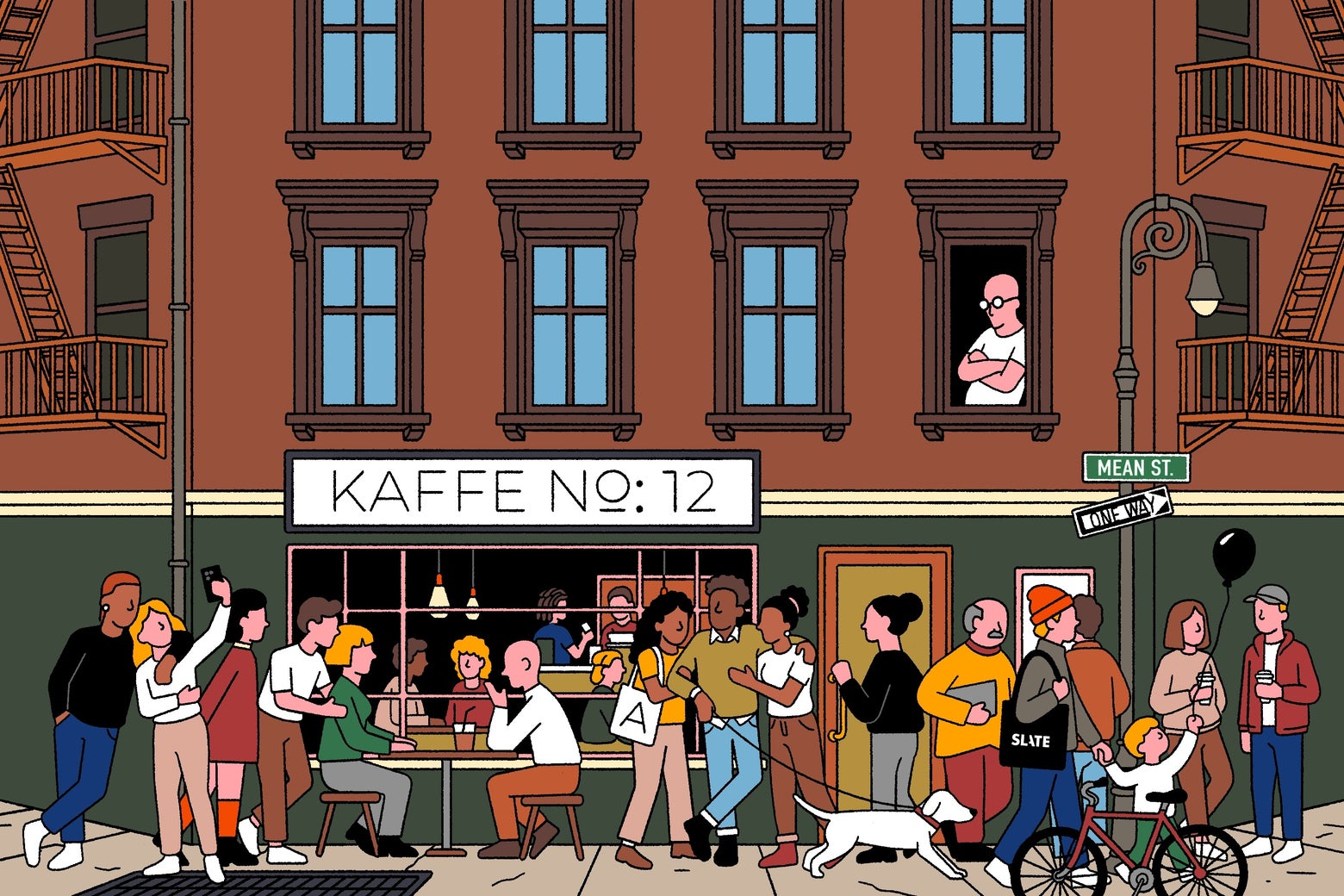
Illustration of people hanging out with friends in a city, outside a cafe. Life America’s Loneliness Trap One group of people is more isolated than anyone else. It’s not men.
Aug 13, 20265:40 AM
Men are lonely, you’ve probably heard. “Few men will admit it, but it’s true of most of them,” declared Los Angeles Times columnist Jean Guerrero in one in a tsunami of recent takes on the “male loneliness epidemic.” Guerrero partially blamed the “virtual world” and its “pornography and ideological provocation.”
This discourse often faults men—or at least masculinity—for our empty social calendars. A Guardian columnist theorized, “Many men are socialized to prioritize strength, independence and stoicism, making it difficult for them to open up and form emotional connections.” An Atlantic writer agreed, writing, “Friendships are hard to maintain … but the social stigma that some men face when opening up and being vulnerable can make things even harder.” A “punk-rock psychologist” told Vice that men have low emotional intelligence.
BuzzFeed has cranked out 12 posts about male loneliness in 2026 alone (so far, at least). Some of them are pretty brutal—for example, “27 Loser Men Whose Actions Single-Handedly Prove the ‘Male Loneliness Epidemic’ Is Self-Inflicted.”
The inability of men to form friendships, or even make conversation, with each other is a ready setup for a Saturday Night Live bit. In one viral sketch, exhausted women take their male partners to a “man park,” where they grunt about sports and Marvel movies. A sketch from April also featured a group of men, sequestered together while their wives have gal time, struggling to move past monosyllables. A mention of “the male loneliness epidemic” was even slipped into a recent cold opening skewering the problem drinkers of Trumpworld. The Daily Show ran two segments about male loneliness over the past few months, one of which culminated in Leslie Jones ranting, “So many of these problems could be overcome if men would just go to therapy.”
I could go on and on. As assembled in the popular imagination, the image of lonely men—evidently, most men—is emotionally repressed, excruciatingly awkward, and freaked out by intimacy outside a romantic relationship (and maybe even within one); overall, they’re a drag on others and susceptible to dangerous influences.
Do such men exist? Perhaps. But the truth is, in aggregate, men are not much lonelier than women. Recent large polls from Pew Research and the Harvard Graduate School of Education found no significant gender gap in self-reported feelings of loneliness. In a KFF survey, more women (18 percent) than men (13 percent) said they always or often feel lonely. In the 2021 American Perspectives Survey, 15 percent of men said they have no close friends, versus 10 percent of women, but when Pew pollsters asked the same question more recently, they found no substantial gender disparity. In the latest American Time Use Survey, the average man spent about five and a half hours per day alone and the average woman about five hours and 20 minutes. Differences in time spent with friends and family were also puny.
Loneliness has, overall, crept up to alarming levels in the U.S. These same studies show that Americans have fewer close friends and spend more time alone than in decades past. Since 1990, the total population who said they do not have a single close friend quadrupled, from 3 percent to 12 percent, according to the APS, while those who counted 10 or more close friends shrank from 33 percent to 13 percent. The number of hours per day an average adult spent alone was about five in 2003 and seven in 2024.
Across all these studies, there is one group that is drastically lonelier than everyone else. The people who are not getting their share of social connection in America are those who aren’t getting their share of a lot: poor people. Those who struggle to afford essentials are also more likely to struggle with feelings of isolation.
When viewed from this angle, loneliness in the U.S. seems less like something people impose on themselves through poor psychosocial maintenance—an inherent premise of blaming gender—and more like something society imposes on people. There isn’t really a male loneliness crisis. But there is, as I learned poring over studies, speaking to experts and to low-income people, a loneliness trap. And since anyone’s luck can go sideways, we’re all at risk of getting stuck in it.
At the start of his 20s, Dan had an assortment of friends left over from high school and a workforce training program. They went to restaurants, caught movies, and hung out at the mall.
Then COVID-19 hit. Dan, who asked me to use only his first name, lived with his mother in the Boston area. They didn’t skip any precautions. He stopped taking community college classes, which he had hoped to use to transfer to a university for a four-year degree. “I’m basically just a shut-in for a year and a half,” he said, “and I don’t do anything.”
His friends moved away or drifted out of contact. Six years later, his social life still hasn’t recovered.
Dan is now 27, and together he and his mother survive on her Social Security payments and his full-time job as a home health aide, which pays $21 an hour. He’s working toward a bachelor’s in business administration via online classes. These days, he tells me, “I don’t hang out with people. That’s not really something I do.”
He attributes his loneliness to a lack of hobbies. People trying to make new friends are often told to get involved in groups of like-minded others, but Dan doesn’t have the means to get out there. With more disposable income, he could afford to go to dance classes or a gym to meet people, he says, or “maybe learn to sail.”
Socioeconomic status is a consistent predictor of loneliness. According to the KFF study, adults in households making less than $40,000 in annual income are about three times as likely to report frequent loneliness as those in households making more than $90,000. In the Harvard survey, 29 percent of those earning less than $30,000 felt lonely, compared to 19 percent of those earning $50,000 and up. In the American Perspectives Survey, 1 in 5 U.S. adults without a college education said they had no close friends—about double the rate of those with at least a bachelor’s. In the American Time Use Survey, people making $25,000 a year or less spent almost six and a half hours alone in an average day, about 90 minutes more than those in the $25,000-to-$50,000 bracket and three hours more than those making $100,000 or more. The poorest group also had the sharpest increase since 2010, when they spent about four hours alone each day.
This trend extends outside the U.S.; in a University of Oxford study of 20 European countries, 49 percent of low-income individuals felt lonely, versus 15 percent of high earners.
Maybe Dan could have made friends in college, but his in-person secondary education was interrupted by the pandemic and he never went back. Some people his age make friends at their job, but his line of work isn’t great for that. Spurred by an aging population, home health and personal care is a growing field that does not require a college degree. According to the Bureau of Labor Statistics, 4 million Americans worked as aides in 2024, a 17 percent jump from 2023. Averaging $16.78 an hour, they barely outearn fast-food employees. “I do see it as a dead-end position in many ways,” Dan said.
One reason is a lack of co-workers to learn from or supervisors to impress. For the most part, his agency sends him to the same few households day after day, alone.
It’s a common predicament: Low-paying fields have changed. Many workers now have tenuous if any ties to others doing the same job.
In decades past, low-wage positions weren’t like this. “If you were a working-class person in the ’70s, you probably saw the same people every day at work,” said Arran Davis, a researcher at Oxford who studies social interaction and public health. “Maybe you went to one of these working men’s clubs or the same bar after work and you had a fairly large social network.” There was also a sense of pride and belonging in being part of a large, public-facing company, like one of the Big Three auto manufacturers, he adds.
Low-paid tasks, like security and cleaning, are now increasingly subcontracted, leaving the people who do them outsiders at the places where they go to work. The people who monitor entrances or vacuum carpets at night are most likely not employed directly by the company and are not invited to the holiday party. Gig apps, like Uber and DoorDash, allow for an even greater level of isolation, with no co-workers and an algorithm acting as a dispatcher and supervisor.
For those in a low-paying sector that does involve a consistent worksite, high turnover in fields like hospitality, food service, and retail impedes bonding among co-workers.
Today’s paradigm might seem “intentionally designed to atomize workforces,” said Davis. There was probably no secret plan by some cabal, he says, but it’s another facet of the modern economy that favors the rich. “They certainly hit upon a thing that is not great for worker solidarity,” he said. The amount of the U.S. workforce belonging to a labor union has been halved since 1983, from 20 percent to 10 percent; this decline can make workers’ economic prospects bleaker, as well as hurt their social connections by dislodging another employment-related source of camaraderie.
Even as poor workers make fewer friends on the job, their professional lives tend to eliminate social time. They may need to put in more hours or work nights and weekends to keep up with the cost of living. In 2025 an employee who earned the minimum wage needed to work 116 hours a week to afford an average two-bedroom rental and 97 hours for a one-bedroom, according to data from the National Low Income Housing Coalition, which factored in higher local and state minimum wages.
Several men sitting alone at tables inside a restaurant. Customers in a New York diner, 1962. Romano Cagnoni/Hulton Archive/Getty Images
“If you’ve got someone who’s working six or seven days a week to make ends meet, there’s just less time to make connections and keep those relationships up,” said Isaac Bledsoe, a researcher at the American Institute for Boys and Men.
The lack of social cohesion in working-class jobs contrasts with the norms of white-collar fields. Physicians, lawyers, software developers, engineers, teachers, accountants, financial managers, marketing professionals, and journalists are conditioned to see one another as colleagues and build professional networks inside their current place of employment and beyond. Attending happy hours and taking advantage of networking opportunities are often seen as parts of the job. These outlets may produce friendships and ease general socializing.
What’s more, much of this “professional class” got an implicit education in socialization in college. “We have entire ecosystems at colleges dedicated to investing in the kids’ social lives through clubs and student affairs and all that stuff,” said Sam Pressler, a research fellow at the University of Virginia who studies social connection.
In a poll from the Survey Center on American Life, 60 percent of four-year college graduates said they made at least one close friend at school—while only 35 percent who did not attend college reported having met a close friend at school.
Pressler calls college “a relational supercharger.” He said: “You build relationships that last with you, not just during college but later in life. You build mentorship relationships. You build certain habits of participation that stay.”
Habits established in college may prevent someone from falling off the “friendship cliff” after school, as Dan did. But for people who are struggling financially, merely having friends is not enough to cure isolation.
Sarah Perez works as a production assistant at a Los Angeles home fragrance company. Unlike Dan, she interacts with co-workers and gets along with them. One recently invited the 32-year-old Perez and some other work friends to a birthday excursion to a renaissance fair.
“They bought tickets and costumes and everything, and I just couldn’t go,” said Perez. “I didn’t have the money, and I wouldn’t have been able to dress up along with them, and it sucked.”
Tickets were $65 and didn’t include add-ons like a giant turkey leg or horn of ale.
Perez earns $22 an hour, and her income is quickly eaten up by expenses, including credit card debt she’s trying to pay down. She spends most of her time in her room, in a shared house that she rents for $1,000 a month. She enjoys journaling and fiction writing and has trained herself to generally avoid visiting places that cost money.
“It’s a bummer, especially because one of the best things to do when you meet new people is to bond over an experience together,” she said. “That’s how you make friends. That’s how you know whether or not you can vibe with somebody.”
For those of us not counting pennies, it’s easy to forget how often hanging out means spending money. Friends see movies or go to concerts together. They catch up over drinks or brunch. Taking a class or investing in a new hobby, like crafting or cosplay, could lead to meeting like-minded people. These activities aren’t free.
American cities and towns once featured a variety of low-cost socially connective spaces to which members contributed mainly time and effort. These are the civic organizations whose decline political scientist Robert D. Putnam lamented in Bowling Alone, his landmark 2000 book on the decay of community participation in the U.S.
In the midcentury, people had a menu of groups tailored to various demographics: women’s clubs, veteran associations, ethnicity-based organizations formed for cultural preservation or political advocacy and religious auxiliary groups, like the Knights of Columbus and B’nai B’rith International. Community members could also volunteer at a local Red Cross or Scouts chapter or join a fraternal order that provided camaraderie with a dose of ritualism for their own sake, like the Eagles or Elks.
In most places in the U.S., these institutions have fewer members and produce much less activity than in decades past—if they still operate locally. Some of them seem downright archaic. But nothing rose up to replace this social infrastructure, and the U.S. experienced a “hollowing out of civic institutions and decline of third spaces,” said Bledsoe, who also notes the decline in attendance at church, another no-cost community.
Instead, friendship often centers on leisure activities and entertainment that requires disposable income—which is in short supply for many. After all, a third of Americans tell pollsters they don’t have funds to cover a $400 emergency.
The effects of this are more than just boredom and loneliness. Missing out can make people feel bland or underdeveloped, creating another social impediment.
When Perez goes on dates, she says, she often feels inadequate during conversations about life experiences. “They’ll tell me, ‘Oh, yeah, I spent two weeks in China, I spent two weeks in Europe,’ and doing all these things, and it’s just like: I haven’t taken a vacation in over five years,” she said. “I can’t. I don’t go anywhere. I’m not cultured. I feel very left behind, and I’m only getting older, so it is very depressing to me.”
She feels alienated even when her co-workers talk about that classic watercooler topic, TV. The streaming services they watch aren’t within her budget.
Mike D was laid off from his job editing a gardening website. Then, an education platform that provided a side income teaching classes in writing and editing closed.
A computer scientist by training, he started a weekly Substack, Pithy Cyborg, that delivers news roundups and philosophical musings on A.I. Mike D—who asked to be identified using the name by which readers know him—gathered “a few thousand” subscribers, 2 percent of whom choose to pay, his only income now. (Mike is among a growing number of computer science professionals not employed in the field; the New York Federal Reserve clocked the underemployment rate of new graduates in the once supercharged career path at 16 percent.)
He said he reaches CEOs, computer engineers, company founders, and scholars at elite universities in the Boston area, where he lives, some of whom suggest meeting up to talk A.I. over coffee. “I literally can’t afford to buy a cup of coffee,” he said. “It’s embarrassing.” Ironically, as his newsletter connects him to more people, Mike feels lonelier.
He still gets invitations. Some of his contacts, old and new, have implicitly or explicitly offered to pay for his expenses during a meetup. He turns them down. “That makes you feel like a stray animal being fed,” he said. “I’d rather disappear than be pitied.”
He goes for walks, reads white papers on A.I., and tends to his readership. He regularly communicates with a handful of subscribers one-on-one, “and those relationships have become meaningful,” he said.
But he finds most socializing exhausting. He hates being asked what he did last weekend or whether he’s tried some new restaurant in the area.
“Every casual conversation becomes a minefield of shameful moments where your poverty might accidentally show,” he said. “So you start preemptively avoiding conversations altogether. At this point, it’s the humiliating exposure that’s more costly than the outing itself.”
To the surprise of no one, income is closely associated with self-esteem in the U.S. This creates another isolator for poor Americans: a hesitation to be seen and share when you’re down-and-out. This can harden into a defensive mindset that persists even when around other people.
Davis, the Oxford researcher, led a study that reviewed survey data from almost 25,000 respondents in 20 countries. Lonely people were more likely to report pain, fatigue, and low mood—a trifecta he dubbed a “defensive symptom cluster,” associated with keeping one’s guard up. Within the lonesome population, poor people were more likely to be burdened by this gloomy cluster than lonely people with more money. Poor people were also more likely to feel lonely than better-off people who spent the same amount of time around others.
Even if they aren’t technically alone, “there’s something that they feel is, like, lacking in their social lives,” said Davis.
It could be several things. Poor people have lower “self-reported social capital,” or internal feelings about their value in a social network, Davis says. They may also develop low expectations of other poor people, as “being poor creates friction between relationships.” Poor people lean on friends for problems rich people either don’t have, like needing a small loan or an emergency place to stay, or solve with money, like childcare and transportation. This can wear down friendships and make people skeptical of new acquaintances.
And the stress of poverty can sap the mental energy required to invest and really connect with someone. “I think being social is like exercising. It has a little bit of a cost,” said Davis. “If you’re feeling tired and you’re feeling a bit shit, you probably don’t want to exercise, and you don’t want to be social.” And if you fall out of your routine, exercising becomes harder.
Money also makes people more likely to feel ready for a relationship; in a 2025 study of single Americans from age 25 to 35, higher income levels were tied to one’s desire to begin a relationship, self-reported relationship readiness, and—after a six-month follow-up—the odds of being in a relationship. And the inverse was true. Low-income people felt less ready and were more likely to stay single. This applied to both men and women. The confidence of the economically comfortable is not misplaced; polls also show that financial stability is a highly attractive quality in a potential partner.
An obvious challenge of dating when poor is that it’s another dreaded social situation that ends with a tab.
Mike D has forgone dating since being laid off. “How am I supposed to go on a date? Seriously?” he asked. “ ‘Hey, want to take the commuter rail to a moderately priced restaurant where I’ll quietly panic about splitting the bill, then literally cry if you order anything expensive?’ It’s just too humiliating. I give up.”
Even if one finds a partner, many people consider financial stability a prerequisite to marriage—including, in one study, 91 percent of 18-to-22-year-olds. This is sensible, considering the startup cost. The average budget for a wedding ballooned from $13,000 in 1990 to $20,000 in 2005 to $36,000 in 2025. The costs of homeownership and childcare, life steps often taken as part of a progression with marriage, also continue to rise.
Perhaps as a result, marriage rates since 1980 have remained consistent among adults age 33 to 44 for the top 25 percent of earners, as per the Brookings Institute, but have declined for everyone else, dropping from 60 percent to 38 percent among the lowest earners.
Income is, again, a social barrier—in this case to an institution built around a promise of perpetual companionship.
Poverty is a perpetual problem that Americans—for the most part—accept as unavoidable or deserved or not so bad except in extreme circumstances. It generates more headlines during recessions and depressions, but rarely is the plight of the poor deemed a crisis.
Yet there’s always a crisis of masculinity in America.
At the end of the 20th century, deindustrialization and the stagnation of wages were demoralizing the gender traditionally tasked with being breadwinners. Journalist Susan Faludi’s 1999 book Stiffed: The Betrayal of the American Man summed up this trepidation. “All the elements of the old formula for attaining manhood had vanished in short order,” Faludi wrote. “The boy who had been told he was going to be the master of the universe and all that was in it found himself master of nothing.”
Before that, psychologists and social critics worried about how men were holding up amid second-wave feminism. “Masculinity is no longer assured by virtue of female dependency,” wrote journalist Myron Brenton in his 1966 book The American Male: A Penetrating Look at the Masculinity Crisis.
We worried about the men who transitioned from World War II battlefields to the tepid worlds of corporate hierarchies and suburban lawns. “What’s Wrong With Men?” was the title of an NBC special that, according to a preview, explored “the dilemma of a man in today’s world, beset by problems of job competition, civic status and accusations of inadequacy as a husband and a parent.” It aired on Oct. 19, 1961.
Earlier, the 50 percent failure rate of World War I–era recruits to meet military fitness standards, the mass migration to cities and their indoor environments, and the end of frontier pushing had all caused waves of concern about men. Whenever society shifts and the hierarchy wobbles, we become anxious about the type of man who sits at the top of it—out of actual apprehension, morbid curiosity, and a fear of the backlash.
It is kind to ask about us men from time to time. As things change, men and boys can struggle in demonstrable ways, such as our recent decline in educational achievement. But the crisis in masculinity has been an amorphous, low-simmering moral panic since forever—and, in looking at the data, the “male loneliness epidemic” seems like its latest iteration. Aside from the scant statistical evidence for it, I find it particularly harmful in two ways.
First, the expansion of loneliness in the U.S. is real. The pundits who fixate on its impact on men usually ignore a troubling number of lonely women. Their isolation and hurt are rarely addressed.
Second, gendering loneliness implies that the root cause of isolation lies deep within the lonely person’s personality, where their gender identity resides.
But looking at how poverty intersects with loneliness illuminated for me that social structures play a large, often ignored role in connection and the lack thereof. Most people need reasons or easy opportunities to repeatedly interact with others to create and maintain friendships. This is why so many are formed in school—be it grade school or grad school. These connectors are getting scarcer for adults in the U.S. Loneliness is a problem that affects not just the poor, but, like any social ill, it’s easier to overcome if you have money.
Unfortunately, the more blame-centric message of the “male loneliness epidemic” has been internalized by lonely men. This stands only to make things worse.
Pressler, the University of Virginia researcher, led a project called Nobody to Call, for which he and his co-authors interviewed 30 men without college degrees. After high school, many of the men’s social circles had “withered and drifted,” he said, without a structure to sustain them.
Numerous interviewees felt culpable. “These men were seeing it as their own responsibility to rebuild their relational lives anew,” said Pressler, “and that felt both cruel [and] very difficult, and also actually put the burden on what we believe to be the wrong group.”
He added: “It should be the responsibility of family, friends, neighbors to call them into community, and obviously that’s a big set of questions of how you do that, but putting the focus on the collective rather than the individual to fix themselves felt like the more appropriate response.”
Thinking about the plight of poor people in America is always difficult, messy, and sad and tends to aggravate political divisions. It reminds us of income inequality, a problem that most people hate but still deepens and persists. The “poor loneliness crisis” would make for bad hot takes and worse comedy sketches. Conceiving of it like this forces us to grapple with our collective responsibility for those who are definitionally outcasts: the lonely.
But it’s worth it. Looking at their loneliness means looking at the social architecture. By examining it, and retooling it where we can, we’ll all be more connected.
TLDR: Poor people are lonelier.
Good read.
what i took from this is that there is an over all loneliness problem, its effecting struggling people because not having time or money makes that harder.
but what i also took from that was, men were specially ridiculed for being lonely, they were told to get over it, as it’s their own fault. and that was before this article. this article is along the same vein of men should get over being in the spot light of as the main victim of loneliness? unnecessary roughness, and putting blame unnecessarily.
men being poor is their own fault.
especially according to the NYTimes elites.
why not just be born into a nice upper middle class family and go to college with zero debt and become a successful reporter have a decade of unpaid internships like they did?
silly working-class men, get your shit together.
This year I got into vollyball and it’s amazing how easy it is to be social when you do that. Every weekend there is a game at the big parks, and there’s always random people who show up and just start playing with everyone else.
But if you don’t jave the courage to go out and speak to strangers you’re fucked.
I also got into volleyball due to Haikyuu and it’s been great even as a grown up learning the sport
If only there were places to find weebs and computer nerds, but we don’t go outside and never meet IRL.
what about conventions?
A one time encounter is different than seeing someone regularly. Also poor.
so the issue isn’t your hobbies, it’s being poor that prevents you from going outside and meeting IRL.
which is the conclusion of the article.
If I had the money, I don’t think frequenting conventions would make me less lonely. You got to spend hours traveling to the city to meet other travelers. I’m thinking meeting like minded people where I live, with physicality and frequency.
A stranger you meet a few times at a distant convention might as well be a internet rando on the other side of the world. It’s not a regular occurrence like running into your neighbor or co worked when touching grass.
If hot singles were in my area, we wouldn’t have the means or RNG circumstances of finding each other.
i’m confused now, the issue is there are no hot single weebs in your area?
are you a hot single weeb? as far as i can tell those people mostly stream on twitch and find their community there and some of them make a lot of money doing it.
Neiche indoor hobbies + small town with nothing going on = not a lot of people with those interest, and they probably go outside a rarely as I do.
Meeting people online is fun but just make you wish you knew IRL relatable people you could casually encounter in day today life. Most my friends don’t really care about anime and there eyes bleed if I start talking tech.
yeah, and not everyone lives in a city with nice big parks where you can do that.
if you’re well-off and privledged and living in a nice place, you aren’t likely to be lonely or social isolated. but that’s a not how the majority of people live these days. they can’t afford to live nice places that have lively and active social communities.
one the easiest ways to become more social and happy is to… become rich and move to a place with other rich people… and get away from your poor community full of poor people who are not social and unhappy…
There should be a study where you randomly sample people in every US city and ask them where they would go to casually meet new people if they their monetary budget was 0 USD, 20 USD, or 100 USD and if their time budget was 30 minutes, 2 hours, or 4 hours.
I mean there are options for sure. Every city typically has free events, lower cost events, and expensive events. Those typically aren’t a great way to meet new people so much as do them with existing people you know.
But the issue in my experience is that people socially sort themselves out of those categories. Like, people with any money would rather sit around feeling bad they don’t have more, than go to a event that costs 0 USD and associate with other 'poor people.
The proverbial Marx quote. Nobody wants to part of a club that would allow them to be a member. A lot of people implicit reject those that would accept them as not being desirable enough and forever change those who reject them because that rejection makes their acceptance desirable.
Anyway, it also just takes effort to find those events and spaces and the events are often once or twice a month… they aren’t ubiquitous and everyday the way restaurants and bars are. And for most people restaurants and bars were the way to socialize for cheap, but well, they aren’t cheap anymore.
If I want to go out and grab a cheap dinner with someone it’s going to start at $30-50 dollars today. 5 years ago it was half that. and 10 years ago it was like 1/3 of that. I remember spending like $15 for a dinner and a beer in 2016.
Its Capitalism, isn’t it?
No time = no social life
Always has been, always will
One thing I’ve noticed post transition is that trans people are overwhelmingly poor and yet still very social. We had 10 people together at a chilis just two days ago. We go to the beach or parks now and then or we get together to play board games. It’s definitely hard, but we manage to scrap together a few bucks and find a place to go to.
Obviously everyone should be paid more and stuff shouldn’t be so expensive, but I definitely think there’s also just a complete void of solidarity between people that exacerbates the effects of capitalist decay.
I [straight] learned sometime 2015-20 that a lot of my queer friends’ friends have questions about them hanging out with me and other straight people, and that they all center around whether we are outgoing and supportive, not whether we’re bigots or anything. ‘Straight’ has become a stand in there for ‘won’t show up to events, won’t message back, won’t reciprocate’. And honestly surveying my straight friends it’s generally true; they’re monogamous and isolated in that fashion or they’re single and they’re dying a slow death on the apps or in a mediocre situationship. And they all love to stay home when invited out and they all love to talk about modern loneliness.
More recently, I also wonder if pandemic messaging about distancing also hit young people who had internalized the whole nuclear family model harder and left them alone or with 1-2 people as their entire support network, as opposed to non heteronormative people who instinctively knew they’d need to help each other out once again. I am always loathe to view the bright side and risk minimizing just how badly we let so many people down. But the lack of centralized support was a springboard for many still thriving community programs and support networks where I live.
I mean, you’re totally right. A lot of people are caught in a feedback loop of their own misery. I don’t think it has anything to do with their gender identity necessary though.
The last date I went i listened to a woman complain to me for 30m about how poor she was because her multi-million dollar investment portfolio wasn’t getting a high enough return. She also complained about being lonely and isolated… and all it did was alienate me from having any interest in seeing her again. A lot of people I meet… also endlessly want to talk about how miserable their lives are, and how nobody asks them out, but when you ask them out they reject your invite. They are ‘too busy’.
To me it feels like a lot of princess and a pea type stuff. The internet and social media has made people hyper selective about everything in a way they were not 10 years ago. People are just relentlessly negative because they are constantly comparing themselves to what their life ‘should be’ via images on social media and concluding that what they have is awful and terrible. And they just mentally ‘hold out’ for some ideal that will never realistic be attainable to them. Every social interaction has to be in such and such a way, or it’s ‘not worth it’ because you can stay home and doomscroll.
It also creates a feedback loop. I too, never want to go out anymore because all I meet are such negative, miserable people most of the time. That wasn’t the case 10 years ago at all. Most of my social interactions 10 years ago, even with people I didn’t like, were far more positive. I went on so many ‘bad dates’ and went to so many ‘lame meetups’ that weren’t great, but weren’t terrible. Now… a lot of people I meet and events I go to are just… straight up bad and make me regret trying at all.
And you can see a lot of this hyperbolic negativity in like every other thread on lemmy. And if you push back against it, people become hostile to you. If I had told that lady she should be happy she has millions in stocks, and not upset she doesn’t have more, she’d have started attacking me and calling me names.
I feel like part of the reason for socialization is to build a safety net in case something happens. People would often know their entire neighborhood and what people did in case they needed help and it required more social contact in order to gain access to that safety net.
Forgive me if I’m wrong, but I feel like being trans is harder than being cis in terms of having access to traditional means of support, so trans people have to build those means of support within their communities. It is more life or death to need friends that you can rely on if you’re trans because social systems outside of their communities will misunderstand you at best and be actively life threatening at worst.
A cis male doesn’t have a metaphorical gun to their head making them get friends.
My friend, I can tell you that the gun is very much not metaphorical. If you find yourself on the other side of society’s constant messaging and actions towards trans people, without friends, you’re dead.
I live in a place that’s pretty safe for trans people, so it’s not really a life or death issue in my experience. It’s just that trans people typically seek out other trans people and the community tries to make sure everyone is involved. Maybe that’s more of a factor in other places where it’s more dangerous, but not really where I am.
Still, what you and I are describing in more words is just solidarity as I understand it.
it’s called minority solidarity.
immigrants do the same thing.
so do like minority groups in professional settings or similar.
you have an inherent commonality of experience that makes social relationships easier to form.
I grew up working-class and it’s way easier for me to talk and socialize to working class people than it is to talk to professional-class people, because common experience and working-class folks are a minority in my city. but it is basically impossible for me to socially connect with professional-class people because we have an entirely different set of experiences that, when expressed, alienate each other. we don’t have the same struggles, hopes, or dreams.
Trans and furry communities tend to be externally “spendy”, but thats because of passion. Passionate males are squashed as soon as possible, which makes it look like a male issue. Also marginalized groups in general tend to magnitize towards each other
Ps, theres a movie or tv series with the premise that people with powers or something are drawn towards each other. Its kinda driving me insane and if anyone knows what it is id greatly appreciate it.
Edit: Its Stand users from JoJo’s
those communites can be spending because they are overwhelmingly consist of middle and upper middle class folks.
Poor people typically don’t get to be so experimental with their identities and hobbies. They lack the existential and imaginative freedom that having disposable income provides.
Being trans isn’t an experiment or a hobby, it’s who you are.
Maybe it’s who you are? But it’s not necessary that way for everyone.
Lots of people experiment with sexual/gender identity in lots of different ways. Who are you to tell them who or what they are?
people’s identity changes over time too.
One thing the article doesn’t go into is the factor of immigration. I am a first generation immigrant. All I had, all I have and all I ever will have, I work for. Nothing made me feel more disconnected from my closest friends (who aren’t immigrants) was when their the older generation family started to die off and suddenly the had access to large sums of money (6-digit sums) through inheritance. Suddenly it wasn’t about going to the cinema on the weekend, or bowling or just hanging out. No now it’s planning vacations half way around the globe, going on cruises, festivals, RV trips, etc. The discussion has shifted from who has a car to pick everybody up, to which one of their multiple cars their going tale to come separately. I would be lying if I said that I’ve never had to take out a payday loan to go on a trip with my friends. At one point you start to wonder whether the benefit of socializing is still worth the stress that the financial burden puts on you. My family is poor, I will never all of a sudden have an influx in disposable wealth to throw around. I’m not saying the way people spend their inheritance money is wrong, it just shows how completely on point this article is.
i can agree with you. i’ve often just not gone to other places because i know that it will probably cost money, so i don’t go there in the first place. even $10 per evening is a lot if it starts accumulating over multiple evenings.
you are supposed to socialize with people of your same economic level.
because as you point out, it’s not practical for you to afford what your friends can afford.
fwiw I totally relate. I was a poor kid at a rich kid college and it cause all sorts of social friction because simple could not afford to socialize. ended up only being friends with other poor kids because we were limited to inexpensive social activities.
and yeah, as people age and their economic prospects change you aren’t going to maintain friendships anymore. the rich look down upon the poor, and the poor envy and hate the rich. I’ve lost most friends as time has gone on because they became richer than me, or I became richer than them.
and it sucks, to be like ‘oh wow i got a promotion life is great’ and your poorer friend starts to hate you because he thinks you’re a douchebag rubbing it in his face. or your rich friend condescends and goes ‘oh finally? i have been promoted twice in the same time period’ etc.
you are supposed to socialize with people of your same economic level.
Didn’t Japan have some success in breaking up socioeconomic hierarchies in schools by forcing everyone to wear the same uniforms and take on the same cleaning responsibilities no matter who your parents were? It would be amazing if public schools and secondary educational institutions enforced similar constraints inhibiting social stratification that otherwise limits the candidate pool for leaders to close relatives of the ultra wealthy.
Yeah, but Japanese society also insanely hierarchical, sexist, and racist.
They also have a 6 day workweek with 10-12 hour days.
So do the Koreans. And both societies have worse structural issues with mental health and dating/birth dates than usa/western ones do.
Sure, during the school day the socioeconomic stuff is blurred, but so are a lot of USA schools and colleges. I had no clue many of my college friends were millionaires or billionaires while I was there. It only became clear after we graduated and I got a starting job at 30K and their starting job was 300K.
The school environment is only ever a vacation from the stratification. Nepotism always wins.
As someone alienated away from their family, the most ive gotten/will ever get from them is a free microwave aboit 8 years ago.
Some of us get it 💕
Reminds me of people suggesting the MeetUp app, but when I looked into it they had a paywall. I can’t afford 14.99 a month to use app that might make me connections.
Meetup.com was always free for attendees, the organizers pay the fees
Fully agree that poverty plays a significant role in loneliness, or at least, the analysis adds up in my view. I’ve also found that in many cases where some other societal denominator is mentioned as a reason for people being worse off, poverty plays a significant, often more significant, factor.
What worries me is what is addressed in the first few paragraphs - the way the male loneliness epidemic, real or not, is talked about in an almost mocking tone, and that just being accepted by society at large as normal. I also know that men are much more likely to die by suicide, and the supposed male loneliness epidemic has often been brought into connection with that. If it’s not that, what is it? I mean, I have my guesses, but that’s another story. I just wish the author would have looked at that angle a little closer, because I feel there’s a significant piece of the puzzle missing there somewhere.
Yeah, it seems like we’ve reached a point in society that mocking men for any reason is just seen as acceptable, and if a man doesn’t like that or complains about it then people just double down on him harder. How is that any different from the traditional “be a man, suck it up, don’t be so emotional” mentality?
This article was pretty good, but it could have done so without starting off by dismissing the common reality of loneliness that a lot of men seem to experience. I for one, as an isolated and lonely man, feel like I’m being gaslit when people badger me about how there’s “no loneliness epidemic” and it must be all my fault.
Maybe women experience loneliness too, but at least they get to talk about their problems and nobody verbally abuse them over it. And anybody who would give them shit for that anyway is likely a crazy right-wing fascist, and who cares what they think? But men who talk about their feelings get bludgeoned by the right-wing crazies for being too “weak” or whatever, and they get bludgeoned by everyone else because berating men seems to be the cool thing to do or whatever.
But we just can’t talk about it. And even articles that are dedicated to loneliness frame it as “there’s not really a male loneliness epidemic… but wait look there’s a loneliness epidemic that many men just incidentally happen to suffer from.”
Like, people can talk about issues that women face and everyone’s like “yas, preach.” But when people talk about issues men face everyone becomes dismissive and it’s either “everyone has those problems” or “women have those problems too.” But, well, men always get left out of those conversations. So why can’t we have our own?
It’s like, women’s spaces are totally fine and normal. But if a space is designated for men then suddenly there’s a moral outrage about the exclusion of women.
I’m tired, boss…
Men are not seen as people.
That’s what it is.
And when you dehumanize people… they struggle. mentally and financially.
Not any different than how a lot of immigrants and other socially negative groups were/are treated.
The only type of man that gets positive response is… rich and successful men.
anyway, you can’t talk about this. because it’s a political third rail. because we’ve been indoctrinated that MEN ARE BAD and if men complaint they are alt-right extremists or some other absurdity.
as you point out, the tone/impulse is always always always to mock and deride a man for talking about his problems. and further, to throw them back in his face as entirely his own making.
but if you do this with a woman or another identity group… you’re a monster.
people can’t detach themselves from the gender expecations they have about men. we have done this with women for decades now, dismantling them. but for men… they are as rigid as they were 100 years ago.
Brace yourself for downvotes, but this comment rings true. I don’t agree with all of your takes by far, but this one is fire.
I’m wondering how many more hundreds of years it will take before men can be humanized and seen as people and have a place within so-called “egalitarian” society.
The answer to injustice isn’t to reverse the playing cards, and as long as people act like it is we’ll be in this endless battle between different demographic groups. Hold individuals responsible for their part in the injustice, but blaming an entire group of people is the definition of prejudice.
Adding to this, and with a side note that this is not my field of expertise, my reading of a few articles from the “tsunami” of articles about male loneliness is that they don’t just focus on quantitative but also qualitative differences of social connections between men and women at large. There’s this hypothesis that close female friendships tend to be more intimate than close male friendships. This is also supported by anecdotal evidence I heard from trans-men, that the absence of love and caring in their new male-male friendships hit them like a truck after socially transitioning, compared to previous (perceived female-female /) egg-female friendships. So I don’t know whether self-reported data like number of close friends is a good metric, or if it would be more informative to ask “how many friends do you have for whom you know the names of their parents” or “how often did you talk to a friend about your feelings this month” or whatever. Again, this is all anecdotal, but this is a vibe I’m getting from other reports on this topic that I was missing in this article. Still, very good article with many valid points, particularly in the second half.
Yeah, the self-reporting was a glaring issue I noticed as well. Like “less men than women report feeling lonely.” No shit, are we all just going to pretend that the previous paragraph didn’t just mention how men are more reluctant to open up about their feelings?
And don’t blame men as individuals for their reluctance. That’s socially conditioned and enforced, just like so many social expectations that people complain about women facing and being forced to conform to.
The qualitative aspect is also something I was wondering about. I wouldn’t even say that men don’t have intimate friendships. Men can have very intimate relationships, but they’re intimate in a different way. I could also well imagine that men have less of those intimate friendships.
that’s true. male intimacy is activity based and less talk-based, and it’s devalued as such.
this also has a lot to do with male mental health. men improve their mental health by doing things, not by talking about feelings.
but our therapy industry/culture highly values talk therapy and regards intimacy as primarily verbal.
when i tell people, women specially, about what I do to maintain my mental health. they immediately dismiss it, because it’s not talk-therapy. if I’m not in talk therapy, I must be mentally ill, if I don’t have ‘deep’ talks about my feelings with friends, they can’t be real friends, etc.
you are entirely right, it’s a massive massive mismatch in expectations and definitions of what these things mean. I personally feel the most intimate with people when nothing is being said, when we can just do something with minimal words… but that type of intimacy is not valued by people who insist ‘talking’ is the solution to everything…
men improve their mental health by doing things, not by talking about feelings.
What a stunningly obtuse and thought terminating belief.
Don’t you generalize for me or anyone else, and how dare you do it in the name of supposedly caring about the people you are generalizing wholistically for.
You are part of the toxic problem.
yeah, please prove my point by telling me how wrong and stupid i am.
and tell me how i can only ‘fix’ my toxicity by going to talk therapy and how that will somehow magically make my life better. or do i fix it by being a socialist, or an ally, or whatever other convenient political term that serves as your basis of gender genuflection?
meanwhile what has made my life better… is going out into the world and doing things and ignoring a lot of the ‘talk about your feelings’ mantra bullshit.
should we also talk about the therapy-industrial complex and it’s use as a method of class warfare? oh no, sorry that’s just me being stupid and toxic right… it can’t be the case that the upper classes basically dehumanize people with words like ‘toxic’ because they don’t have access to to 500/hr therapists like they do.
only person who is trying to terminate thoughts here is you, maybe because thoughts make you uncomfortable? so you need to call people who share thoughts that you don’t like names to try and make them go away and stop the bad feelings in your head? maybe you could go to therapy and tell your therapist how some random person on the internet hurt you today because they said something you don’t like!
Please take a step away from the internet for a bit, you are not a healthy presence here.
and tell me how i can only ‘fix’ my toxicity by going to talk therapy and how that will somehow magically make my life better. or do i fix it by being a socialist, or an ally, or whatever other convenient political term that serves as your basis of gender genuflection?
I never said anything of the sort, when I say reject placing people into narrow categories I am not saying that what you say you need is not what you say you need, I am saying our needs our individual and esoteric…and I am saying you are an asshole for extrapolating from your misery to “all men” or whatever the hell other generalizations you are making.
I am a man, you have NO idea what I need, do not speak for me when you speak for yourself.
lol, right anyone who disagrees with you is unhealthy… that’s not at all a toxic way to view the world.
you are the thing you hate man, and yeah self-loathing people tend to view the world in bizarre miserable absolutes and think everyone else also thinks that way.
i never placed anyone in any narrow category dude, you simple interpret my words that way because that’s how you view the world.
I never said all men, you said that. Again, you misinterpret me and distort what I say into some hyperbolic extreme, because I don’t know, probably that’s how you view the world, as hyperbole. and then you double down with the personal attacks, using the word ‘toxic’ and the dismissal and starts saying how I’m the problem because what, I don’t subscribe your your personal narrow vision of man behavior?
I’m not talking about you. The fact you take random internet comments and find them personally offensive because they don’t cater to your references is you being entitled and egotistical. You are not the center of the universe, even if you wish you were. Other people exist outside of you, even if that upsets you. And you can’t control them… the horror!
it’s not male-male relationships.
it’s every relationship.
being a man gets you treated a certain way, and has certain expectations. and one of those is that you are never emotionally open or vulnerable without severe social consequence. And everyone also… lectures you how it’s your fault because you aren’t open and vulnerable…
it’s a catch 22. You cannot win.
Unless you win the lottery and have a family or partner who doesn’t view you as ‘man’. but that’s rare and many men will never get that privilege or experience their entire life.
people respond… to how they are treated by other people… and we accept this with everyone else. we go on about it with women and minorities… but we seem to think this basic concept doesn’t apply to men at all.
Capitalism destroys everything. Everything costs way too much. Most social gatherings have an entry fee and all kinds of merch. Most people are overworked too tired and don’t have the money anyway.
Yes, the article covers that and more
If I had a dollar for every time a white man tells me my problems aren’t actually whatever they are, but a class struggle - I’d be rich.
Also, Jesus bloviating Christ
Across all these studies, there is one group that is drastically lonelier than everyone else. The people who are not getting their share of social connection in America are those who aren’t getting their share of a lot: poor people. Those who struggle to afford essentials are also more likely to struggle with feelings of isolation.
Hard truths
billionaire guillotine
amirite?
billionaire guillotine
billionaire guillotine doesn’t guarantee that our lifes will be better, it only ensures that theirs will be worse. i’d instead start with universal basic income and such (which has to be paid by higher wealth taxes because how else do we pay for it?)
Do you think the billionaire class will allow that?
why not? it would increase GDP if people have more money to spend.
They don’t actually care about GDP, no billionaire does what they do for GDP.
This is a great article thank you for sharing; and thank you for getting the content onto the post body for easy reading, much appreciated.
Maybe unions could organize social gatherings outside working hours for people with these kinds of jobs to increase solidarity and a place to meet outside work. But even free time is expensive when not paid a living wage.
I’m suddenly very happy with the bubble of friends I’m in😭 (and yeah I’m currently unemployed and don’t have any cash left)
This is capitalism,.working just the way it’s supposed to. Isolate the low level workers so that all they have is work.