

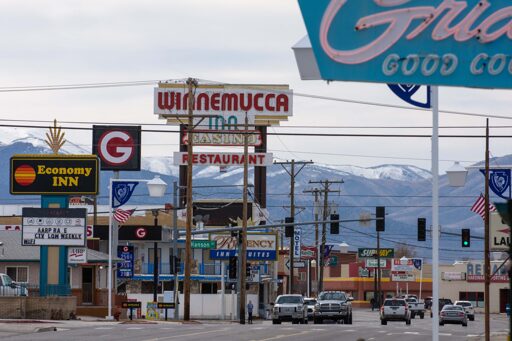
Patience Rousseau was 26 years old and living in Winnemucca when she miscarried in 2018. She was convicted under a Nevada law, put on the books in 1911, that makes it illegal to take drugs to end a pregnancy after the 24th week. Civil rights lawyers and abortion rights advocates say the statute is the only law like it nationwide and unfairly targets women who want to end a pregnancy.
Rousseau says the money from Humboldt County is welcome but not enough to make up for years of trauma. She wishes the county had been forced to pay more.
“They fought so much to avoid paying me,” said Rousseau. “I went through so much and so did my children, who are still facing these issues. It’s not fair.”
Rousseau told The Nevada Independent her life was turned upside down by the nearly decade-long ordeal. Already suffering from depression and substance abuse before her miscarriage, in its aftermath she was labeled a “baby killer,” sent to prison and separated from her young children for more than two years before her conviction was tossed out for ineffective assistance of counsel.
“The trauma of all of it was pretty horrendous,” said Paola Armeni, the Las Vegas-based civil rights attorney representing Rousseau. Armeni likened Rousseau’s treatment after her miscarriage to being attacked by a lynch mob, “all the while under a statute that was on the books before women were even allowed to vote in Nevada.”
Her lawyers say the money is a final act of justice in a case that should have never existed. They submitted a demand letter to Humboldt County in March, outlining their view that the county had broken state law, violated Rousseau’s state and federal constitutional rights and intentionally inflicted emotional distress upon her. The settlement was finalized in early August and the money was received last week.
Roughly $1.2 million of the settlement is reserved for Rousseau, who now lives in South Dakota with three sons, aged 4, 7 and 9. She said she will use the money to finance her house, buy her mom a car and open a store selling rare aquatic plants and animals — she’s an animal lover who owns five dogs and three cats.
The rest of the money will go to pay lawyers and to repay the state of Nevada for a $100,000 settlement it awarded Rousseau in February.
Not necessarily. I got a few hundred thousand from selling my mom’s house when she died, and I paid off my house and bought a car I sorely needed, while still keeping a good chunk to pad my retirement. Now that my house is paid off, I can make much larger contributions to my retirement as well, so it wasn’t a huge deal that only a fraction of the initial inheritance went to retirement.
I imagine if I’d gotten over $1 million more, I’d probably have been able to start a small business on top of all that. You get the things you need, and then you go back to your normal spending. It’s that last part that some people have trouble with, but we don’t know that this lady will.
Most small businesses fail. I just hope she doesn’t put too many eggs in that basket.
Yes and my concern is she won’t go back to normal spending. It’s really depends on the her financial literacy. Which isn’t something that should be assumed.
Paying your house feels good but did you do the math? If your mortgage rate is lower than the average market returns, you should keep the loan and invest the funds.
Once you’ve got over 100k you can start using it for collateral while it continues to make gains. This is how wealthy people operate their finances.
The whole zero debt movement is for poor people because Americans are taught to internalize their exploitation rather than fight for higher wages.
I hate wealthy people, and I hate what they do to the economy. Yes, I probably could have made more money by exploiting how our broken system makes it more profitable to use borrowed money than to just be financially independent, but my goal wasn’t to maximize profit, it was to be debt free and able to build up a retirement fund, which I am, and I can.
It has nothing to do with whether I can fight for higher wages and fairer wealth distribution - I absolutely still can, and I’m much more likely to want to do so if I’m not trying to use the same avenues of financial exploitation as the wealthy, since those are the exact avenues we need to close.
You seem to have things backwards with what you shouldn’t assume - you can be worried about someone, but you should have enough faith in your fellow human that you err on the side of assuming they’re capable of making the right decisions for themselves.
Sorry but my knowledge on this doesn’t disappear because you have faith.
Being poor is trauma. Money often causes a over spending response. This is backed behavior science studies.
If you’ve never been poor, living among poor, it probably sounds made up. It may also sound like I’m blaming them but I cannot overstate that I’m pointing out a trauma response not a character flaw.
Of course I’ve been poor - I’d rarely ever seen my bank account with 5 digits until my mom died. I’m fully aware of the feeling of “Oh, man this is so much money! I’m never going to have money trouble again!” that you get. That was the point of my original comment - you can have that feeling, make big purchases that you need to make, and still understand when to stop spending. Again, you can be worried about someone, but you can’t just say “Sorry, you can’t handle this. Science says so.”
Yes, it’s difficult to stop spending money when your bank account still has more money than you ever thought you’d see, but people are capable of overcoming it, and we shouldn’t assume someone is struggling with it until we can see that they’re struggling with it. As I said, I made nearly the same big purchases this woman did before going back to my usual penny-pinching - what we know about this woman isn’t enough to comment on whether or not she’s struggling to return to her normal spending.
If she says she’s having problems, or if we see that she’s spending herself into bankruptcy, then yes, we can say she has a problem. Until then, she’s a stranger who should be assumed to be capable of making good decisions for herself. It’s not our place to force “help” on someone. No matter how good the intentions, it’s unfair and belittling to assume it’s needed when you don’t actually know.
Thank you for understanding this.