
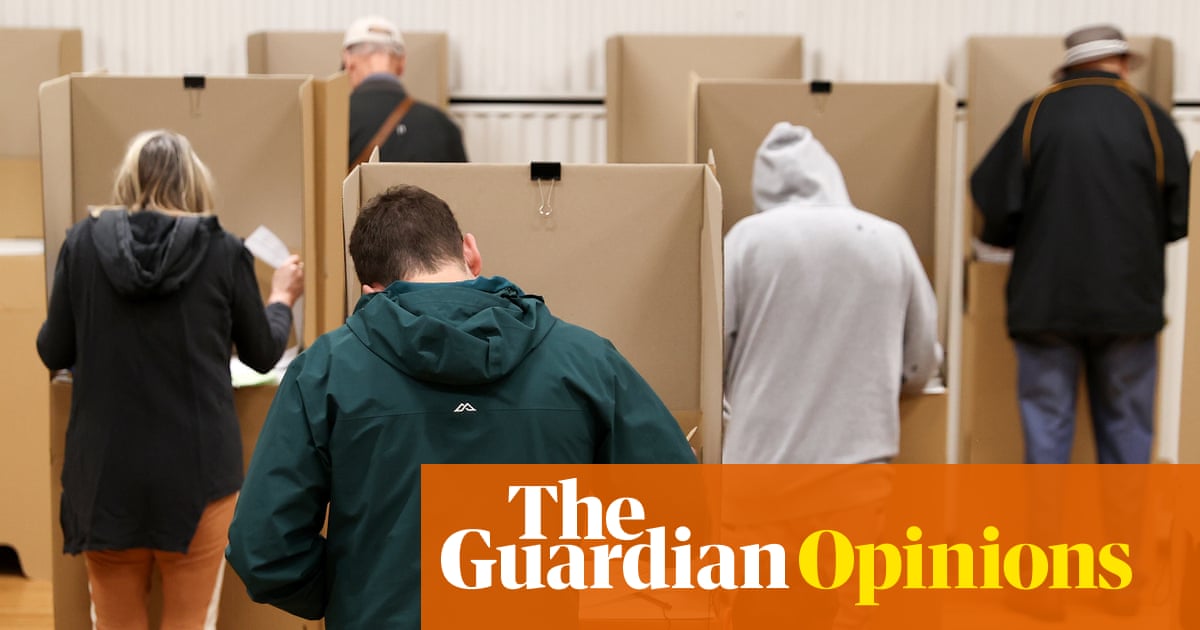
My preferred method is to weight votes according to age: voters below, say, 30 would receive a more heavily weighted vote, voters 30 to 60 would get a less weighted vote, and those over 60 would retain their current single vote. For argument’s sake, you could multiply the vote of under-30s by 1.3 and that of 30- to 60-year-olds by 1.1. People’s ballot papers could be distinguished by colour – under-30s get blue, 30s to 60s green and oldies red – to make counting easier on election night.
Then half of the Aussie population (or more) wouldn’t be able to vote! You are being super-elitist! 😆
Agree.
Why would you need a maximum voting age? If someone has the maturity and clarity to vote, they should vote.
I did say it’d be funny, not good.
RE max: just as human brains start life half formed and silly, they end life that way too. It is well established that we suffer cognitive decline after a lifetime of various insults to the brain and general aging. Nobody is ever as sharp as they were in the mid twenties. We try and make up for this with wisdom but we all go to the grave early or a shell of ourselves.
The cognitive arguments around a minimum extend to a maximum. Realistically you can’t, but you can’t have a well defined minimum either. I think it would be cool to let anyone interested vote, provided they can pass some general knowledge stuff first if they’re say under 16 or 14 or something to demonstrate they’re cognizent of what they’re doing.
We’re on the same page but not the same paragraph.
If we’re gonna be ageist and generalise I’ll add my 20c worth. In your mid-twenties you are neither more or less sharp than in your mid-sixties or even seventies. Much has to do with genetic, developmental, cultural and particularly lifestyle factors. A twenty-something person who has lived in physical, social, or cultural deprivation is unlikely to be as sharp as a sixty-something person who has lived in relative affluence which would be marked by healthy nutrition, reasonable educational opportunities, contacts, stability, etc.
General knowledge is also culturally loaded.
Anyway, I won’t rave on. The gist is that generalising about personal attributes like age, gender, etc, is a bit silly and not useful. They cannot be used as sole indicators of anything. We grow and develop out of a complex of factors and we need to implement real democracy, as you say, and also work towards a much fairer and just society than we have now.
Age related cognitive decline is extremely well documented. There is no way around it, you can slow it sometimes but everyone shows decline, it’s well established. Particularly between 60-80 decline starts becoming rapid.
https://link.springer.com/article/10.1007/s41999-025-01377-8 for example is a longitudinal study of several hundred adults. They find:
If you think people can be too young to think clearly because their brain is far enough from a healthy adult human’s as to represent one unsuitable for decision making you necessarily must draw the same conclusions around aged brains. It’s not bias, it’s just decay. We all rot in the end
You cant use age as a discriminatior for cognition. There’s plenty of older people who are more congniscent than people of a younger age.
What I am saying is that all of us, no matter our age, are affected by multiple, complex factors and that we shouldn’t be too quick to generalise. Our body does wear down but this doesn’t have to affect decision-making. Some go to their deaths in their 90s with a very lucid mind, some start getting dementia symptoms in their 40s and some a lot earlier, including childhood. We are all affected by a society which tends to promote health-reducing habits and environments for reasons of profit and then there are genetic factors in the mix as well. There’s quite a bit of research at present on healthy old age.
From the moment we are born, we are one day closer to our death but that doesn’t mean we must accept how we fare according to general trends. Our intelligence changes, not only declines, and we can play a conscious role in this.