

A few years ago, Democrats in Washington were circulating a chart showing that the economy always does better when they’re in charge and worse when Republicans hold the White House. This is statistically true — at least in the past few decades — but mostly irrelevant. And that’s because economic cycles and presidencies are sort of like shifting tectonic plates: They overlap, but they almost never perfectly align. Presidents don’t actually create the economies that attach to their names. They only react to them, ably or not.
There are a couple of reasons for this. The first is that economic upheavals are generally underway long before people feel them, and it takes years for the data to catch up. In 1992, when George H.W. Bush was running for reelection, the economy was estimated to have grown, quarter by quarter, at rates between 1.4 and 2.7 percent — evidence of the recession that helped Bill Clinton roll to victory. Years later, though, revised numbers showed that growth rates, while flat, had actually been solidly above four percent and that the recovery was already underway. (By the end of Clinton’s first year, the economy was growing at 5.6 percent.) You could run this same exercise for other presidents, and the basic lesson would be the same: Presidencies are always shaped by the underlying trends they inherit, even if they’re not visible at the time.
The second reason is that economies are subject to external shocks that have nothing to do with a president’s domestic policy. The Iranian revolution in 1979 sharply worsened an energy crisis that predated the Carter administration. The terrorist attacks of 2001 paralyzed George W. Bush’s economy, and the onset of the Covid pandemic in 2020 did the same to Donald Trump’s first term. All of these presidents confronted painful recessions, but they had about as much control over the events that triggered those recessions as they might have had over an asteroid hurtling toward Earth.
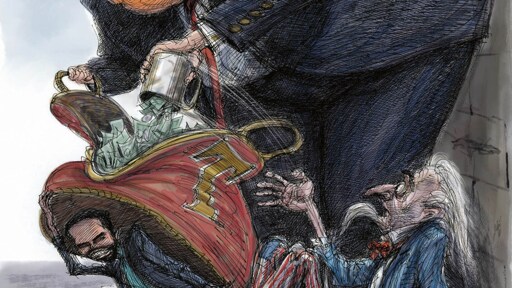
At least that’s how it was before Trump’s second term, which in this way — as in so many other ways that it’s become almost cliché to say it — marks a departure from everything we’ve seen before. Unlike any president since at least Woodrow Wilson a century ago, Trump actually has created his very own economic hellscape, by embarking on a series of radical steps that no one asked for and that only the most boneheaded ideologues would have advised. Trump is the only president in our lifetimes to be placed at the helm of a fundamentally seaworthy economy and immediately chart a course for the nearest field of icebergs.
Bush Jr hadn’t been president for long before 2001 so it’s hard to say he had an influence there (ignoring conspiracies). The 2007/2008 recession also predated Obama, and Bush would have had limited influence over the bullshit mortgage lenders were up to without the help of Congress.
Can’t speak about Carter because that predates me, and Covid wasn’t Trump’s fault, nor was it Biden’s. The stimulus checks were controversial to say the least, but the economy was fucked before those were relevant.
It really wasn’t until this term that Trump took the economy into his own hands and destroyed it. His first round of (unconstitutional) tariffs royally fucked the US economy with tariffs totaling over 200% for some Chinese imports, then the Iran situation more than doubled gas prices in many places, and the newer tariffs are also likely to kill any remaining hope many people had towards being able to afford anything nonessential. Compound this with the AI shit he’s had direct influence on, and it’s hard to argue that the economy wouldn’t have been dramatically different if he had just shut up and played golf instead.
Sure, president’s have always had some influence over the economy. No president for as long as I’ve been alive has nuked the economy the way Trump has done in his current term, though.
I’m not disputing most of what you said. Just saying that in each of the examples, similar events might have happened regardless, but they did things that might have contributed to the causes of the economic shock. Carter’s support for the Shah antagonized a lot of Iranians who theoretically might not have supported Khameni. The Bush admin dropped the ball on security by ignoring red flags. Trump eliminated the pandemic response team in 2018 and tried (unsuccessfully) to cut CDC funding every year including 2020. Each example is more subtle than the tariffs, and in each case things could possibly have turned out the same if they had made different decisions, but the phrasing used was “shocks that have nothing to do with a president’s domestic policy”. OK, in Carter’s case it was foreign policy.