
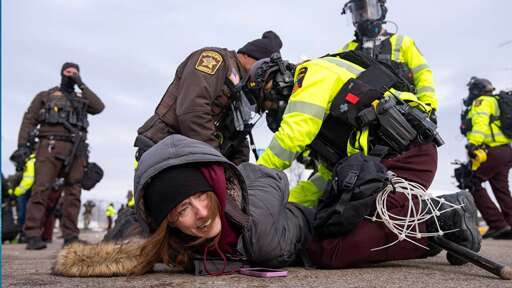
For weeks, a sprawling, informal network of group chats—largely using the encrypted messaging app Signal—had been a vital part of the public response to what the Trump administration called “Operation Metro Surge.” The operation deployed thousands of Immigration and Customs Enforcement (ICE) officials and other federal law enforcement personnel, tasked with apprehending and deporting undocumented immigrants. Their tactics were blunt and aggressive, as they disregarded warrant requirements and drew allegations of racial profiling and unlawful arrests.
In response, those decentralized Signal chats turned ordinary Minnesotans into modern-day Paul Reveres. Participants shared information about ICE activity, warned businesses of potential raids, helped track agents and vehicles across the city, and organized legal assistance for detainees.
…
Those same chats now sit at the center of another story. In a 94-page [indictment](https://www.justice.gov/opa/media/1446251/dl?inline) filed in June, the Department of Justice (DOJ) accused 15 protesters of participating in a conspiracy to interrupt federal immigration enforcement and law enforcement operations. That alleged conspiracy was coordinated via “social media, text messaging, and encrypted messaging applications, such as Signal,” the indictment explains, “with the goal of preventing, hindering, delaying, and impeding the enforcement of federal immigration law.” The defendants have pleaded not guilty.
Has the Trump administration finally brought antifa to justice? In [a statement](https://www.whitehouse.gov/releases/2026/06/trump-administration-delivers-another-crushing-blow-to-antifa-terrorist-network/), the White House called the indictment “a crushing blow” to the “domestic terrorist organization.”
Those who participated in or cheered on the protests against immigration enforcement during Operation Metro Surge are calling it something else: a worrying crackdown on Americans’ First Amendment rights to talk and organize with their neighbors, friends, and co-workers against the federal government’s violent behavior.
It’s a pity that Signal insists on using a phone number for authentication, leaving people vulnerable to identification.
In principle they have to provide this information given a warrant.
Hopefully signal doesn’t cave to pressure from the feds if applied. If so these groups will have to get more clever and start using decentralized chat apps like simplex, jami or others.
They don’t need to cave to pressure.
If anybody in the group chat has a phone that doesn’t resist forensic imaging (essentially most phones) then the feds will have the whole group conversation without needing Signal’s cooperation.
i know i can look it up but for sake if sharing with the thread what is forensic imaging?
When your phone is seized for evidence the lab will use software, from a company like Cellebrite, to create an exact 1:1 copy of the storage on your phone. Once they have a copy of your phone’s storage, they can analyze things like your message database (or Signal’s message database) to recover useful things like text messages, Internet history, photos.
Most phones don’t allow this to happen and take steps to prevent it, like encrypting the storage. The software often takes advantage of hardware or software exploits to bypass the security of your phone and most phones are some sort of vulnerability which would allow their security to be bypassed.
If you’ve heard of GrapheneOS, it’s because it is a community-made OS that is built with security in mind and is generally immune to the attacks like this which used to bypass your phone’s security. If you were involved in community organization I’d suggest, at a minimum, that communication is done with dedicated secure (GrapheneOS) devices that only run Signal.
Regardless, as a general rule, if your phone is going to resist forensic imaging it is much more likely to work if the phone is in the ‘Before First Unlock’ stage. After your phone powers off, the keys required to access the disk encryption are removed from memory. When you power the phone back on, the first time you unlock your phone, the keys are re-generated using your login information. So, if you’re worried that your phone will be imminently searched, power it off.
Also, don’t use biometrics because they can physically compel you to provide your thumb print but they cannot legally compel you to divulge a password (in the US, it’s a violation of your 5th amendment protection against self-incrimination.) Check your local laws, ofc.
What do you expect they’d get by pressuring Signal? Besides, they’d already infiltrated Signal chats the old-fashioned, zero-tech way. Changing to another chat system wouldn’t help.
If the US government tries to pressure signal to allow encryption backdoors (or some other silliness) they’re liable to leave the US
https://stateofsurveillance.org/news/uk-sweden-encryption-backdoor-signal-2026/