
Snippet:
According to long-standing textbook explanations, this evolutionary shift occurred after the most devastating extinction event in Earth History, which happened about 252 million years ago. Known as the end-Permian mass extinction, this event, often called the ‘great dying’, eliminated more than 90 percent of marine species. Scientists link the catastrophe to intense greenhouse conditions, oxygen loss in the oceans, widespread acidification, and massive volcanic eruptions tied to the breakup of the ancient Pangaean supercontinent.
How quickly marine ecosystems recovered after this disaster has been one of the most hotly debated questions in paleontology. The prevailing theory suggested a slow rebound that unfolded over roughly eight million years, with amphibians and reptiles gradually moving into open ocean environments in a step-by-step process. The fossil evidence from Spitsbergen now challenges that assumption.
[…]
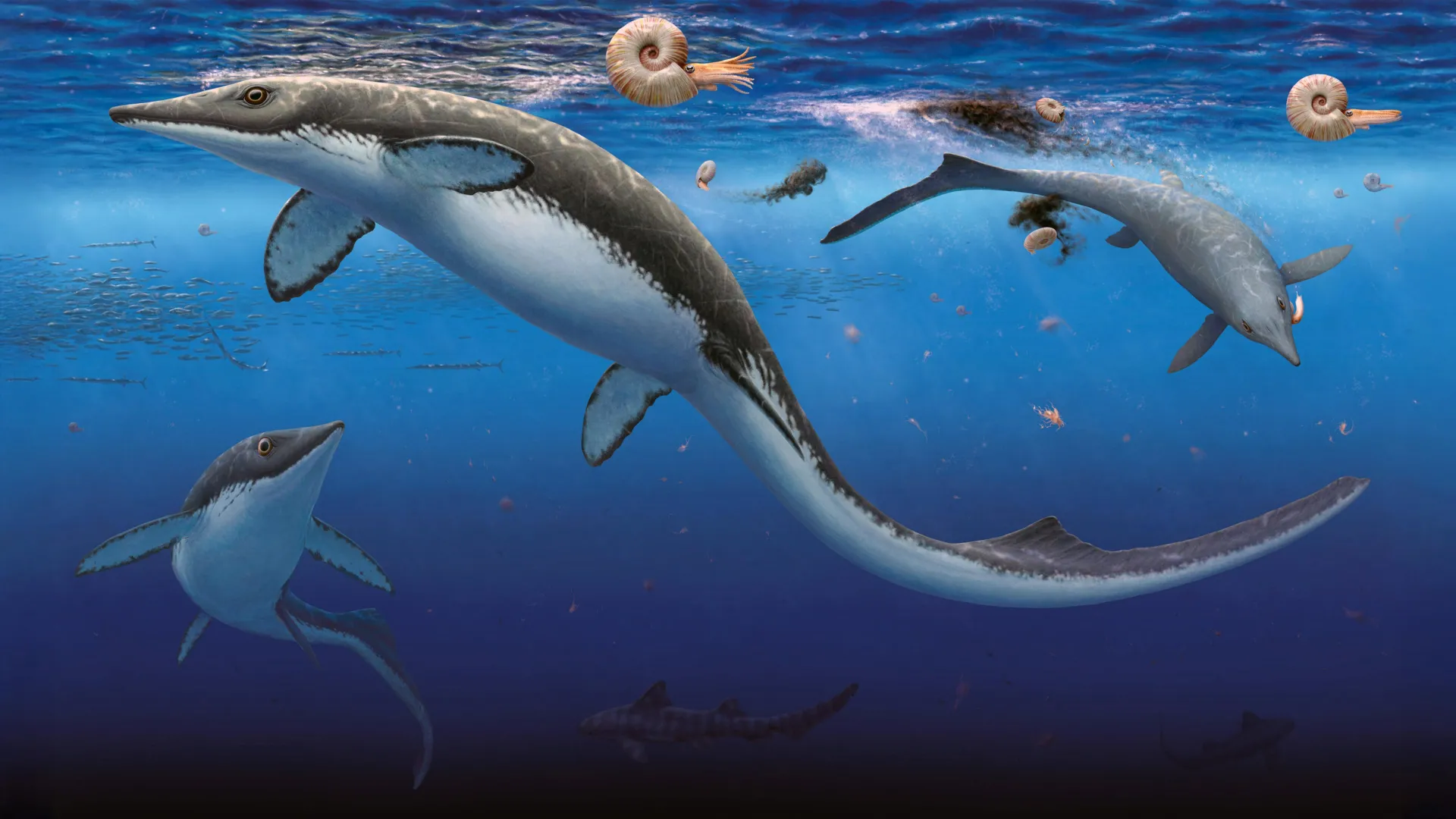
The Spitsbergen bonebed shows that marine ecosystems rebounded far more quickly than previously believed. Within as little as three million years after the end-Permian mass extinction, the oceans supported complex food webs filled with predatory reptiles and amphibians.
One of the most surprising findings is the wide range of fully aquatic reptiles present at the site. These included archosauromorphs (distant relatives of modern crocodiles) as well as diverse ichthyosaurs (‘fish-lizards’). Some species were small, squid-eating hunters measuring less than 1 m long, while others were enormous apex predators exceeding 5 m in length.