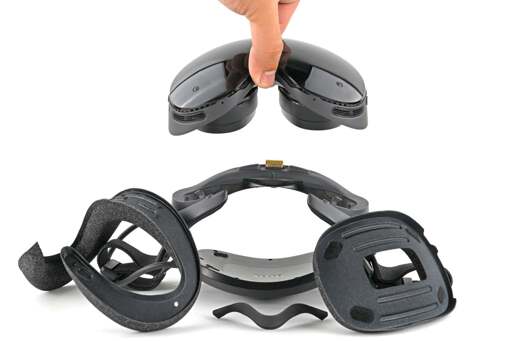
When a cushion wears out, a battery fades, or a display breaks, there’s a plausible repair ahead of you. But the heat management’s a little more buried.
The point they are getting at is that in order to stream games to a VR headset, that headset needs to have a certain amount of compute power in order to interpret the stream while also handling tracking, connecting to controllers, etc. That amount of compute power is also capable of running games in standalone, so they may as well support that option as well.
Streaming to a VR headset involves the headset computing more than just controller tracking. It needs to interpret the incoming stream and all sorts of other various things that need to be computed. A VR headset that has a processor that is powerful enough to stream heavy games is also powerful enough to play light games in standalone.
Streaming to a VR headset involves the headset computing more than just controller tracking.
Yes but not much. Again streaming games from weak hardware is a whole industry. It’s the point of platforms like Luna, GeForce Now, Stadia, etc. Streaming from cheap Android TV boxes and such. Valve even sold their own cheap streaming box, the Steam Link.
Yeah, the most powerful boxes are on par with the chip in the Steam Frame, aside from RAM and the SSD. The biggest costs are elsewhere. It’s not the chip itself.
There are devices more powerful than that. And from what I can tell, you’d cut $100 in SoC cost and lose 75% of the the performance compared to the closest competitors.
Again, you’re comparing to devices which does not have to do onboard SLAM tracking, which displays a single output image instead of two, which does not need to meet the latency and image refresh rate targets, which does not connect two dual Wi-Fi connections for extra stability and redundance, etc.
Even if you go for the tightest margin, economics still give you mass market chips with excess capacity because you have to pick chips with enough ports, enough bandwidth, low latency, high maximum CPU frequencies, etc. And then the question is again back to a difference in parts cost between “can only ever stream” vs “can stream AND game locally” that’s just some hundred dollars of parts cost.
Not much, but apparently enough that the minimum requirement is capable of running simpler games locally.
platforms like Luna, GeForce Now, Stadia, etc.
Streaming foveated VR is more computationally taxing on the client than simply streaming basic pancake games. You can stream Cyberpunk to your Chromecast because it just involves the server sending a video feed to the client and the client sending controller inputs back to the server. Streaming a VR game involves all those same things, but it also involves extra computation on the client side (controller tracking, eye tracking, headset gyro, and other various spatial calculations) that then get sent off to the server along with the controller inputs. That extra computation requires more client-side processing power than is needed for streaming Cyberpunk to your Chromecast.
Are you talking about game streaming some AAA ultra graphics Unreal game? Because there are a lot of other games that only take a fraction of compute (an extreme being doom) that take maybe even less compute ressources than trying to stream anything. And streaming can take a lot of compute if you ever looked at hardware stats during a discord stream. that would be especially true for something “surroundHD” like a 3D wirtual vorld where a lot of video gets to be stored or its going to be a pain in the eyes turning the head (and that ping will be too high for foveated streaming)


The point they are getting at is that in order to stream games to a VR headset, that headset needs to have a certain amount of compute power in order to interpret the stream while also handling tracking, connecting to controllers, etc. That amount of compute power is also capable of running games in standalone, so they may as well support that option as well.
But that isn’t true at all, and I’ve still seen no one from valve actually claim it is true.
That makes no sense. It requires more compute to run a whole-ass game along with tracking controllers than it does just tracking controllers.
Streaming to a VR headset involves the headset computing more than just controller tracking. It needs to interpret the incoming stream and all sorts of other various things that need to be computed. A VR headset that has a processor that is powerful enough to stream heavy games is also powerful enough to play light games in standalone.
Yes but not much. Again streaming games from weak hardware is a whole industry. It’s the point of platforms like Luna, GeForce Now, Stadia, etc. Streaming from cheap Android TV boxes and such. Valve even sold their own cheap streaming box, the Steam Link.
Yeah, the most powerful boxes are on par with the chip in the Steam Frame, aside from RAM and the SSD. The biggest costs are elsewhere. It’s not the chip itself.
The most powerful boxes are using a 10 year old Nvidia Tegra chip. Not to mention the rest of them.
There are devices more powerful than that. And from what I can tell, you’d cut $100 in SoC cost and lose 75% of the the performance compared to the closest competitors.
Again, you’re comparing to devices which does not have to do onboard SLAM tracking, which displays a single output image instead of two, which does not need to meet the latency and image refresh rate targets, which does not connect two dual Wi-Fi connections for extra stability and redundance, etc.
Even if you go for the tightest margin, economics still give you mass market chips with excess capacity because you have to pick chips with enough ports, enough bandwidth, low latency, high maximum CPU frequencies, etc. And then the question is again back to a difference in parts cost between “can only ever stream” vs “can stream AND game locally” that’s just some hundred dollars of parts cost.
Not much, but apparently enough that the minimum requirement is capable of running simpler games locally.
Streaming foveated VR is more computationally taxing on the client than simply streaming basic pancake games. You can stream Cyberpunk to your Chromecast because it just involves the server sending a video feed to the client and the client sending controller inputs back to the server. Streaming a VR game involves all those same things, but it also involves extra computation on the client side (controller tracking, eye tracking, headset gyro, and other various spatial calculations) that then get sent off to the server along with the controller inputs. That extra computation requires more client-side processing power than is needed for streaming Cyberpunk to your Chromecast.
Try decoding an AV1 stream from Sunshine without hardware acceleration. It takes a much higher compute performance than you apparently believe.
Are you talking about game streaming some AAA ultra graphics Unreal game? Because there are a lot of other games that only take a fraction of compute (an extreme being doom) that take maybe even less compute ressources than trying to stream anything. And streaming can take a lot of compute if you ever looked at hardware stats during a discord stream. that would be especially true for something “surroundHD” like a 3D wirtual vorld where a lot of video gets to be stored or its going to be a pain in the eyes turning the head (and that ping will be too high for foveated streaming)