

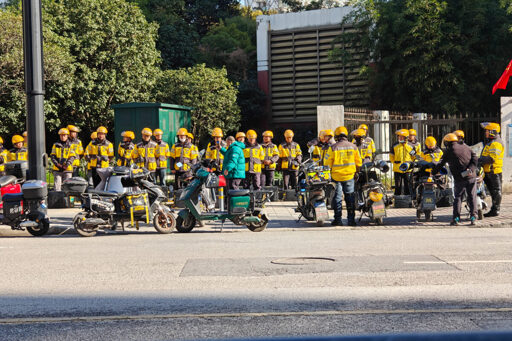
- In April 2026, the Chinese party-state issued new guidelines for platform workers who now count almost half of the Chinese workforce
- Even if the intended move to a consumption-led growth in an era of a slowing Chinese economy is successful, the new guidelines do not esolve the precarity facing China’s underclass
- Rural migrant workers and gig economy workers are groups long excluded from full social protections by the hukou system and increasingly, by algorithmic labour management
[…]
Many of China’s over 300 million rural migrant workers work without contracts that would entitle them to full social insurance. This two-tiered labour market is a direct result of China’s hukou (household registration) system institutionalised in the 1950s, which continues to keep migrant workers from receiving the same benefits as their urban counterparts. While they built the factories, roads and cities which powered economic growth, the reproductive costs of housing, healthcare and schooling were offloaded onto rural families and the workers themselves — a subsidy to Chinese manufacturing unaccounted for by trade calculations.
[…]
Rural migrant workers and platform economy workers face overlapping but distinct forms of insecurity, with the two groups intersecting substantially. Rural residents are overrepresented among the roughly 84 million people in China’s new employment forms and food delivery app Meituan reported in 2019 that 77 per cent of its riders come from rural areas.
While platform workers may be local residents with urban hukou, migrant workers’ tolerance for gig work should be understood in view of wider imposed condition. Trapped within a contracting labour market, they are excluded from better jobs due to their hukou and confined by platform algorithms built to extract maximum hours at minimum costs.
[…]
China’s economic growth made precarity tolerable by fostering an expectation that the next generation would join the protected middle class and that the social contract would eventually extend to everyone. The gap between this promise and what the labour market now delivers is the defining social fault line of China’s current moment.
China’s youth unemployment rate for the cohort aged 16–24 sat at 17.9 per cent in July 2026, excluding students. A record 12.7 million university graduates in 2026 are now entering a saturated job market. And in response to an ageing population, the retirement age was raised in 2025 — the first increase since the 1950s.
[…]
The cultural markers of this economic pressure are difficult to ignore. The 996 schedule [working 9am to 9pm, 6 days per week] shows that even formal employment is now precarious. Young urban workers have coined their own vocabulary in response. Tang ping (lying flat) describes the quiet refusal to chase exhausting ambitions in a market which only offers diminishing returns, while bai lan (letting it rot) goes one step further, signifying a complete and deliberate disengagement from a system seen as rigged. These generational attitudes can be understood as rational responses to an irrational labour bargain.
The historical record offers limited comfort. In no comparable economy has the end of high growth improved outcomes for the workers who powered it.
[…]
Wow the poor in China are worse off than anywhere in the western world.
