

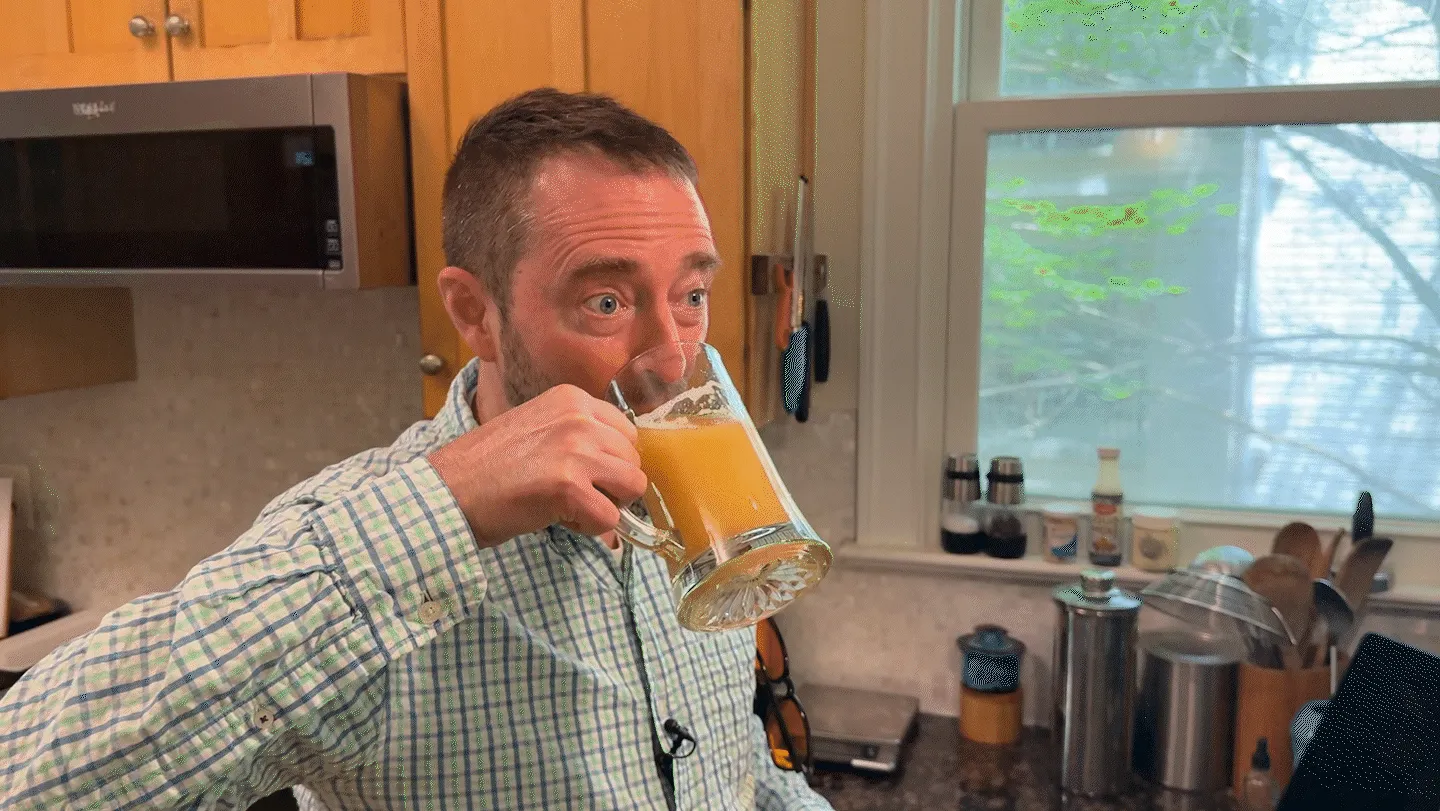
Buck’s body made antibodies against several types of the virus after drinking the beer and he suffered no ill effects, he and his brother Andrew Buck reported December 17 at the data sharing platform Zenodo.org, along with colleagues from NIH and Vilnius University in Lithuania. Andrew and other family members have also consumed the beer with no ill effects, he says. The Buck brothers posted a method for making vaccine beer December 17 at Zenodo.org. Chris Buck announced both publications in his blog Viruses Must Die on the online publishing platform Substack, but neither has been peer-reviewed by other scientists.
A second ethics committee at the NIH objected to Buck posting the manuscripts to the preprint server bioRxiv.org because of the self-experiment. Buck wrote a rebuttal to the committee’s comments but was loathe to wait for its blessing before sharing the data. “The bureaucracy is inhibiting the science, and that’s unacceptable to me,” he says. “One week of people dying from not knowing about this is not trivial.”
I appreciate that there are ethics boards holding scientists to standards, but sometimes (not usually, I know – only in very specific cases!) it takes someone with initiative to “just do it”. And the guy isn’t some crank, he’s a virologist who’s discovered multiple viruses. Good for him, I say.
This is no different IMO from the scientist who proved that H.Pylori causes a common form of stomache ulcer.
Funny how you only hear about the successful self-experiments.
Any biomedical experiment with an N=1 is meaningless. Buck should know this. Many self-experimenters proved drugs “safe” only to have others repeat the experiment and die.
Dr. Ignaz Semmelweis sought to prove body fluids cause sepsis on himself. He was right, and he died of sepsis. In your face, doubters!
In 1936, Edwin Katskee took a very large dose of cocaine. He attempted to write notes on his office wall, but these became increasingly illegible as the experiment proceeded. Katskee was found dead the next morning.
Around 1886, Nicholas Senn pumped nearly six litres of hydrogen through his anus. Senn used a rubber balloon holding four US gallons connected to a rubber tube inserted in the anus. An assistant sealed the tube by squeezing the anus against it. The hydrogen was inserted by squeezing the balloon while monitoring the pressure on a manometer. The experiment was to detect intestinal leaks by lighting the hydrogen gas. We don’t understand the pure Musk-like genius here.
Daniel Alcides Carrión described the disease in the course of what proved to be a fatal experiment upon himself in 1885, in order to demonstrate definitively the cause of the illness. He was inoculated by close friends with blood which had been taken from a wart of a 14-year-old patient. Carrión’s aim was to prove a link between the acute blood stage of Oroya fever with that of the later chronic form of the disease, called verruga peruana, typified by numerous red, wart-like dermal nodules.
Jesse William Lazear (May 2, 1866 – September 25, 1900) was an American physician. In 1900, he deliberately allowed a mosquito to bite him to test the hypothesis that mosquitoes were the vector for yellow fever transmission. He contracted the disease but did not recover and died on September 25, 1900.
https://en.wikipedia.org/wiki/Self-experimentation_in_medicine
The result is cool, assuming it’s real, but he did not go about this in a scientific way, so the “published” results are basically junk, and it doesn’t reflect well on him as a scientist, and it sounds like it might lose him his job, for good reason IMO.
But he did it on personal time, with personal resources, under the purview of a non-profit totally unrelated to his employer. He didn’t use their name/brand, so there’s no defamation here either is there?
I understand the fear of some rogue ‘mad scientist’ doing something stupid but this really doesn’t seem to be that situation here.
Every institution has strict rules for research ethics on any human, and this would not pass ethics.
Let’s state the fucking obvious: some researcher injects himself with a virus or bacteria to make a vaccine and the strain mutates to be more infectious and virulent. Stupid. Full stop.
Running a study that’s unethical and scientifically rigorous and pushing the results, is a mark of a bad scientist.
This is rather similar to how the “vaccines cause autism” myth started.
You’re assuming the conclusion though – that it’s unethical. The argument here is that he tested it on himself specifically in order not to endanger others – as that would be unethical.
I’d respectfully disagree it is analagous to the “vaccines cause autism” situation. This is trying to claim a potential beneficial medical procedure, not to sow fear or distrust in a long-standing, proven medical practice. And there’s nothing in the article that says he is resisting others attempting to confirm or refute his work.
In the spirit of the scientific method, hopefully other scientists try to reproduce the results then it’ll get corroboration, or be shot down.
If the brews contain only safe test viruses, it should ethically be a safe experiment. Test for antibodies before and after ingestion to the innocuous viruses and the mechanism is proven or disproven.
Again, he’s doing exactly the same thing that scientist that experimented on himself to test if H. Pylori was responsible for peptic ulcers. If he Darwin-Awards himself, that’s very unfortunate, but so long as mild, innocuous test viruses are being used, he’s not endangering anyone else (I certainly hope he did this with ‘safe’ test virus varieties, for his own sake as well as others!).
I sit on an institutional REB. This is unethical. There’s a long list of accidental deaths in history from medical “geniuses” and if left unchecked, eventually we could get more virulent infectious agents from idiots trying to CRISPR edit themselves in their garage.