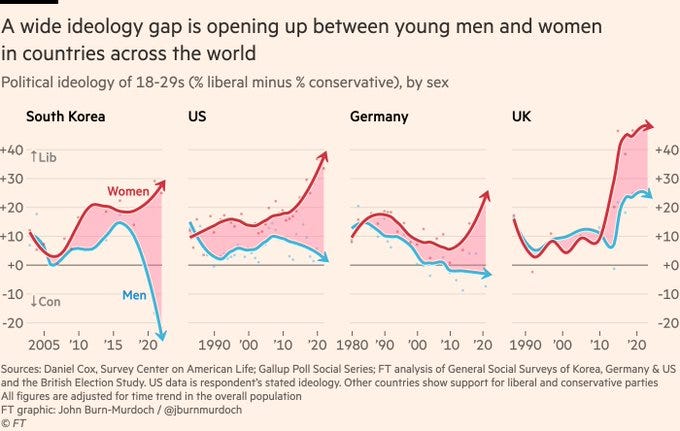
young women backed the liberal Democratic party in almost equal and opposite numbers
This is only partially true. The key swing vote in the election, that handed Trump the win were; 40+year old white women without a college education. Until this election, that group was almost entirely in the Democrat camp, but went full MAGA.
The youth vote only has a small turnout, with voting patterns locked into geographic regions, there wasn’t too much unexpected that happened with the youth vote.
Be skeptical of recent survey data, reflection on this past election, or any survey data for that matter, especially in a Medium article.
What they are explicitly saying, and not implying at all is, “Korea’s is an extreme situation, but it serves as a warning to other countries of what can happen when young men and women part ways. Its society is riven in two.”
They are not implying the specifics of how the election unfolded in South Korea bears clear resemblance to the US like you stated.
This is a silly discussion because you did read the FT article, speculated wildly, and now are defending your bad take with a vague and baffling two sentence defense. Construct an actual argument.
It’s a shitty article, that uses shitty polling data.
What it means to be lib vs. con in different time periods and different countries is a complex question. I guarantee you that in absolute terms, white boys from the Midwest are much less racist than they were 40 years ago.
It misses the biggest swing from lib to conservative that happened, that older white women, without a college education, flipped to conservative, from consistently voting Democrat.
The article implicitly is trying to cast blame on young white boys, turning conservative, and therefore pushing the country into being regressive. It misses that the biggest regressive block are still the elderly white folk, and that that block is also the biggest voting block.
Both the articles were written in January 2024, ten months before the election. They weren’t analyzing the 2024 elections. There is no possibiliy of mentioning elderly white folks ev
They never mention whiteness anywhere in either article and the FT article is explicitly a global take mentioning Germany, UK, South Korea, Tunisia, and China.
There is nothing in the FT article implicitly or explicitly blaming “young white boys”. It is saying that when there is an ideological gap between young men and women, it has sociological implications.
I agree that the larger media narrative blames young white men’s regressive turn for the Trump presidential win and not elderly white folks or white Gen X women, but this is not that article.


This is only partially true. The key swing vote in the election, that handed Trump the win were; 40+year old white women without a college education. Until this election, that group was almost entirely in the Democrat camp, but went full MAGA.
The youth vote only has a small turnout, with voting patterns locked into geographic regions, there wasn’t too much unexpected that happened with the youth vote.
Be skeptical of recent survey data, reflection on this past election, or any survey data for that matter, especially in a Medium article.
This quote comes from the graph’s source article from the FT. They are talking about South Korea and not the US.
The author is discussing several countries, including the U.S.A., saying that it is the same trend for each. So yest they are implying the US.
What they are explicitly saying, and not implying at all is, “Korea’s is an extreme situation, but it serves as a warning to other countries of what can happen when young men and women part ways. Its society is riven in two.”
They are not implying the specifics of how the election unfolded in South Korea bears clear resemblance to the US like you stated.
This is a silly discussion because you did read the FT article, speculated wildly, and now are defending your bad take with a vague and baffling two sentence defense. Construct an actual argument.
It’s a shitty article, that uses shitty polling data.
What it means to be lib vs. con in different time periods and different countries is a complex question. I guarantee you that in absolute terms, white boys from the Midwest are much less racist than they were 40 years ago.
It misses the biggest swing from lib to conservative that happened, that older white women, without a college education, flipped to conservative, from consistently voting Democrat.
The article implicitly is trying to cast blame on young white boys, turning conservative, and therefore pushing the country into being regressive. It misses that the biggest regressive block are still the elderly white folk, and that that block is also the biggest voting block.
Both the articles were written in January 2024, ten months before the election. They weren’t analyzing the 2024 elections. There is no possibiliy of mentioning elderly white folks ev
They never mention whiteness anywhere in either article and the FT article is explicitly a global take mentioning Germany, UK, South Korea, Tunisia, and China.
There is nothing in the FT article implicitly or explicitly blaming “young white boys”. It is saying that when there is an ideological gap between young men and women, it has sociological implications.
I agree that the larger media narrative blames young white men’s regressive turn for the Trump presidential win and not elderly white folks or white Gen X women, but this is not that article.