

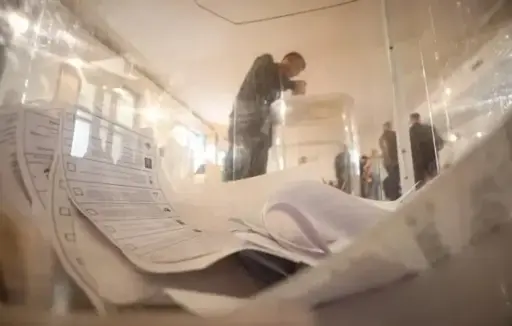
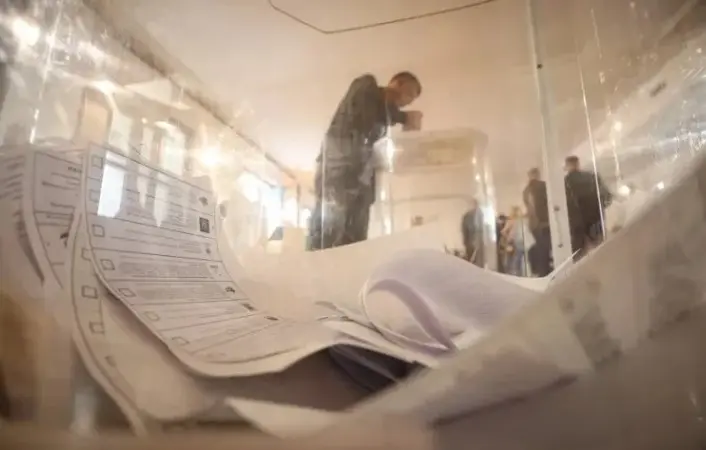
Russia 2026 parliamentary elections reach 32.58% turnout on day two, with more than three million remote votes and ballots cast across 152 countries.
Related: Drone Strikes Cooling Tower at Russia’s Kursk-2 Nuclear Plant
Russia 2026 Parliamentary Elections Reach 32.58% Turnout
The Russia 2026 parliamentary elections recorded voter participation of 32.58 percent by the second day of voting, according to the country’s Central Election Commission.
The three-day election will determine the composition of Russia’s 450-member State Duma, the lower house of parliament, for the next five years.
Approximately 111 million citizens are eligible to vote in the election, which began on Friday, September 18, and will conclude on Sunday, September 20.
The Central Election Commission said participation across the federal electoral districts stood at 32.58 percent as of Saturday afternoon.
The figure remains provisional because polling stations will remain open until Sunday evening across Russia’s multiple time zones. Final turnout figures will be released after voting ends and ballots are counted.
Participation has been especially high in several regions. The Central Election Commission reported turnout of 63.20 percent in Chechnya, 60.70 percent in Bryansk Region, 58.31 percent in Kherson Region, and 51.05 percent in Tuva.
Authorities have linked the elevated participation in some regions to early voting, local political mobilization, and the use of electronic voting platforms.
More than three million people had voted remotely through Russia’s electronic voting system in 32 regions by the second day of the election.
The remote system is designed to make voting more accessible for people who cannot easily reach polling stations. It is also being used as a security measure for citizens in border regions exposed to attacks connected to the Russia-Ukraine conflict.
President Vladimir Putin described the election as Russia’s most important internal political event. He cast his ballot electronically and encouraged citizens to participate in the vote.
The 2026 election is the first parliamentary contest since Russia launched its full-scale military operation in Ukraine in February 2022. It is therefore being closely watched as a measure of support for the government and its wartime policies.
Authorities have encouraged citizens to vote over three days, saying the extended schedule can help voters participate across the country’s vast territory and reduce pressure on polling stations.[globalbankingandfinance][apnews][africanews]
Russia stretches across 11 time zones, from the Far East to the country’s western regions. Polls opened first in Kamchatka and Chukotka before voting continued across the rest of the federation.
Russia 2026 Parliamentary Elections Use Remote Voting and International Observers
See the key facts about Russia’s 2026 State Duma elections.
The Russia 2026 parliamentary elections include voting at polling stations, remote electronic voting, and special arrangements for citizens living in hard-to-reach or security-sensitive areas.
The federal electronic voting platform is operating in 32 regions, while Moscow is using a separate system. More than four million people registered or applied to vote remotely before the election began.
By the second day, more than three million voters had cast ballots through the digital platform.
Supporters of electronic voting say it reduces barriers for citizens who live far from polling stations, work irregular hours, are ill, or face mobility problems.
The system has also been presented as particularly useful in border areas where security concerns could affect access to polling stations.
Critics of the voting system have questioned whether electronic ballots can be independently audited and whether voters can verify that their choices were recorded accurately.
Russian authorities have reported cyberattacks against election-related systems and communications networks during the second day of voting. Officials said the attacks did not prevent the election from continuing, but they increased concern over the security of digital infrastructure.
Central Election Commission Chair Ella Pamfilova also reported what she described as attempts at provocation. She said voting began as planned and that election officials were monitoring potential threats.
More than 380,000 domestic observers are taking part in the election. The CEC also reported the presence of 1,126 international observers and experts from 133 countries, along with representatives of 13 international organizations.
The observers include representatives of political parties, public organizations, and foreign institutions. Their presence is intended to provide oversight and document the organization of the vote.
The ballot includes 10 political parties. They are United Russia, the Liberal Democratic Party, Direct Democracy, the Greens, A Just Russia, Rodina, the Communist Party, the Russian Party of Pensioners for Social Justice, Communists of Russia, and New People.
United Russia, the party associated with President Putin, won more than two-thirds of the State Duma seats in the previous parliamentary election and is expected to remain the dominant force.
Half of the State Duma’s 450 seats are elected through party lists, while the other half are contested in single-member districts.
The election also includes regional and local contests. Voters in eight regions are choosing senior regional officials, while more than 2,200 local electoral campaigns are taking place across the country.
The broader voting process therefore extends beyond the federal parliament. It will determine governors, regional lawmakers, municipal representatives, and local officials.
For many voters, local elections provide the most direct connection to public authorities. Campaigns have focused on social services, infrastructure, employment, public utilities, and regional security.
The Russia 2026 parliamentary elections also include residents of the Donetsk People’s Republic, Luhansk People’s Republic, and the Zaporozhye and Kherson regions for the first time as part of the regular electoral process.
These territories were occupied and annexed by Russia after referendums held in 2022, which Ukraine and most governments around the world rejected as illegal. Kyiv says Russia’s elections in the territories are illegitimate.
Moscow has established early-voting procedures and electronic or special voting arrangements for residents in those areas.
Voting Abroad and the Political Significance of the Duma Election
Read about the Russia parliamentary vote and its regional and international dimensions.
The Russia 2026 parliamentary elections have also opened voting facilities for citizens living abroad.
The electoral infrastructure includes 333 polling stations in 152 countries, allowing Russian citizens outside the country to vote until the election closes on September 20.
Approximately 1.8 million Russian citizens registered abroad are eligible to participate in the parliamentary election.
Most overseas polling stations are expected to operate in person. Remote electronic voting is not generally available through foreign polling locations.
The international vote is politically important because Russian citizens abroad include migrant workers, students, diplomats, military families, and people who left the country after the beginning of the conflict in Ukraine.
The government has presented the overseas voting network as evidence that Russian citizens can participate regardless of where they live. Opposition groups abroad have questioned whether the process offers genuine political choice.
Only registered parties may compete for State Duma seats. The election does not include a major organized party that openly opposes the military operation in Ukraine.
Authorities have described the election as a democratic exercise that reflects public support for the country’s political system and national priorities.
Independent Russian opposition figures and international observers have argued that the political environment is heavily controlled. They point to restrictions on anti-war candidates, prosecutions, pressure on independent media, and limits on public protest.
The election is therefore likely to produce continuity in the State Duma rather than a major change in the balance of power.
United Russia is expected to remain the largest parliamentary force. The Communist Party, the Liberal Democratic Party, A Just Russia, and New People are also expected to retain representation.
The key political question may not be whether the Kremlin-aligned majority survives, but how turnout and voter participation are interpreted.
The government is likely to present high participation as evidence of public engagement and support for national policy. Lower turnout, by contrast, could indicate political fatigue, apathy, or disengagement.
The electronic vote is especially important in that debate because it allows participation figures to rise quickly and makes voting possible in regions where transportation and security conditions are difficult.
The Central Election Commission has emphasized the efficiency and accessibility of the digital system. Critics have called for greater transparency about software, verification procedures, and independent auditing.
The elections are also taking place against the backdrop of the war in Ukraine. Russian officials have described the conflict as a national security struggle, while Ukrainian and Western governments continue to condemn Russia’s military actions.
The composition of the next State Duma will influence legislation involving defense, national security, economic sanctions, social spending, and relations with territories under Russian control.
The parliament is also expected to play a role in shaping policies related to sanctions, trade, energy exports, military mobilization, and relations with China and other non-Western partners.
The Russia 2026 parliamentary elections therefore carry significance beyond the selection of lawmakers. They are being used by the government to demonstrate institutional stability during wartime.
🚨 Rusia denuncia sabotaje a su sistema de voto electrónico. La Comisión Electoral Central alerta sobre un intento masivo de comprometer la integridad del proceso electoral.#teleSUR #EleccionesRusia pic.twitter.com/5IO18PVkWb
— teleSUR TV (@teleSURtv) September 18, 2026
Geopolitical Context: Elections During the Ukraine Conflict
The Russia 2026 parliamentary elections are taking place at a critical point in relations between Russia, Ukraine, the United States, and European governments.
The vote is the first parliamentary election held during the full-scale war. It provides the Kremlin with an opportunity to demonstrate domestic political continuity despite sanctions, military casualties, economic restrictions, and international isolation.
The inclusion of Russian-occupied Ukrainian territories has further increased tensions. Ukraine rejects the legitimacy of the vote in Donetsk, Luhansk, Kherson, and Zaporozhye, while Russia presents participation there as confirmation of its territorial claims.
Most Western governments are expected not to recognize the results in those regions. The elections could therefore deepen the dispute over sovereignty and territorial control.
The contest also has consequences for Russia’s relationship with the Global South. Moscow is seeking stronger economic and diplomatic ties with China, India, Iran, Brazil, and other countries as sanctions restrict its access to Western markets.
A parliament dominated by pro-government parties would support the continuation of Russia’s current foreign-policy direction.
The vote also takes place amid heightened cyber tensions. Russian authorities have accused foreign actors of attempting to disrupt election infrastructure, while Western governments have repeatedly accused Russia of cyber operations targeting their own electoral systems.
The electronic voting system has become part of that broader conflict over digital sovereignty, information security, and trust in online institutions.
International observers may provide assessments of polling procedures, but disagreement over the political environment is likely to continue after the vote. The presence of foreign observers does not resolve questions about candidate access, media conditions, campaign freedoms, or the counting process.
The election’s final results will be announced after polling stations close on September 20. Until then, the 32.58 percent figure remains an interim turnout measure rather than a final judgment on participation.
The next State Duma will inherit responsibility for legislation during a period of war, sanctions, economic restructuring, and growing confrontation between Russia and Western governments.
The political system is expected to remain stable, but the election will indicate how effectively authorities can mobilize voters and maintain public support while the conflict continues.
From teleSUR English via This RSS Feed.