

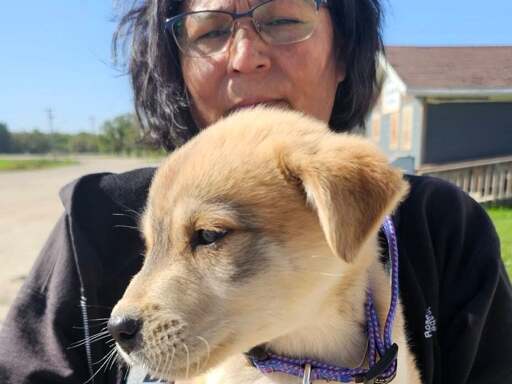

June Thomas, with Ginew Animal Care Services on Roseau River Anishinabe First Nation, holds a puppy on her reserve in southern Manitoba. Photo courtesy Ginew Animal Care Services/Facebook
As an animal lover, June Thomas grew increasingly concerned about the many stray dogs and cats roaming her community’s reserve in southern Manitoba — and decided to do something about them.
What started as a home operation to better care for the animals in 2017, which she called “June’s Adoptables,” has since grown into a full animal shelter on Roseau River Anishinabe First Nation (RRAFN), nearly 100 kilometres south of Winnipeg.
Thomas believes the shelter, which opened in February, is the first one on-reserve in the province.
“I started off in my own house rescuing animals like dogs and cats,” Thomas told IndigiNews.
She was inspired to take action after her beloved dog Bessie became sick and died from canine parvovirus, a highly contagious disease commonly known as parvo.
Eventually, June’s Adoptables outgrew Thomas’s house — and she became incorporated as Ginew Animal Care Services.
“I took a veterinary assistant program,” said Thomas, who graduated in 2024 from Robertson College and is now certified to give vaccinations.
“It gave me the skills and helped me want to set up a shelter.”
On reserves, “rez dogs” are beloved mixed-breed strays who roam communities without a single owner.
However, rez dogs and other strays can carry diseases and become overpopulated because they lack veterinary care.
And sometimes, they can create safety concerns if stray dogs become aggressive towards people — even in some cases fatally.

A volunteer holds a puppy on Roseau River Anishinabe First Nation. Photo courtesy Ginew Animal Care Services/Facebook
After tragedy, calls for action
In July, Thomas joined other Manitoba pet rescue advocates at the provincial legislature to honour Amanda Nobiss, a 37-year-old Métis volunteer with the Indigenous-founded group K9 Advocacy Manitoba.
Nobiss died after being mauled by a dog in Sandy Bay Ojibway First Nation. (An online fundraiser in her memory has garnered more than $12,000).
The advocates called on the province to help prevent further tragic incidents, specifically advocating for veterinary and rescue funding to address the booming dog population in many First Nations communities.
“People think we don’t care for our animals, but we do,” Thomas said. “They just need that support and guidance on how to care for them.
“They think we have a lot of money, but we don’t; they don’t know the conditions on the reserves.”

READ MORE: A syilx Youth’s fight to save her horses, and the thread that cannot burn
Alexandra Jarrett, a member of Canoe Lake Cree First Nation in Saskatchewan, is an advocate with Save Rez Dogs.
The organization advocates for the wellness and protection of dogs on reserves and educates from what it calls a “sovereign” First Nations perspective.
“Lack of being able to provide veterinary care doesn’t mean there’s a lack of love for the dog,” Jarrett said.
She said she’s seen outsiders come to First Nations with a “saviour mentality,” instead of compassion towards relatives who need support.
“It makes more sense to be compassionate towards people,” she added. “Instead of, ‘We rescued a dog,’ we are helping a relative who couldn’t support their animal.”
And rather than seeing First Nation members as not “competent enough” to care for domestic animals, Jarrett said her approach is to say, “They couldn’t at this time, so we are.”

Hundreds of animal advocates protest for provincial support for Indigenous-led on-reserve dog management outside the Manitoba legislature in July. Photo by Crystal Greene
‘Stop the shame game’
Richard Herbert, a former veterinarian, agreed. He said stray dog issues are “a reflection of the lack of infrastructure in communities” compared to the rest of “Canada.”
As a visiting veterinarian, he saw connections between scarce access to veterinary care, and other areas, such as a chronic shortage of quality housing, minimal medical services resulting in poor health outcomes, no clean drinking water, and less access to affordable and healthy food.
The Assembly of First Nations (AFN) has kept tabs on a broader infrastructure problem impacting reserves across the country.
In the organization’s report Closing the Infrastructure Gap last year, it concluded that First Nations infrastructure has always been “historically” underfunded.
The AFN criticized the federal funding approach as “project-by-project” — which it argued has failed to support community needs — not the long-term sustainable development that’s needed.

READ MORE: Amid budget cuts, clean water and mega-projects, ‘Carney is at a crossroads’: AFN national chief
Animal welfare is one of the many infrastructure gaps facing many First Nations, say advocates.
Herbert argued animal management cannot be separated from broader infrastructure gaps hampering essential services on reserves.
He called on non-Indigenous animal advocates to “stop the shame game” towards Indigenous people.
If communities don’t even have basic infrastructure for people, he asked, “What are they going to do about veterinary infrastructure?”
“There should be a shift from blaming Indigenous communities for not caring for their dogs and for not caring about dogs, which is not true,” Herbert said
“Recognize the problem, and that there are reasons for the problem — and then work to try to resolve those problems.”
Herbert criticized the federal government for not keeping data on tragedies like Nobiss’s death.
He believes doing so could force Health Canada to act on what he calls a “dog-related public health crisis.”
Not knowing the overall statistics makes it “conveniently” difficult for the federal government to measure the severity of the problem.

A Saint Bernard-cross dog gets care on Roseau River Anishinabe First Nation. Photo courtesy Ginew Animal Care Services/Facebook
With no available national data, Herbert took it upon himself to sift through CBC News archives for dog-mauling deaths reported on from 1998 to 2007.
He found 11 dog-mauling deaths of children under eight. Seven of them happened in First Nations and Inuit communities during that timeframe, according to his research.
He then compared his findings with a 1997 Health Canada report on dog attack injuries tracked by the Canadian Hospitals Injury Reporting and Prevention Program.
That report looked at 1,237 dog-inflicted injuries recorded in 1996, but did not include a tally of dog-attack deaths.
He then took the national population data from Statistics Canada’s 2001 Census to estimate the rate of dog-related children’s deaths on-reserve, compared to all children in the country.
He concluded First Nations children were 180 times more likely to be killed by a dog than the rest of the population.
But his calculations — based on only those attacks reported by CBC and 2001 Census data — is an estimate, not an official national statistic.
Neither Statistics Canada nor Health Canada has ever compiled a comparable dataset to what Herbert pulled together.
“None of these national death and hospitalization datasets report by First Nations or Inuit identity,” wrote a Health Canada spokesperson in an email to IndigiNews.
Statistics Canada has tracked national “deaths and hospitalizations involving individuals struck or bitten by dogs,” under the agency’s mortality database — the Canadian Institute for Health Information, and the Canadian Hospitals Injury Reporting and Prevention Program.
“As a result, national-level comparisons of dog-attack related deaths or hospitalizations between First Nations or Inuit communities and the rest of Canada are not readily available from these sources,” noted Health Canada’s spokesperson.

A dog walks freely on Roseau River Anishinabe First Nation in southern Manitoba. Photo courtesy Ginew Animal Care Services/Facebook
From initial ‘resistance’ to community involvement
At the Roseau River Anishinabe First Nation, Thomas has been supporting a plan to address dog and cat overpopulation on reserve.
Thomas helped develop RRAFN’s animal bylaw and management plan in 2021.
“I got council on board, to sign it off and adopt it, ratify it, and send it out to the community,” she recalled.
She then “went to every house” on the reserve, surveying 200 homes to ask owners if they had a dog or cat, and if they wanted to register them.
This helped her to understand which animals needed to be vaccinated, spayed or neutered.
Initially, she recalled, she “got a lot of resistance” — which she said mainly stemmed from a lack of knowledge.
“People didn’t know why they should spay and neuter their animals,” she explained, or “why they should vaccinate their animals, where to take their animals when they’re sick, what the costs were.”
Since 2017, she has offered several on-reserve spay-and-neuter clinics, hoping to eliminate the barrier of having to transport pets to veterinarians outside the community.
The first such community clinic, she said, cost more than $15,000 — the bill split between six RRAFN community programs who “chipped in,” she said.
She said they spayed or neutered more than 65 dogs and cats, and rescued 32 dogs and cats, from the reserve.
Working with outside animal-rescue organizations to co-ordinate surrenders and adoptions has helped the First Nation, Thomas said.
Measures of success were noticeable after community members first showed up with their pets to mobile clinics.

READ MORE: Long after the woolly dog’s extinction, Coast Salish kin carry on the canine’s legacy
“We had a spay-and-neuter clinic July 1, and we had about 30 people sign up,” she told IndigiNews.
“We had another one two weeks later, and I couldn’t even find 10 or 15 to sign up” — not out of a lack of interest, she recounted, but because many of the pets’ shots were up-to-date and they were already sterilized.
Revisiting the original data she collected from going door-to-door, she also noticed the population of the First Nation’s dogs and cats dropping.
“There were 214 dogs and cats that had registered,” she said.
“Now, it’s probably 117 because of the spaying and neutering, the surrenders, the rescues.”
Additionally, Thomas said has not seen parvo in the community for about a year, which she credits to public education and clinics.
RRAFN’s chief and council has been able to cover the cost of building the new shelter, using revenues from land leases and tobacco sales tax, according to Thomas. The ongoing work includes adding a water system.
After the shelter’s grand opening, she told IndigiNews she received a lot of calls and texts from other First Nations interested in what hers is doing.
Asked what she’d advise others inspired by her work, she replied, “Go ahead, go do it. Involve the community … If it’s theirs, they will follow it.”
Previously on band council for 12 years, Thomas said she knows how hard it is to pressure the government to meet a community’s needs — especially for funding.
“The reserves need help,” she said. “We need help advocating for the animals.”
But the shelter still doesn’t have a permanent funding source.
“I have a budget that council had approved just for three months,” said Thomas, who said fundraising to keep Ginew Animal Care running is “constant” and “ongoing.”
Despite opening the shelter six-to-eight hours every day — including cleaning, hauling water, transporting animals and feeding them — she doesn’t pay herself or the other volunteers.
With pet food donations, she divides those up to distribute to community residents struggling to feed their pets.
“It’s on an emergency basis,” Thomas said.

Donated dog food is placed on a table at Ginew Animal Care Services, for distribution to households that can’t afford it. Photo courtesy Ginew Animal Care Services/Facebook
Who is responsible?
In Manitoba, the province funds a veterinary services program called the Northern and Remote Veterinary Care Initiative, which includes mobile veterinary and spay-and-neuter clinics.
Funding gets distributed to organizations including the Winnipeg Humane Society and rescue organizations that offer services in First Nations communities.
But because First Nations fall outside provincial jurisdiction, animal rescue groups have been offering free charitable veterinary services.
With reserve lands administered under the Indian Act, they are ultimately under federal jurisdiction — it’s the Crown which holds the fiduciary obligation for on-reserve services and infrastructure.
There are no permanent Indigenous Services Canada (ISC) funding programs for animal welfare on reserves. But ISC has supported a pilot project since 2024, Matawa First Nations Management Animal Services.
In an email, an ISC spokesperson called the Matawa pilot “an exceptional initiative,” but said it was “a unique project” without establishing any a new funding stream to help First Nations manage issues with stray dogs.
However, the spokesperson said the project’s outcome would result in a community-of-practice report, which could potentially serve as a model for others to follow.
“Community leadership is responsible for decisions regarding the health and safety of their community, including the management of its dog population,” the department email stated. “Animal services initiatives are community-led.
“The department can provide advice … while connecting First Nations with existing programs, services, or partners that may be able to assist.”
Matawa isn’t the only dog-management initiative receiving federal funding.
This year, Public Safety Canada budgeted nearly $650,000 to the Meadow Lakes Tribal Council in Saskatchewan until February 2028 for the tribal council’s nine communities to offer spay-and-neuter clinics, administer vaccines, and provide dog-management training and education.
Because RRAFN could not depend on Indigenous Services Canada to fund its animal-care initiative, it used its own band revenues.
Being close to Winnipeg and other urban centres, RRAFN’s southern location in Manitoba has its advantages. Ginew Animal Care has access to roads to transport animals to outside rescue organizations for fostering and adoption, or to veterinary hospitals for specialized care.
As animal rescues across Manitoba and “Canada” struggle for funding, First Nations face additional barriers to building and sustaining their own animal-management infrastructure.
Not every First Nation has access to revenue and some are more geographically isolated.
“The community is the one who has all of the solutions somehow within them,” Herbert said. “They just don’t know about infrastructure.
“It costs money, that’s all it is.”

June Thomas feeds a dog on RRAFN. Photo courtesy Ginew Animal Care Services/Facebook
Honouring dogs’ role in Indigenous communities
Without well-funded infrastructure for animal management, the consequences can be dire for stray dogs.
In one community with an out-of-control dog population, after a small child was seriously injured by a dog pack, Herbert was brought in to euthanize them.
“We did 29 dogs that day,” he recalled, “but man, it barely scratched the surface.”
But communities must determine for themselves how they see dogs’ role locally, he said, rather than adopting the models or approaches of non-Indigenous communities.
He explained that, 60 to 100 years ago, “there was a change” in approach to stray animals as the country became increasingly urbanized — “they were coming into the cities and now the dogs were loose.”
“In a larger city … then there were rules on how to take care of the dogs,” he said.
In contrast, in First Nations, dogs often traditionally hold different roles, for instance protecting their community by scaring away bears, or as sled dogs for transportation.
“How do you proceed? Well, the first thing is to find out what roles does the community have or need for a dog?” he said.
“It wasn’t that the dogs weren’t cared for when the RCMP went in and killed off the sled dogs — it’s because the role didn’t exist in non-Native communities; they had a role very different from in a white community.”
READ MORE: Long after the woolly dog’s extinction, Coast Salish kin carry on the canine’s legacy
In contrast, Herbert urged communities to come up with their own solutions by looking within as they draft animal welfare plans and bylaws.
As Save Rez Dogs declares on its website, “Rez dogs are relatives, not problems.” The non-profit organization steers clear of words like “rescue” and other “colonial responses to Indigenous dog populations” — instead supporting “sovereign solutions” within First Nations.
One tool to help with planning is a Community Dog Book, a free resource by Tasha Epp and Jasmine Dhillon, of the Western College of Veterinary Medicine at the University of Saskatchewan.
Herbert described how a broader system is needed to support dog management and infrastructure, which goes beyond mere veterinary services.
For example, without infrastructure to enforce bylaws — such as animal control officers, a shelter, veterinary clinic or community education — animal-management plans cannot be carried out, he explained.
He suggested permanent veterinary facilities in First Nations communities, similar to nursing stations, where routine procedures could be done without requiring animals to be flown out or driven far distances.
“If a small hospital was put into every community,” Herbert said, “they can do a whole bunch of minor surgical things up in those communities as well.
“After that … it’s about stabilizing the dog population, so it’s not growing, and it’s not in the areas that cause the same problems.”

June Thomas holds a dog from her First Nation who was delivered to find a home via a Winnipeg-based adoption agency. Photo courtesy Ginew Animal Care Services/Facebook
‘Advocating for the animals’
Jarrett said public education is necessary to help communities understand dog behaviour, including the role of pack mentality in groups of stray dogs, what can trigger aggressive behaviour, and how to safely interact with free-roaming animals.
“It depends what the context of the dog’s aggression is,” said Jarrett, who gave examples of female dogs protecting their pups, or male dogs competing for females in heat.
Teaching people to recognize when a dog should not be approached by reading its body language, and showing children how to interact with dogs, is an essential part of that education, Jarrett added.
Mobile spay-and-neuter clinics, he explained, are just the “first effort” in a bigger changes needed, and should be replicated across the country.
This proven model may seem straightforward. But paying for it is not.
In the north, some communities facing dog issues are isolated, with rough gravel roads that can take hours of travel from urban centres where most of the animal helpers originate.
Others are even more isolated because some have only winter-accessible roads, or others are only fly-in communities. This makes it more difficult and expensive to transport animals out, or to offer temporary pop-up clinics.
Located more than 100 kilometres north of “Saskatoon,” the Mistawasis Nêhiyawak community where Jarrett lives is roughly an hour-and-a-half drive to the closest animal hospital.
The Canine Action Project (CAP), a non-Indigenous rescue organization, has been working with Mistawasis.
“They focus on building the relationships,” Jarrett said. “Relationships don’t need to be loud.”
She suggested that the non-Indigenous rescue and First Nations partners must be in it together for the long-term, and be aligned in their prevention strategies and goals for a First Nation’s own dog-management strategy.
Together, they must identify the roots of the “problem,” she explained.
“It’s multifaceted. There’s not one solution, and there’s not one reason.”
However, not every resident with pets in Mistawasis has the resources to care for them, and she said volunteers are “burning out” because they don’t have enough people to overcome infrastructure gaps in animal welfare systems.
“We need help with advocating for the animals, like with lobbying the governments,” Thomas added. “We need that support — and funding, too.”
Encouraging Indigenous Youth to become veterinarians is also important, she said.
Two of her shelter volunteers have expressed interest in studying veterinary medicine, she said — and in August both received an RRAFN Youth achievement award.
“To encourage all the young ones to get their veterinary medicine careers,” she said, “I guess that will help us a lot in the community.”
The post Indigenous volunteers are helping care for ‘rez dog’ relatives — with little funding appeared first on Indiginews.
From Indiginews via This RSS Feed.