

Ecuador boat strikes raise alarm over civilian deaths, disappearances, torture and due process as Washington and Quito expand militarized anti-drug operations.
Related: U.S. Marines Carry Out Construction Operations at Ecuadorian Air Force Base
Ecuador Boat Strikes Deepen Legal and Human-Rights Crisis
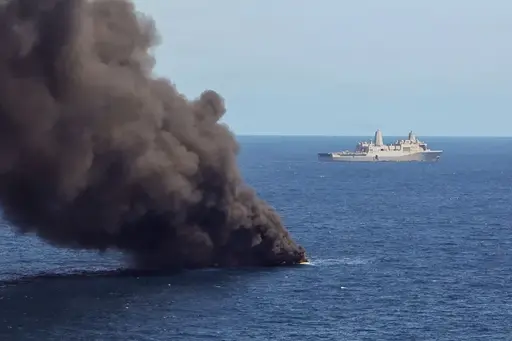
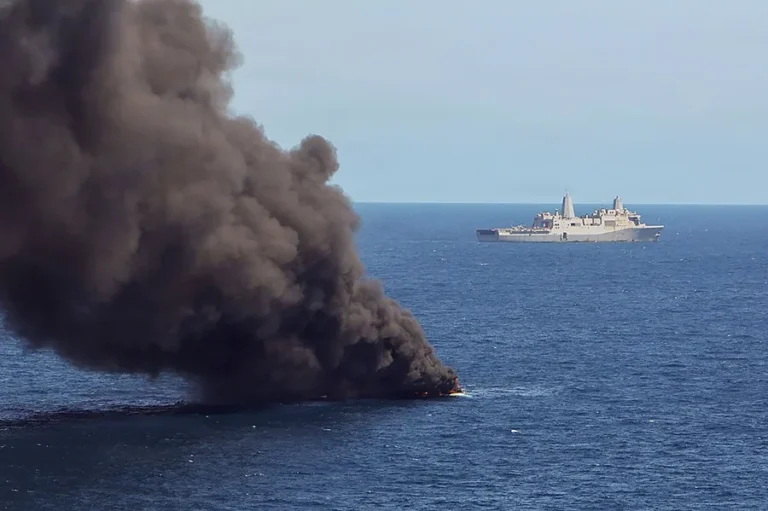
Ecuador boat strikes have escalated into a major legal and political controversy after U.S. forces destroyed at least 11 Ecuadorian vessels in the Pacific with the consent of President Daniel Noboa’s government.
Washington says the vessels were linked to drug trafficking and were used as floating refueling stations for speedboats carrying narcotics. Ecuadorian human-rights organizations, fishing communities, and defense lawyers dispute those claims and accuse the United States and Ecuador of conducting operations that violate international law.
The latest incident occurred on September 16, when the U.S. Southern Command reported that its Joint Task Force of the Western Hemisphere had sunk the fishing vessel Por Siempre Don Carlos approximately 140 nautical miles from Manta.
The military said the boat was linked to the criminal organization Los Choneros. Its 25 crew members were reported missing after the vessel was destroyed.
With the latest case, the Permanent Committee for the Defense of Human Rights in Ecuador said that 206 Ecuadorian fishermen had been affected by U.S. military operations at sea during 2026.
The committee also reported that 11 vessels had been attacked or destroyed in operations coordinated with Ecuadorian authorities. It said that many of the people involved were civilian fishermen whose boats were their principal means of work and income.[prensa-latina][telesurtv]
The boat strikes have generated allegations of extrajudicial executions, arbitrary detention, torture, forced disappearance, and destruction of property.
According to human-rights advocates, surviving fishermen were detained on U.S. vessels, including the amphibious assault ship USS San Antonio, before being handed over to Ecuadorian authorities in restraints or under humiliating conditions.
In previous cases, families said they received little information about the location or condition of their relatives. Some fishermen were reported missing for days, while authorities offered limited details about the operations.
In one case, Ecuador’s Navy located 10 crew members after a fishing boat was destroyed. The fishermen were found at sea and transferred to the naval vessel BAE Atahualpa.
The United States has defended the strikes as part of Operation Southern Spear, a campaign designed to disrupt maritime drug-trafficking routes. U.S. officials claim that intelligence confirmed links between the vessels and criminal organizations operating in Ecuador.
Ecuadorian President Daniel Noboa has supported the operations. He recently said there was “clear evidence” that the boats had assisted drug-trafficking activities, although Ecuadorian courts have released many of the detained fishermen after prosecutors failed to provide sufficient evidence.
The conflicting accounts have become central to the legal debate. The United States and Ecuador describe the vessels as criminal infrastructure, while judges, defense attorneys, and human-rights groups say the allegations cannot replace evidence presented in court.
Ecuador Boat Strikes and International Law
Read the United Nations International Covenant on Civil and Political Rights.
The Ecuador boat strikes raise questions under several international legal instruments, including the International Covenant on Civil and Political Rights, the United Nations Convention on the Law of the Sea, the Universal Declaration of Human Rights, and the American Convention on Human Rights.
The International Covenant on Civil and Political Rights is binding on both Ecuador and the United States. It protects rights that cannot be suspended simply because a government is conducting an anti-drug operation.
Right to life
Article 6 of the covenant protects the right to life. Human-rights organizations argue that attacks on civilian vessels have caused deaths and disappearances among fishermen who were not convicted of any crime.
The destruction of a boat with people aboard, they say, cannot be treated as a criminal punishment. An accusation of drug trafficking does not authorize a government to impose a death sentence at sea.
The use of lethal force can only be justified under strict circumstances, such as an immediate threat to life. A suspected connection to criminal activity does not automatically establish such a threat.
Prohibition of torture
Article 7 prohibits torture and cruel, inhuman, or degrading treatment. Survivors and rights groups have reported beatings, threats, coercive interrogations, isolation, and psychological abuse during detention.
The prohibition is absolute. No anti-drug campaign, state of emergency, or criminal accusation permits authorities to torture or mistreat detainees.
Arbitrary detention
Article 9 protects liberty and security of the person. The reported detention of fishermen on foreign military vessels, periods without communication, and transfers outside normal judicial procedures raise concerns under this provision.
Defense lawyers say that some fishermen were held without formal charges or access to legal counsel. If confirmed, such practices could constitute arbitrary detention.
Due process
Article 14 guarantees the right to a fair hearing and the presumption of innocence. The fishermen were publicly identified as drug traffickers or members of criminal organizations before courts established their responsibility.
Recent Ecuadorian court decisions are important because judges released dozens of crew members after prosecutors failed to substantiate the allegations.
Fifty-six fishermen have been released without charges, while another 32 remain under conditional release measures as investigations continue.[telesurenglish]
The rulings do not necessarily resolve every question about the vessels, but they demonstrate that military statements cannot substitute for evidence and judicial review.
The Convention on the Law of the Sea also establishes limits on the actions of states in international waters.
Articles 87 and 90 protect freedom of navigation and the right of vessels to engage in lawful activities on the high seas. Article 92 establishes that ships generally remain under the jurisdiction of the state whose flag they fly.
An Ecuadorian fishing vessel in international waters normally falls under Ecuadorian jurisdiction. U.S. forces cannot automatically assume the authority to board, detain, or destroy such a vessel solely by declaring it part of a drug-trafficking network.
Article 110 establishes a limited right of visit for warships. That authority applies in specific circumstances, including suspected piracy, slave trading, or cases involving vessels without nationality.
A suspected drug-trafficking connection does not by itself create an unlimited right to use military force. Counter-narcotics operations should be carried out through cooperation, evidence-sharing, judicial warrants, and maritime-interdiction mechanisms consistent with international law.
The destruction of fishing boats also affects the rights protected by the Universal Declaration of Human Rights. Article 3 guarantees life and personal security, Article 11 establishes the presumption of innocence, and Article 17 protects people against arbitrary deprivation of property.
For fishermen, a vessel is not simply an object. It is a workplace, a productive asset, and the source of income for their families. Destroying it without a judicial conviction can eliminate an entire household’s livelihood.
The American Convention on Human Rights, known as the Pact of San José, imposes additional obligations on Ecuador. As a state party, Ecuador is required to investigate deaths, disappearances, torture, and unlawful detention connected to operations carried out on its territory or with its authorization.
The state must also identify missing people, clarify the participation of foreign forces, and provide justice and reparations to victims.
Militarization, Sovereignty, and the Noboa Government
See the Inter-American Commission on Human Rights, which monitors human-rights conditions across the Americas.
The Ecuador boat strikes are part of a broader security strategy introduced by the Noboa government since 2024.
The administration has repeatedly imposed states of emergency and curfews, restricting movement and allowing temporary limits on constitutional guarantees. Authorities have also gained greater powers to search homes, intercept communications, and carry out requisitions.
These measures have not stopped the deterioration of public security. According to figures cited in the article, homicides increased by 47 percent between the first half of 2024 and the same period in 2025.
The year 2025 ended as Ecuador’s most violent on record, with approximately 9,300 violent deaths, equivalent to around 52 homicides per 100,000 inhabitants.
The worsening violence has provided the political justification for deeper military involvement in domestic and maritime security. It has also allowed Washington to expand its operational presence in Ecuador.
Noboa attempted to amend the Constitution to remove the prohibition on foreign military bases. Voters rejected the proposal at the ballot box, but the government has continued to facilitate U.S. military personnel, contractors, and security operations through bilateral agreements.
One controversy involved Taura Air Base. Ecuadorian Air Force commander Mauricio Salazar Machuca was dismissed after publicly questioning the U.S. presence and calling for legal instruments clarifying its compatibility with the constitutional ban on foreign military bases.
In August, Noboa’s government expanded legal protections for U.S. military personnel, civilian employees of the U.S. Department of War, foreign companies working for that department, contractors, subcontractors, and non-Ecuadorian employees.
The protections reportedly shield them from administrative sanctions and require disputes to be handled through diplomatic channels. Critics fear this could make it difficult for Ecuadorian courts to prosecute crimes allegedly committed by foreign personnel.
The government has also kept information about alleged extrajudicial executions classified or restricted. That secrecy has strengthened demands for independent investigations.
The military cooperation has generated a sovereignty debate. Critics say Ecuador is allowing a foreign power to perform law-enforcement functions in international waters while weakening the authority of Ecuadorian courts.
Supporters argue that Ecuador’s organized-crime crisis requires U.S. intelligence, technology, and operational assistance. They say the country lacks the capacity to stop maritime trafficking on its own.
The controversy has been further complicated by allegations involving businesses linked to the Noboa family. Between 2020 and 2025, at least eight major cocaine shipments were reportedly seized after drugs were hidden in banana containers belonging to Noboa Trading and destined for Europe.
Investigations by the Organized Crime and Corruption Reporting Project, KRIK, and the Investigative Journalism Bureau identified several shipments through court documents and transport records. Ecuadorian magazine RAYA also reported on police records involving drugs found in containers connected to the family company.
The reports do not establish that President Noboa or his relatives participated in drug trafficking. However, they have fueled questions about the business environment surrounding the government and the consistency of its anti-drug policy.
Geopolitical Context: U.S. Power in the Eastern Pacific
The Ecuador boat strikes form part of a broader expansion of U.S. military activity in Latin America and the Caribbean.
Washington has increasingly described drug trafficking as a national-security threat rather than solely a criminal matter. That shift can lead to military operations against suspected trafficking infrastructure without the judicial safeguards normally applied to civilian law enforcement.
The campaign also reflects the United States’ effort to strengthen its presence in the Eastern Pacific. Ecuador’s location makes it strategically important for monitoring maritime routes connecting South America with Central America, Mexico, and the United States.
The consequences could extend beyond Ecuador. If the United States normalizes the destruction of civilian vessels based on intelligence claims that are not tested in court, other states may adopt similar practices.
The case also raises questions about the relationship between military cooperation and national sovereignty. Ecuador may receive funding, intelligence, and equipment from Washington, but the country remains responsible for protecting the rights of people affected by joint operations.
For the United States, the campaign’s credibility depends on its ability to demonstrate that the vessels were genuinely connected to organized crime. For Ecuador, credibility depends on guaranteeing judicial oversight and investigating allegations of abuse.
The release of dozens of fishermen has already weakened the official narrative in several cases. If prosecutors cannot sustain charges, military claims that the vessels were criminal assets become more difficult to defend.
The missing crew members from the Por Siempre Don Carlos represent the most urgent issue. Their families need verified information about whether they survived, where they are located, and which authority is responsible for the investigation.
The case also affects fishing communities in Manabí and other coastal provinces. Destroying boats can produce economic consequences long after the military operation ends.
A genuine anti-drug strategy would need to combine maritime surveillance with due process, evidence-based prosecution, financial investigations, protection for fishermen, and support for coastal communities.
The current approach, critics argue, has produced more militarization, fewer legal guarantees, and increasing uncertainty about who can be attacked or detained at sea.
Until the United States and Ecuador provide transparent evidence and independent investigations, the Ecuador boat strikes will remain at the center of a growing debate over international law, human rights, and the limits of foreign military power.
From teleSUR English via This RSS Feed.