

This article by Pablo Carlos Rojas Gómez originally appeared in the September 17, 2026 edition of Contralínea, a Mexican investigative journalism magazine.
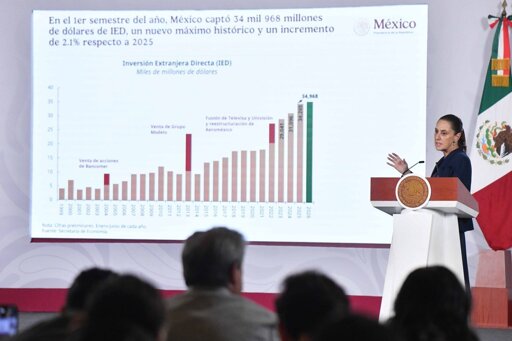
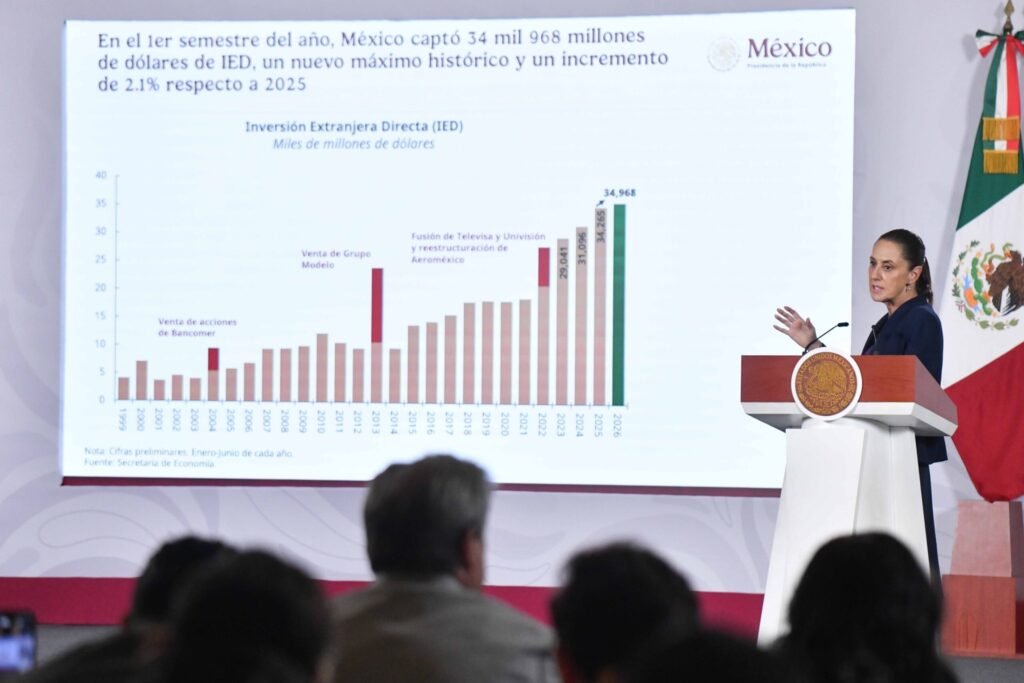
2025 positioned itself as the year with the highest foreign direct investment (FDI), growing 10.8 percent more than in 2024. As a result, Mexico reached the historic figure of 40.871 billion dollars. Meanwhile, in the first quarter of 2026, “FDI also reached a record figure for a similar period,” with 23.591 billion dollars, according to the Second Government Report of President Claudia Sheinbaum. This is equivalent to 10.4 percent more than the first quarter of 2025.
As for the origin of the most relevant investments, it notes that they come from the United States, Spain and Canada, which together account for 60 percent of the total. And regarding their destination, it points to the financial, insurance, mining and vehicle-manufacturing sectors. According to President Sheinbaum’s report, “the FDI flows reaffirmed the confidence of foreign investors in Mexico, and the certainty in the long-term commercial relationship under the USMCA.” During the first quarter of 2026, the United States remained Mexico’s largest partner, with 43.3 percent of the total, equivalent to 10.2105 billion dollars. And in second place is Spain, with 16.1 percent: 3.804 billion dollars.
The FDI flows reaffirmed the confidence of foreign investors in Mexico, and the certainty in the long-term commercial relationship under the USMCA.
President Claudia Sheinbaum, Second Government Report
The federal government stated that “the record FDI figures during the first quarter of 2026 positioned Mexico as a strategic destination in the relocation of companies, particularly in the sectors of advanced manufacturing, electromobility, semiconductors and clean energies. Contributing to this have been macroeconomic stability, the regional integration derived from the USMCA and the strengthening of global supply chains.”
The Second Report details that these achievements are part of the results of the economic policy that forms part of Plan México, since “for the government of Mexico the attraction of investments from abroad and the optimal use of the relocation of companies (nearshoring) play a fundamental role in the international-promotion strategy; with the objective of consolidating Mexico as a highly competitive logistics and industrial hub and a generator of regional well-being.”
In terms of promoting “investment in new fixed-asset goods,” a total of 173 projects were analyzed, of which 148 were approved, “considered eligible for the issuance of certificates of compliance with fiscal incentives under the Plan México strategy. The projects represent investments of 987.5 million dollars distributed across strategic sectors such as agro-industry, automotive, consumer goods, construction, pharmaceuticals, the plastics and cardboard industry, logistics, metalworking, mining, chemicals and transportation.”
Separately, among the other most important macroeconomic indicators, manufactured-goods exports positioned themselves throughout 2025 as the most essential; this represents “91.6 percent of the total value exported, and the trade balance registered a surplus of 771 million dollars.” And for the January-to-June half of the year, that trend held at 91.3 percent.
Although it did not specify which are the main manufactured export goods, it did make explicit that, “from September 2025 to July 2026, investments of 1.5894 billion dollars were promoted to establish, expand or modernize productive facilities in the industry that manufactures new light motor vehicles, in addition to incentivizing the export of vehicle parts and components for 1.286 billion dollars, through the authorization of quotas to import 250,760 units, under a tariff-rate quota at zero percent.”
In turn, in the period from September 2025 to June 2026, the investment-attraction policies facilitated registrations in the Single Registry of Investment Projects (RUPI), handling “400 procedures linked to investment projects, and 23 companies were registered with projects representing approximately 22 billion dollars. The main companies capable of capturing those resources are in the sectors of wholesale trade; generation, transmission, distribution and marketing of electric power; supply of water and of natural gas by pipeline to the final consumer, and manufacturing industries.”
-
Foreign Direct Investment Reached a Record High of $40.8 Billion in Sheinbaum’s Second Year
September 19, 2026
The United States, Spain and Canada supplied 60% of the inflows, and the first quarter of 2026 set another record at $23.6 billion under Plan México.
-
Authorities Investigate the Origin and Destination of Fuel Seized in Guanajuato
September 18, 2026
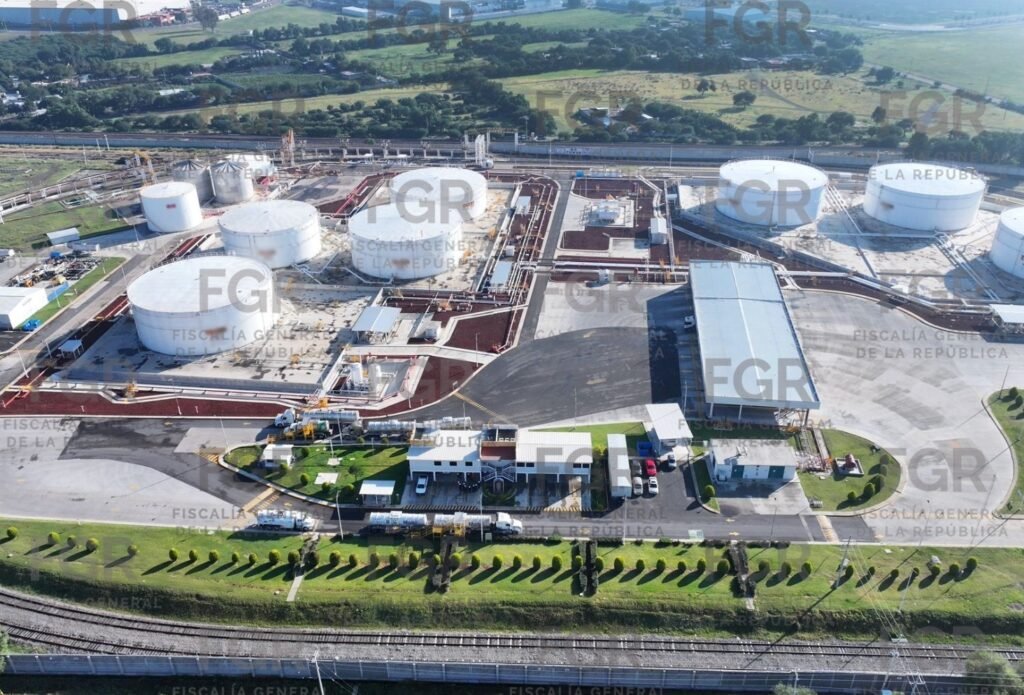
The seized site held storage facilities resembling Pemex’s; officials have not said who operated it or made any arrests, pending the investigation.
-

Historic ‘Huachicol’ Seizure in Guanajuato, Thanks to Setting Aside Political Differences and Tightening Coordination, Sheinbaum Says
September 18, 2026
More than 50 million liters of stolen fuel were seized as Guanajuato’s daily homicides fell from over 12 to about four, a 75% drop.
The post Foreign Direct Investment Reached a Record High of $40.8 Billion in Sheinbaum’s Second Year appeared first on Mexico Solidarity Media.
From Mexico Solidarity Media via This RSS Feed.