For those like me who actually didn’t know:
Initial Public Offering. It’s the first time (initial) the company sells shares (offering) on public stock exchanges. Aka: they went public.
In addition, in a well functioning economy, companies only go public when they want to raise a lot of new money, because they have ambitious plans that can’t be achieved with their current sources of funding. Now, really, that’s bullshit. Companies mostly go public because the insiders want to cash out. Going public allows them to sell their shares for actual money. But, still, in theory the company should be going public with a story about how they’re going to use all the new funds they’re raising, otherwise they (in theory) won’t be able to con people into investing.
The end result of going public is that the company is no longer in the control of the founders or even the early investors. Now it has a bunch of public investors who don’t care about the company culture, don’t care about the relationships with the employees or the customers. They just want to see a 15% year-over-year growth in the value of their stocks. That means that pretty often once a company goes public its products or services start to suffer, because you can make more money by squeezing suppliers, finding the cheapest parts, outsourcing jobs, etc.
Miele was sold to a private equity firm and they’ve been reputation-fracking, so their recent stuff is supposed to be pretty mediocre but priced as if it’s top-end.
The cheapest LG refrigerators that are 2 door freezer on top are pretty well regarded. Their more expensive refrigerators have linear compressors that aren’t a great design to begin with and an even worse design for the refrigerant used in the USA compared to the refrigerant they were designed for in Korea. (As I understand it)
$1700 for a seven-year warranty. How much you want to bet it’s specifically engineered to last no more than eight years?
The water heater that came with my house I bought in '98 lasted 20 years. I replaced it with the best I could afford at the time, which had a seven-year warranty. It lasted just over seven years. I replaced that one a couple of months ago with the longest warranty one I could find, which is twelve years. I know I’ll be replacing it in twelve years.


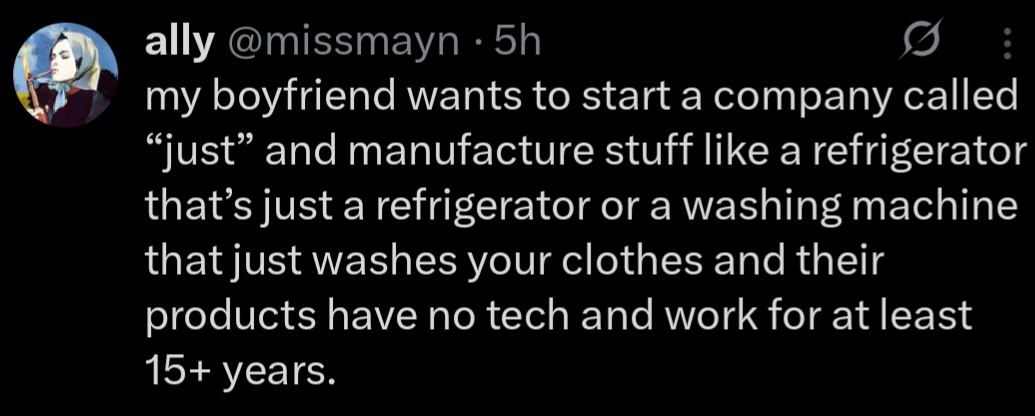
This often actually exists still, but those companies dont do big marketing and their products will cost 3x that of a “normal” one.
As I’ve heard it:
and Mielemake the best stoves and fridgesAnd yes, they are all very expensive. But I want to get me a Speed Queen so bad.
Speed Queen IPOd recently. Make of that what you will.
They overdosed on Internet Protocol‽ /s
For those like me who actually didn’t know: Initial Public Offering. It’s the first time (initial) the company sells shares (offering) on public stock exchanges. Aka: they went public.
In addition, in a well functioning economy, companies only go public when they want to raise a lot of new money, because they have ambitious plans that can’t be achieved with their current sources of funding. Now, really, that’s bullshit. Companies mostly go public because the insiders want to cash out. Going public allows them to sell their shares for actual money. But, still, in theory the company should be going public with a story about how they’re going to use all the new funds they’re raising, otherwise they (in theory) won’t be able to con people into investing.
The end result of going public is that the company is no longer in the control of the founders or even the early investors. Now it has a bunch of public investors who don’t care about the company culture, don’t care about the relationships with the employees or the customers. They just want to see a 15% year-over-year growth in the value of their stocks. That means that pretty often once a company goes public its products or services start to suffer, because you can make more money by squeezing suppliers, finding the cheapest parts, outsourcing jobs, etc.
Miele was sold to a private equity firm and they’ve been reputation-fracking, so their recent stuff is supposed to be pretty mediocre but priced as if it’s top-end.Do you have a source for that? Their wiki page says that they are still family owned.
https://en.wikipedia.org/wiki/Miele
I do not - I’ve heard it so many times from so many places that I didn’t bother checking it before repeating it, but it looks like it was wrong.
Damn. I hate to hear that. Guess I’ll scratch them off my list.
Cafe (spinoff from GE) does a pretty good job with stoves. AFAIK they are still pretty well respected.
The brands to stay away from at all costs are LG and Samsung.
The cheapest LG refrigerators that are 2 door freezer on top are pretty well regarded. Their more expensive refrigerators have linear compressors that aren’t a great design to begin with and an even worse design for the refrigerant used in the USA compared to the refrigerant they were designed for in Korea. (As I understand it)
As I posted a little lower down:
If the company has ever made a TV or a cell phone I’m not buying their appliance.
Samsung burned me once….
Got links?
Speed queen is one for washers and dryers
$1700 for a seven-year warranty. How much you want to bet it’s specifically engineered to last no more than eight years?
The water heater that came with my house I bought in '98 lasted 20 years. I replaced it with the best I could afford at the time, which had a seven-year warranty. It lasted just over seven years. I replaced that one a couple of months ago with the longest warranty one I could find, which is twelve years. I know I’ll be replacing it in twelve years.
Replace your sacrificial anode before that time and you’ll be good.